
Document Type & Number Range Tcode in SAP FICO
 Editorial Team
⚡ Smart Summary
Document types and number ranges in SAP FICO classify every accounting document and assign its unique identifier, controlling allowed account types, reversal behavior, and whether numbers are generated internally by the system or entered externally by users.
What is a Document Type in SAP FICO?
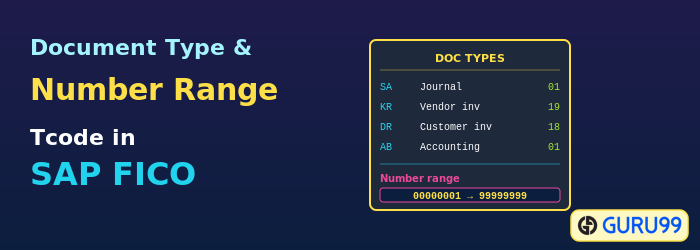
A document type is a two-character key that classifies every accounting document in SAP, such as SA for G/L documents, DR for customer invoices, or KR for vendor invoices. It controls which account types may be posted, the number range used, and the reversal document type.
Document types are defined at client level, so all company codes share the same set. This keeps document classification consistent across the entire organization.
What is a Number Range in SAP?
A number range defines the interval of numbers SAP assigns to documents of a given type, for example 1900000000 to 1999999999. Each document type is linked to a number range key, and the range itself is maintained per company code with transaction FBN1.
Number ranges come in two forms:
| Number Range | How the number is assigned |
|---|---|
| Internal | The system assigns the next sequential number automatically (numeric only). |
| External | The user or an external system enters the number manually (can be alphanumeric). |
Steps to Define a Document Type in SAP
The following steps show how to create a new document type using the SPRO customizing path.
Step 1) Enter Transaction Code SPRO in the SAP Command Field.

Step 2) In the next screen, select ‘SAP Reference IMG’.

Step 3) In the next screen, “Display IMG”, follow the menu path: Financial Accounting -> General Ledger Accounting -> Business Transactions -> G/L Account Posting -> Carry out and Check Document Settings -> Define Document Types.
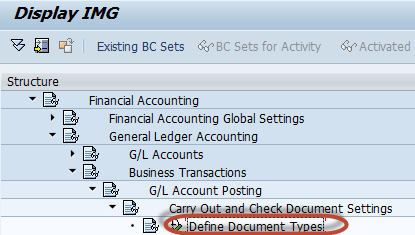
Step 4) In the next screen, press the ‘New Entries’ button from the Application Toolbar.




For maintaining a new document type:
Step 5) In the next screen, enter the following:
- Enter a unique Document Type Key.
- Enter the Document Type description.
- Select a number range for the Document Type.
- In the Account Type Allowed section, select the account type you would like to post.
- Enter the appropriate selection in the Control Data section.
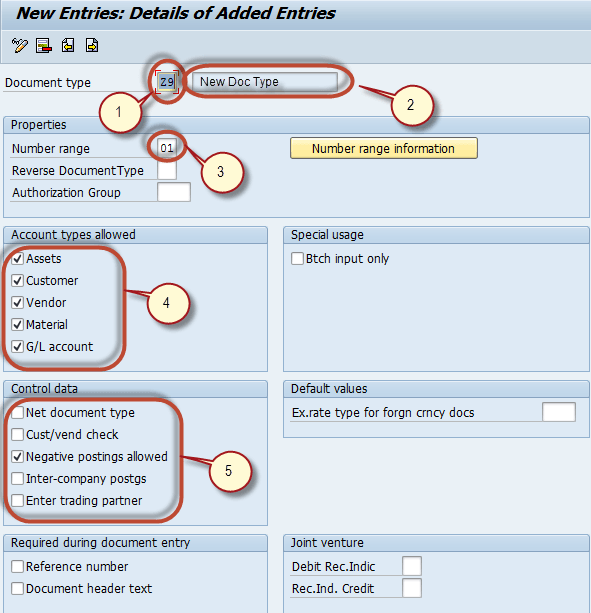
Step 6) Press the ‘Save’ button.

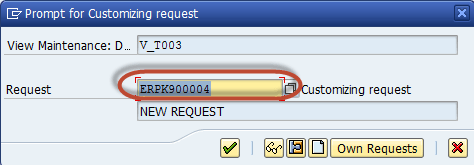
Step 7) In the next screen, enter the Customizing request number to create the new G/L document type.
Steps to Define a Number Range in SAP
After the document type is saved, define the number range that supplies its document numbers.
Step 8) Press the ‘Number Range Information’ button in the properties section.

Step 9) In the next screen:
- Enter the Company Code for which you want to maintain the number range.
- Press the ‘Change Interval’ button.
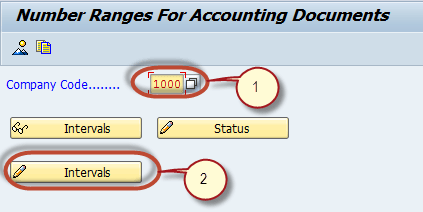
Step 10) In the next screen, press the ‘Insert Interval’ button.

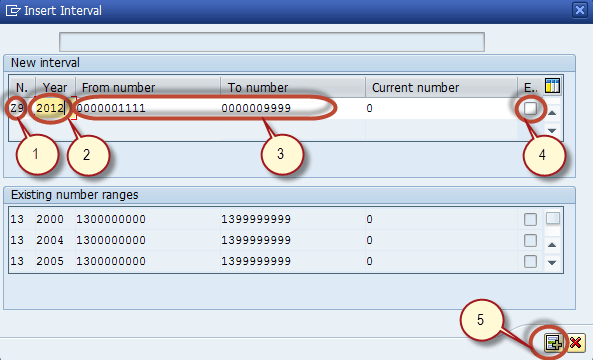
Step 11) In the next screen:
- Enter a unique number range key.
- Enter the fiscal year for which the range is defined.
- Enter the Start Number and End Number of the range without overlapping other number ranges.
- Mark it as External if you want to insert the document number manually during document creation.
- Press the ‘Insert’ button.
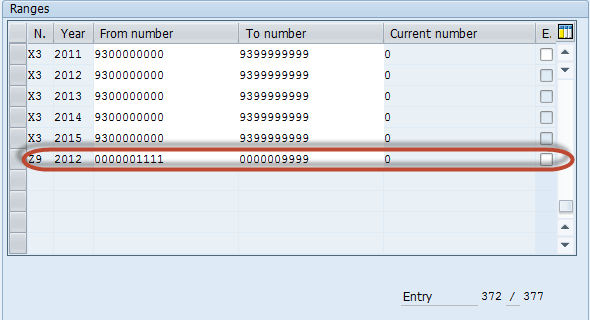
Step 12) In the next screen, the new number range is listed.
Standard Account Types and Document Types in SAP
Account Types in SAP
| Account Type | Description |
|---|---|
| A | Asset |
| D | Customer |
| K | Vendors |
| M | Material |
| S | General Ledger Accounts |
Standard Document Types in SAP
| Document Type | Description |
|---|---|
| AA | Asset posting |
| AB | Accounting doc |
| AE | Accounting doc |
| AF | Dep. postings |
| AN | Net asset posting |
| C1 | Closing GR/IR accts |
| CI | Customer invoice |
| CP | Customer payment |
| DA | Customer |
| DB | Cust.recurring entry |
| DE | Customer invoice |
| DG | Customer credit memo |
| DR | Customer invoice |
| DZ | Customer payment |
