
MB1C: How to Create Material Stock in SAP
 Editorial Team
⚡ Smart Summary
Material stock in SAP records the opening balance of a material at a plant and storage location. This resource explains creating that stock with transaction MB1C using movement type 561, and compares MB1C with MIGO for goods movements.

What Is Material Stock in SAP?
In SAP, material stock represents the physical quantity of a material available at a particular plant and storage location. Stock is tracked in the Materials Management (MM) module and is the foundation for procurement, production, and sales, because every goods movement raises or lowers a stock figure. When a company first goes live, or when a new material is introduced, an opening balance must be loaded so the system reflects the quantity already on hand.
This opening balance is created as a goods receipt without a purchase order, using transaction MB1C and movement type 561. The posting increases unrestricted-use stock and generates a material document that records the plant, storage location, quantity, and date. Keeping stock accurate matters, because availability checks, valuation, and inventory reports all depend on it. An incorrect opening balance therefore ripples into every later transaction, which is why the initial load is treated as a controlled, one-time activity during implementation.
MB1C vs MIGO for Stock Creation
SAP offers more than one transaction code to create material stock. MB1C and MIGO can both post goods receipts, but they suit different situations, so it helps to know when to use each one.
| Basis of comparison | MB1C | MIGO |
|---|---|---|
| Main purpose | Other goods receipts, including opening balance | Single screen for goods receipt, issue, and transfer |
| Typical use | Loading initial stock with movement type 561 | Day-to-day movements against POs, orders, or reservations |
| Interface | Classic, fast data entry | Modern and guided, with reference documents |
| Reference document | Not required | Often posted with reference to a PO or order |
| Best for | Quick opening-balance postings | Everyday inventory transactions |
For the one-time task of loading an opening balance, MB1C with movement type 561 is the quickest route, while MIGO is preferred for ongoing goods movements across the plant. Many teams restrict MB1C to the go-live data load and standardize on MIGO afterwards, so that all routine receipts follow the same guided process.
Steps to Create Material Stock in SAP
Follow these steps to post an opening stock balance in transaction MB1C. In this example, movement type 561 loads the initial quantity into unrestricted-use stock.
Step 1) Start the transaction and enter the header data.
- Enter T-Code MB1C in the command field.
- Enter Movement Type 561, the Plant, and the Storage Location.
Then click the Enter button.
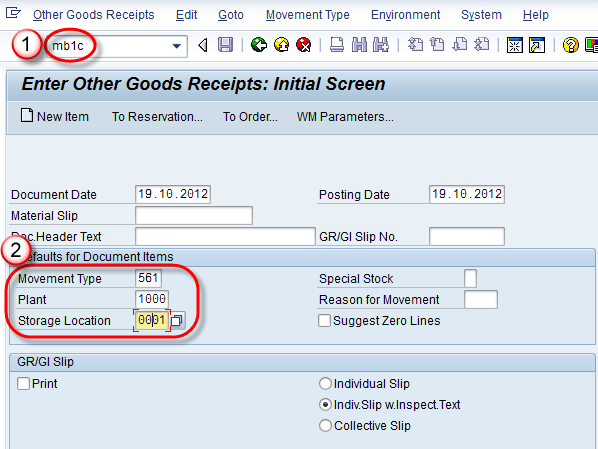
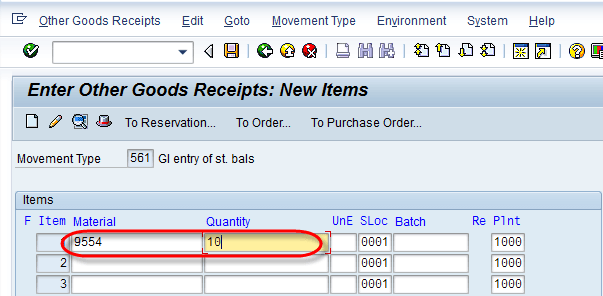
Step 2) After you confirm the header screen, the item screen appears. Enter the item details:
- Enter the Material code for which you need to create stock.
- Enter the Quantity of material for the stock creation.
Step 3) Click on the Save  button.
A message “Document 5000021944 posted” is displayed, confirming that the stock has been created.

Common Movement Types Used in MB1C
A movement type tells SAP how a goods movement affects stock. When you post through MB1C, the movement type controls whether stock increases or decreases and which stock type is updated. The following movement types are commonly used when creating or adjusting stock:
- 561 – Initial stock entry: Loads an opening balance into unrestricted-use stock, as shown in this tutorial.
- 562 – Reversal of initial entry: Cancels a 561 posting when the opening balance was entered incorrectly.
- 501 – Goods receipt without a purchase order: Receives material into stock when no purchase order exists.
- 511 – Delivery free of charge: Receives goods that a supplier provides at no cost.
- 201 – Goods issue to a cost center: Consumes stock for internal use by a cost center.
Choosing the correct movement type keeps stock quantities and inventory reports accurate, so confirm the type before you post the document. If you are unsure which type applies, review the movement type list in Customizing or check with your MM consultant before posting.
