
SAP Routes & Layers: Step by Step Configuration
 Editorial Team
⚡ Smart Summary
SAP transport routes and layers connect the systems of a landscape so changes move safely from development to production. Configuring them in the Transport Management System defines consolidation and delivery paths for every change request.
Transport routes and layers are the backbone of change management in an SAP landscape. They define how a released change request travels from the development system, through quality assurance, and finally into production. This step-by-step configuration explains each route type and how to set them up in the Transport Management System.
What are Transport Routes and Layers?
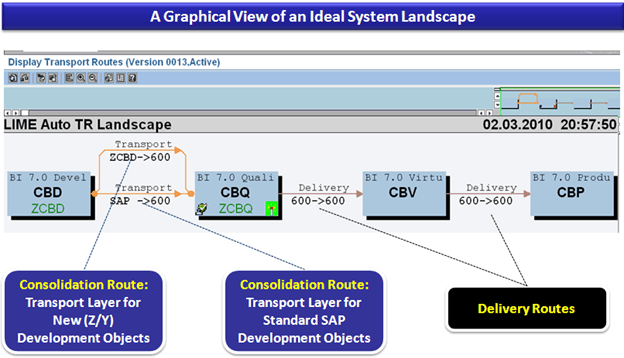
A transport layer is assigned to every development object and determines the transport path that its change requests will follow. A transport route then connects two systems along that path. SAP uses two kinds of routes: a consolidation route that moves released changes from the development system to the quality-assurance system, and a delivery route that forwards imported changes onward to production or further systems.
All routes are maintained centrally in the Transport Management System (STMS) on the domain controller. Once configured, the domain controller distributes the settings to every member system, ensuring that the entire landscape shares one consistent transport configuration.
Consolidation Routes
Consolidation routes – We need to establish a consolidation route for each transport layer. Development/ Integration system is taken as the source of these consolidation routes. Quality assurance/ Consolidation system as the transport target. Any modified objects that have a consolidation route for their transport layer can be included in change/transport requests. After the request has been released the objects can be imported into the consolidation system. If the changes are made to the objects with no consolidation route set-up (or in Customizing requests without a transport target) for their transport layer, such changes will be automatically taken as local change requests, i.e., not-transportable. Only one consolidation route per transport layer per system can be set-up.

Setting up Transport Routes
Once the Domain and other systems of a landscape are defined, we need to connect them with the help of proper transport routes (and layers). As for many customers’ systems landscape fall into the same categories, the TMS provides some standard system groups that can be used for easily defining routes. When standard options are used, routes are generated automatically; we can select one of the following options:
- Single System
- Two-System landscape: DEV and PRD
- Three System landscape: DEV, QAS, and PRD
If we need to define a more complex transport system, we can also use standard options initially and there after defining additional consolidation and delivery routes.
Transport Routes – Standard Configuration

Transport Routes – Manual Configuration


Transport Routes
Distributing and Verifying the Configuration
- After the transport route settings are made or modified in the domain controller, all other member systems of the domain ought to know the new configuration. For that we need to execute STMS -> Transport Routes Screen -> Systems Overview -> Configuration -> Distribution and Activate Configuration
- Additionally, we should also verify various check-points, to ensure that the whole arrangement is behaving in the desired manner:
- For RFC Connections: Overview -> Systems -> SAP System ->Check -> Connection Test
- For Network: Transport Routes Overview -> Config. -> Check -> Request Consistency
- For tp & TPPARAM: System Overview Screen -> SAP System -> Check -> Transport Tool
Consolidation vs Delivery Routes
Both route types move transport requests, but they operate at different stages of the landscape. Understanding the difference prevents changes from stalling before they reach production.
| Aspect | Consolidation Route | Delivery Route |
|---|---|---|
| Source system | Development / Integration | Quality assurance |
| Target system | Quality assurance | Production or further systems |
| Trigger | Release of a change request | Import into the consolidation system |
| Limit | One per transport layer per system | Multiple delivery routes allowed |
Best Practices for Configuring Transport Routes
A clean route configuration keeps transports predictable and auditable across the landscape. Apply these best practices:
- Use standard groups first: Start with the TMS single, two, or three-system templates before adding manual routes.
- Maintain one domain controller: Configure routes centrally and distribute them to all member systems.
- Keep one consolidation route: Define only one consolidation route per transport layer per system.
- Always distribute and activate: Activate the configuration so every system shares the same routes.
- Verify connections: Test RFC, network, and transport tool checks after every change.
