
ME22N Tcode in SAP: How to Change a Purchase Order
 Editorial Team
⚡ Smart Summary
Change a Purchase Order in SAP using transaction ME22N. The transaction opens the most recently handled order, and any other document is reached through the Purchase Order menu path before edits are saved.
What Can Be Changed on a Purchase Order?
A purchase order is a commitment to a supplier, so SAP allows edits but constrains them according to what has already happened to the document. Knowing the boundaries prevents a wasted trip into the transaction.
| Field or action | Changeable? | Condition |
|---|---|---|
| Order quantity | Yes | Cannot fall below the quantity already received or invoiced |
| Delivery date | Yes | Freely editable while the item is open |
| Net price and conditions | Yes | Blocked once an invoice has been posted against the item |
| Add a new item | Yes | Allowed at any time while the order is open |
| Delete an item | Conditional | Only if no goods receipt or invoice exists for that item |
| Vendor | No | Vendor is a key field; a new order must be created instead |
| Purchasing organisation and document type | No | Fixed at creation, they determine number range and processing |
| Plant on an existing item | No | Delete the item and add a new one for the correct plant |
Where a release strategy applies, changing a value that the strategy evaluates, typically the item value, resets the approval and the order must be released again before transmission.
Steps to Change a Purchase Order
In this tutorial, we will learn how to change a purchase order.
Step 1) For changing an existing purchase order you can use transaction code ME22N (or ME22 – the old version).

Immediately after executing transaction code, system will take you to the most recent purchase order you have created, changed or viewed. If you need to change some other purchase order, you can use the option which appears in the menu
Purchase order > Other Purchase Order.

Step 2) You will be presented a screen to enter the document you want to process.

We can add another item and save our purchase order.
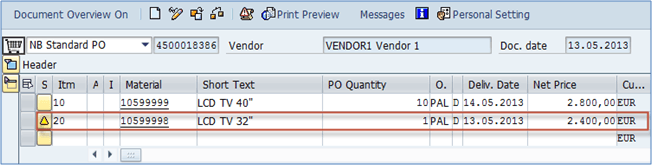
After saving we will be informed by the system that our PO is saved with changes.
💡 Note: Displaying of purchase orders can be reached through t-code ME23N (or ME23 – old version). Everything looks and works the same as in change mode except that data isn’t changeable, you can only display it.
Tracking Changes with the Change History
Every saved edit is written to a change document, which is what makes a purchase order auditable months after the fact. Reaching that log takes two clicks and answers most disputes about who altered a price or a date.
From inside ME22N or ME23N, open the menu path Environment → Header changes for document level edits, or Environment → Item changes with an item selected. The log lists the field changed, the old and new values, the user, and the timestamp.
Three details are worth knowing:
- Header and item logs are separate. A quantity change appears under item changes and will not be found in the header log.
- Only changes after the first save are recorded. Values typed while the order was being created form the original document, not a change.
- Version management, where active, groups edits. Each round of changes becomes a version that can be printed and re-transmitted to the vendor as an amendment.
If the vendor already holds a printed copy, changing the order is only half the task. Output determination must resend the amended document, otherwise the supplier continues working from the superseded version.
Common Errors When Changing a Purchase Order
Most blocked edits produce a message that names the constraint rather than the cause. The table maps the frequent ones to their fix.
| Situation | Why it happens | What to do |
|---|---|---|
| Quantity cannot be reduced | Goods receipt already posted for more than the new figure | Reverse the goods receipt first, then reduce the order |
| Price field is greyed out | An invoice has been posted against the item | Cancel the invoice, or correct the value with a credit memo |
| Item cannot be deleted | Receipts or invoices exist for the item | Set the delivery completed indicator instead of deleting |
| Order becomes unreleased after saving | A change altered a value the release strategy evaluates | Route the order through release again before transmission |
| Document is locked by another user | The order is open in another session | Wait, or ask the named user shown in the message to exit |
Where the underlying terms rather than a single order need correcting, update the purchase info record so future orders default correctly. Related steps are covered in creating a purchase order with reference and across the SAP MM tutorial series.
