
How To Create Debit Memo in SAP
 Editorial Team
⚡ Smart Summary
Debit memo creation in SAP raises a debit memo request that charges a customer more when they were undercharged. This resource explains what a debit memo is, how it differs from a credit memo, and how to create one.
What Is a Debit Memo in SAP SD?
A debit memo is a document that increases the amount a customer owes. In SAP Sales and Distribution, the process starts with a debit memo request, which is a sales document created to request that extra charge. When the request is billed, it becomes a debit memo that raises the customer’s receivable.
Debit memos are typically raised to correct an undercharge. A common example is when the price calculated on the original invoice was too low because the wrong rate was selected, so the customer needs to be charged the difference. To keep control, a debit memo request can be blocked with a billing block, so that it is checked and approved before it is processed. Only after approval, when the block is removed, can the request be billed. This makes the debit memo a controlled way to correct billing without editing the original invoice, and it keeps a clear audit trail of why the extra charge was raised.
Debit Memo vs Credit Memo in SAP
Debit memos and credit memos are opposite corrections in SAP billing. Both fix an amount after the original invoice, but they move the customer’s balance in different directions, so it is important to choose the right one.
| Basis of comparison | Debit memo | Credit memo |
|---|---|---|
| Effect on customer | Charges the customer more | Refunds or reduces the charge |
| Typical reason | Customer was undercharged | Customer was overcharged or returned goods |
| Request order type | Debit Memo Request (L2) | Credit Memo Request (G2) |
| Created in | VA01 | VA01 |
| Result of billing | Increases the receivable | Decreases the receivable |
In short, use a debit memo when the customer should pay more, and a credit memo when the customer should pay less. Both are created in VA01 with the matching request order type and then billed. The choice also affects accounting: a debit memo posts an additional receivable to the customer account, whereas a credit memo posts a reduction, so finance can reconcile both against the original invoice.
Steps to Create Debit Memo
Follow these steps to create a debit memo request in transaction VA01, with reference to a sales order.
Step 1) Enter the T-code.
- Enter T-code VA01 in the command field.
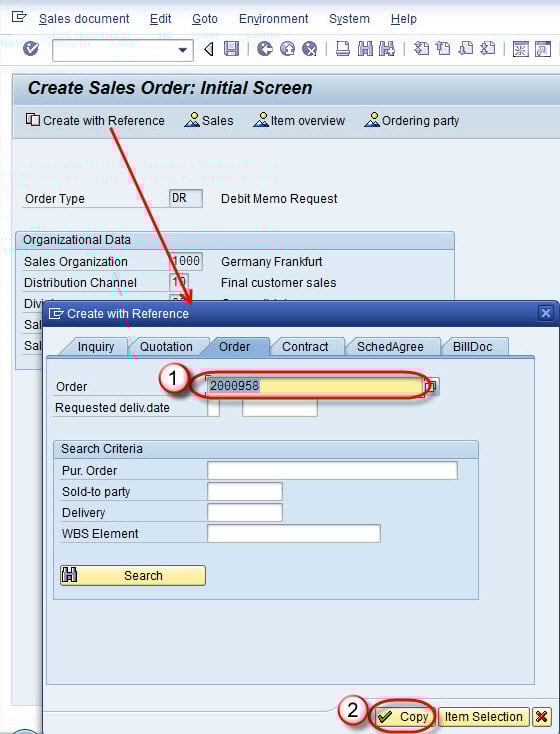
- Enter the order type “Debit Memo Request”.
- Enter the Sales Organization, Distribution Channel, and Division in the sales organization tab.
- Click on the “Create with Reference” button.

Step 2) Enter the sales order number.
- Enter the Sales Order number for reference to create the debit memo request in the order tab of the pop-up window.
- Click on the Copy button.
Step 3) Create the debit memo request.
- Enter the Purchase order number.
- Enter the Billing Block (the reason for the debit memo).
- Enter the Pricing Date (the date on which the condition records are accessed).
- Enter the Billing Date.
- Enter the Target quantity (the quantity for which you are creating the debit memo).

Step 4) Click on the Save button.
Click on the Save  button. A message “Debit Memo Request 700000 has been saved” is displayed.

When Is a Debit Memo Used? Common Scenarios
A debit memo is useful whenever a customer needs to be charged again after the original invoice. The most common scenarios include:
- Price undercharge: The original invoice used a rate that was too low, so the difference must be billed.
- Missed charges: A freight, surcharge, or handling fee was left off the first invoice.
- Quantity correction: The customer was billed for less than was agreed and owes the balance.
- Interest or penalties: A late-payment charge or an agreed penalty needs to be raised.
- Contract adjustments: A price increase agreed after invoicing applies to a delivered quantity.
In each case, the debit memo request captures the extra amount and the reason, and a billing block ensures the charge is reviewed before the customer is billed. Documenting the scenario on the request also helps auditors understand why the customer’s balance changed after the first invoice was issued.
