
8 Best PHP Books for Beginners & Advanced Programmers
 Editorial Team
We are reader supported and may earn a commission when you buy through links on our site
PHP is a server-side scripting language used to build websites and web applications. Its name stands for PHP: Hypertext Preprocessor, although it originally meant Personal Home Page. PHP can process forms, manage user sessions, connect to databases, and create pages that change based on stored information.
A well-chosen PHP book can help you learn the language in a clear order, from basic syntax and functions to MySQL, security, and object-oriented programming.
The books in this article suit beginners as well as developers who want to strengthen specific skills. Each review explains what the book covers, the experience it expects, and when it was published, helping you choose a starting point for learning PHP. Read more…
Best PHP Books for Beginners and Developers
| Book Title | Author Name | Latest Edition | Publisher | Ratings | Link |
|---|---|---|---|---|---|
| Learning PHP, MySQL & JavaScript | Robin Nixon | 5th edition | O′Reilly |  |
Learn More |
| Head First PHP & MySQL | Lynn Beighley, Michael Morrison | 1st edition | O′Reilly |  |
Learn More |
| The Joy of PHP | Alan Forbes | 6th edition | BeakCheck LLC | |
Learn More |
| PHP for the Web | Larry Ullman | 5th edition | Peachpit Press |  |
Learn More |
| PHP and MySQL Web Development | Luke Welling | 5th edition | Addison-Wesley | |
Learn More |
Ratings: These ratings come from Amazon book listings, not Guru99. They may vary by book edition or seller. Ratings, publisher names, and edition details were checked in October 2026.
1) Learning PHP, MySQL & JavaScript
Author Name: Robin Nixon
Publisher: O′Reilly
Latest Edition: 5th edition
No of Pages: 827 pages

Learning PHP, MySQL & JavaScript by Robin Nixon covers the main parts of a data-driven website in one guide. It moves from PHP and MySQL to JavaScript, CSS, and HTML, then joins them in working examples. The broad coverage suits readers who want to understand how browser and server code work together.
The book covers many subjects, so some chapters move quickly and the 827 pages can feel heavy. Published in 2018, the fifth edition covers PHP 7, MySQL 8, jQuery, and React. Use the exercises to build a small site as you read.
What You’ll Learn:
- Build dynamic web pages with PHP and MySQL
- Process HTML forms and validate user input safely
- Store, retrieve, update, and delete database records efficiently
- Add JavaScript interactions to server-generated web pages smoothly
- Manage cookies, sessions, and user login workflows securely
- Combine PHP, CSS, HTML, and JavaScript projects successfully
Best For: Beginners who want one practical guide covering PHP, MySQL, JavaScript, HTML, CSS, forms, databases, and complete web projects from scratch.
2) Head First PHP & MySQL
Author Name: Lynn Beighley, Michael Morrison
Publisher: O′Reilly
Latest Edition: 1st edition
No of Pages: 812 pages

Head First PHP & MySQL by Lynn Beighley and Michael Morrison uses pictures, puzzles, questions, and projects to teach server-side development. It explains PHP basics, form handling, database queries, sessions, authentication, and common security concerns through a visual style designed to keep beginners involved.
Published in 2009, the book is strongest at explaining how forms, databases, and sessions fit together, and its projects make each idea concrete. The busy page design may distract readers who prefer a standard textbook.
What You’ll Learn:
- Write basic PHP scripts using variables and functions
- Collect and check data submitted through HTML forms
- Create MySQL tables and run common database queries
- Use sessions and cookies to remember website visitors
- Build login features with safer password handling practices
- Spot common security mistakes in database-driven websites early
Best For: Visual learners who prefer diagrams, exercises, and project examples while studying beginner PHP, MySQL, forms, sessions, and database-driven practical websites.
3) The Joy of PHP
Author Name: Alan Forbes
Publisher: BeakCheck LLC
Latest Edition: 6th edition
No of Pages: 238 pages

The Joy of PHP by Alan Forbes gives new programmers a short introduction to building interactive websites. It starts with basic PHP, explains how pages receive form data, and shows how PHP can work with MySQL. The tone stays friendly and avoids long theory sections.
Its short length makes the book approachable, but it also limits detail on security, testing, and project structure. Readers may outgrow it quickly. Use it to finish a first small website, then move to a fuller guide before building a public or business application.
What You’ll Learn:
- Set up a basic local PHP development environment
- Write simple scripts with variables, conditions, and loops
- Send form data from HTML pages into PHP
- Create MySQL tables for small website projects correctly
- Read and display stored records on web pages
- Build a small interactive site from start to finish
Best For: New programmers who want a short, friendly introduction to PHP, MySQL, forms, and small interactive websites without dense technical explanations.
4) PHP for the Web
Author Name: Larry Ullman
Publisher: Peachpit Press
Latest Edition: 5th edition
No of Pages: 496 pages

PHP for the Web by Larry Ullman teaches PHP through short lessons and clear examples. It covers basic syntax, conditions, loops, functions, forms, cookies, sessions, and database work. The Visual QuickStart format makes it easy to read one task, try the code, and check the result.
Published in 2016, the fifth edition is written for PHP 7. The compact lesson format leaves less room for architecture and testing, but it works well as a first course.
What You’ll Learn:
- Understand PHP syntax, variables, operators, and constants clearly
- Control program flow with conditions, loops, and functions
- Handle browser forms and check submitted user data
- Work with cookies and sessions across multiple pages
- Connect PHP scripts to a MySQL database safely
- Apply basic security steps to small web projects
Best For: Beginners who learn best through short, visual lessons covering PHP syntax, forms, cookies, sessions, databases, and basic web security skills.
5) PHP and MySQL Web Development
Author Name: Luke Welling
Publisher: Addison-Wesley Professional
Latest Edition: 5th edition
No of Pages: 688 pages
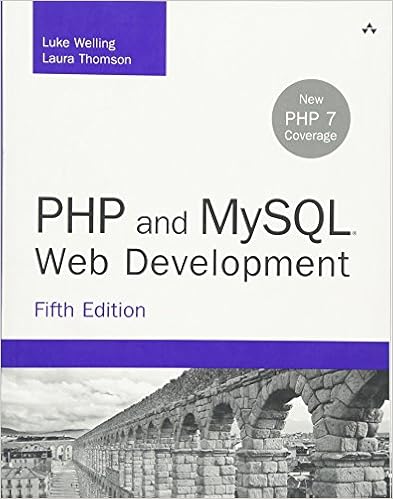
PHP and MySQL Web Development by Luke Welling and Laura Thomson is a detailed guide to building database-backed sites. It covers PHP, MySQL, forms, files, authentication, security, networking, and larger application examples. Readers can use it as both a course and a desk reference.
The book is long, so beginners may need to read it in sections instead of from cover to cover. Published in 2016, the fifth edition is updated for PHP 7 and covers security, databases, email, and server configuration in detail.
What You’ll Learn:
- Plan database-backed websites using PHP and MySQL together
- Design tables and write useful SQL queries correctly
- Process forms, files, sessions, and user accounts safely
- Add authentication and protect common website entry points
- Organize larger applications into reusable PHP components effectively
- Review e-commerce, email, networking, and server tasks together
Best For: Developers seeking a detailed reference for PHP, MySQL, database design, security, e-commerce, authentication, and larger web application projects in practice.
6) Modern PHP: New Features and Good Practices
Author Name: Josh Lockhart
Publisher: O′Reilly
Latest Edition: 1st edition
No of Pages: 268 pages

Modern PHP by Josh Lockhart explains practices that helped PHP projects become easier to organize and maintain. It covers namespaces, interfaces, traits, Composer, standards, testing, deployment, hosting, and security. The book is useful for developers moving beyond single-file scripts and older coding habits.
Published in 2015, the book covers PHP 5.x and the then-new PHP 7. Its advice on Composer, coding standards, testing, and deployment remains the core of a well-organized PHP project.
What You’ll Learn:
- Organize PHP code with namespaces, interfaces, and traits
- Manage project packages and autoloading through Composer correctly
- Follow shared coding standards across development teams consistently
- Test application behavior before changing production code safely
- Review deployment, hosting, profiling, and security practices together
- Replace older project habits with maintainable development workflows
Best For: Intermediate PHP developers updating older habits with namespaces, Composer, standards, testing, deployment, security, and modern application development practices for teams.
7) PHP Advanced and Object-Oriented Programming
Author Name: Larry Ullman
Publisher: Peachpit Press
Latest Edition: 3rd edition
No of Pages: 491 pages

PHP Advanced and Object-Oriented Programming by Larry Ullman helps readers move from basic scripts to structured applications. It explains classes, objects, inheritance, exceptions, design patterns, database work, and testing. The examples show how reusable code can reduce repeated work in larger projects.
This is not a first PHP book because it assumes comfort with basic syntax and web development. Published in 2012, the third edition also covers namespaces, the Standard PHP Library, and PDO for database work.
What You’ll Learn:
- Create classes, objects, properties, and methods in PHP
- Use inheritance and interfaces to share application behavior
- Handle errors and exceptions with clearer recovery paths
- Apply common design patterns to reusable project code
- Connect object-oriented applications with relational databases safely and reliably
- Test and improve larger PHP applications over time
Best For: PHP developers ready to study object-oriented design, inheritance, exceptions, design patterns, databases, testing, and reusable application code for larger projects.
8) Murach’s PHP and MySQL
Author Name: Ray Harris
Publisher: Mike Murach & Associates Inc.
Latest Edition: 4th edition
No of Pages: 848 pages

Murach’s PHP and MySQL by Ray Harris and Joel Murach pairs explanations with code so readers can study a topic and see its use on facing pages. It covers PHP basics, forms, sessions, database work, object-oriented code, security, and complete application tasks. The layout also makes later review easier.
The fourth edition, published in 2022, runs to 848 pages, so readers seeking a quick introduction may find it slow. It suits structured study better than a short weekend overview.
What You’ll Learn:
- Read paired explanations and code examples side by side
- Build forms that collect and validate visitor information
- Store application data in structured MySQL tables safely
- Manage sessions, cookies, and account access securely and properly
- Use object-oriented PHP in practical database applications confidently
- Find earlier topics quickly through the reference layout
Best For: Beginners and working developers who prefer paired explanations and examples while learning PHP, MySQL, forms, sessions, security, and database applications.
How to Choose a PHP Book
Match the book to what you can already build. A complete beginner needs PHP syntax, forms, and simple database work. A reader who knows the basics may need object-oriented programming, testing, Composer, or application structure. Check the publication date, because older books may teach database functions that later PHP versions removed.
Look for exercises that produce a working result instead of isolated code fragments. A good next book should fill a clear gap, such as MySQL, security, object-oriented design, or project organization. Avoid buying several beginner books that repeat the same lessons.
Which PHP Topics Should You Learn First?
Start with variables, operators, conditions, loops, functions, strings, and arrays. Then learn forms, validation, cookies, sessions, file handling, and database queries. The PHP tutorial can help you review these basics while you work through a book.
After that, study object-oriented code, Composer, error handling, testing, and security. Learn prepared database statements, output escaping, password handling, and access control before publishing a project. Frameworks make more sense once you understand what their routing, database, and template features do.
How to Practice PHP While Reading
Build one small project across several chapters, such as a contact manager or task list. Add a form, validate the entries, save them in MySQL, display the results, and protect private pages with a login. This connects separate lessons through one working application.
Type each example, change an input, and predict the result before running it. Keep notes about errors and fixes. When a book uses an older PHP version, compare the code with current documentation and replace removed functions before moving to the next chapter.
