
10 BEST Online Coding Courses with Certificates (2026)
 Editorial Team
Online coding courses provide a structured way to build practical problem-solving skills across programming languages, data tools, cybersecurity, and web development. The right course can help beginners understand core concepts while giving experienced learners a focused path to expand their technical abilities. This article compares high-quality options based on their curricula, learning formats, prerequisites, certificates, and intended audiences.
The selected courses include free-to-start and paid programs for different goals, schedules, and experience levels. They cover Python, Excel, data science, IT support, ethical hacking, and full-stack development. Each review explains the main skills, duration, certificate availability, enrollment conditions, and important limitations, helping you choose a course that matches your career plans and preferred learning style effectively. Read more…

Affiliate Disclosure: Guru99 is reader-supported. We may earn a commission when you buy through links on our site.
Best Online Coding Courses with Certificates
| Course Name | Provider | Duration | Rating | Link |
|---|---|---|---|---|
| Business Statistics and Analysis | Rice University on Coursera | 3 months at 10 hours per week | ⭐ 4.7 | Enroll Now >> |
| Python for Everybody | University of Michigan on Coursera | 2 months at 10 hours per week | ⭐ 4.8 | Enroll Now >> |
| Excel Skills for Business | Macquarie University on Coursera | 3 months at 10 hours per week | ⭐ 4.9 | Enroll Now >> |
| Coddy | Coddy | Self-paced | ⭐ 4.5 | Enroll Now >> |
| Google IT Support | Google on Coursera | 3 months at 10 hours per week | ⭐ 4.8 | Enroll Now >> |
1) Business Statistics and Analysis (Coursera)
Top Recommendation | Specs: Duration: 3 months at 10 hours per week | Certificate on Completion: Yes | Level: Beginner | Courses: 5 | Rating: 4.7
Business Statistics and Analysis from Rice University teaches statistics through Excel rather than code. Across five courses, it covers Excel data analysis, descriptive statistics, probability and the normal distribution, the Central Limit Theorem, hypothesis testing, and linear regression, and finishes with a capstone project on real business data. It suits business professionals and newcomers who want practical analysis skills before learning a programming language.

What will you learn?
- Introduction to Data Analysis Using Excel: You will explore the essential features of Excel used in data analytics, including pivot tables, charts, and basic formulas. This allows you to manipulate datasets and gain actionable insights.
- Statistical Descriptors & Hypothesis Testing: You will learn statistical measures and hypothesis testing to evaluate business data accurately. This is one of the best ways to support strategic decision-making using evidence.
- Linear Regression for Business Statistics: You will gain proficiency in using regression models to identify trends and relationships. It is best used when projecting future business outcomes based on historical data.
- Business Statistics and Analysis Capstone: You will complete a hands-on project involving real business data. The capstone is a great way to apply theoretical knowledge in practical settings.
Pricing:
Enroll for free
How to Enroll in Business Statistics and Analysis
- Step 1) Open the Coursera specialization page.
- Step 2) Review the current subscription, purchase, and financial-aid options.
- Step 3) Create an account, enroll, and begin the first course.
2) Python for Everybody (Coursera)
Specs: Duration: 2 months at 10 hours per week | Certificate on Completion: Yes | Level: Beginner | Courses: 5 | Rating: 4.8
Python for Everybody from the University of Michigan teaches programming from scratch with no prerequisites. Across five courses, Charles Severance covers installing Python, variables, conditions, functions, and loops, then moves to data structures, web data, and databases, finishing with a capstone that retrieves, processes, and visualizes data. Its steady pace suits students and professionals who have never written code.

What will you learn?
- Intro to Python Programming: You will learn the basics of writing Python code with proper logic, flow control, and error handling. It is one of the easiest ways to begin coding.
- Data Structures in Python: You will work with data containers like lists and dictionaries that help organize your data. These are essential for building clean and efficient applications.
- Accessing Web Data with Python: You will use Python libraries to fetch and process web data from various sources. This is great for projects involving APIs or scraping.
- Python and Databases: You will learn how to execute SQL queries using Python and work with database records programmatically. Helpful to manage and analyze persistent data.
- Capstone: Data Integration Project: You will complete a final project that brings together your Python, data, and visualization skills. This may help build your portfolio and showcase real-world readiness.
Pricing:
Enroll for free
How to Enroll in Python for Everybody
- Step 1) Open the specialization page.
- Step 2) Review the available access and certificate options.
- Step 3) Register and begin Programming for Everybody.
3) Excel Skills for Business (Coursera)
Specs: Duration: 3 months at 10 hours per week | Certificate on Completion: Yes | Level: Beginner | Courses: 4 | Rating: 4.9
Excel Skills for Business from Macquarie University builds spreadsheet skills over four courses, from Essentials through Intermediate to Advanced. It moves from the Excel interface and formatting to formulas such as IF and VLOOKUP, data validation, charts, and spreadsheet design, with downloadable practice workbooks for each lesson. It suits office workers and analysts who use Excel daily and want to work faster and more accurately.

What will you learn?
- Excel Interface & Data Handling: You will gain confidence using Excel’s workspace, formatting cells, and entering structured data. This is one of the easiest ways to prepare for more advanced analytics.
- Formulas & Functions Automation: You will use functions like IF, VLOOKUP, and SUM to automate processes and return dynamic results. It is best to master these in order to build efficient sheets.
- Data Analysis & Visualization: You will transform data into readable summaries and clear visualizations using Excel charts and tables. This helps you present insights in a user-friendly way.
- Error Handling & Navigation Tools: You will validate data entries and use built-in navigation aids to work with large sheets effectively. This may help you avoid common spreadsheet errors.
- Spreadsheet Usability & Design: You will create well-structured, user-friendly spreadsheets that support easier collaboration and readability. This is a great way to ensure clarity and reduce confusion when sharing workbooks.
Pricing:
Enroll for free
How to Enroll in Excel Skills for Business
- Step 1) Open the Coursera specialization page.
- Step 2) Choose the access option shown for your account.
- Step 3) Enroll and download the first practice workbook.
4) Coddy (Interactive Coding Courses)
Specs: Duration: Self-paced | Certificate on Completion: Yes, free | Level: Beginner to advanced | Catalog: 137 courses across 18 languages | Rating: 4.5
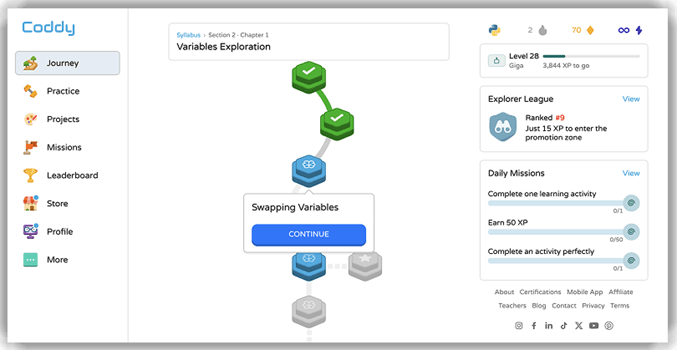
Coddy lets you start coding right in your browser. Each lesson pairs an explanation with an exercise in the built-in editor, where you can run your solution and check the result, so there is no development environment to set up. That makes it an easy place to begin if you have been meaning to learn programming.
You can choose Python, JavaScript or another language from the catalog and follow the lessons in order. They are short enough to fit around work or school, with streaks and XP to track your daily practice. When a challenge trips you up, AI hints help you figure out what to try next, and finishing a section earns a free certificate you can share.
What will you learn?
- Programming Syntax: Practice language-specific variables, operators, conditions, loops, and functions.
- Problem Solving: Break programming challenges into smaller steps and test possible solutions.
- Data Structures: Work with collections, stacks, trees, graphs, and related algorithms.
- Project Development: Apply lessons by building small programs, games, and interactive projects.
- Debugging: Run code, inspect errors, and use hints to correct faulty logic.
Pricing:
Courses and certificates are free. The free plan has daily energy limits; optional paid plans remove those limits and add features.
How to Enroll in Coddy
- Step 1) Open Coddy and choose a language or learning path.
- Step 2) Create an account to save progress.
- Step 3) Complete every lesson and challenge in a section to earn its certificate.
5) Google IT Support (Coursera)
Specs: Duration: 3 months at 10 hours per week | Certificate on Completion: Yes | Level: Beginner | Courses: 6 | Rating: 4.8
The Google IT Support Professional Certificate prepares beginners for entry-level IT support roles across six courses. It covers technical support fundamentals, computer networking, operating systems, system administration, and IT security, with hands-on labs throughout, and adds a course on using AI in the job search. No prior experience or coding knowledge is required.

What will you learn?
- Technical Support Basics: You will develop skills to support users, solve basic technical problems, and maintain system performance. This may help you enter entry-level IT roles confidently.
- Networking Concepts: You will gain insights into how networks function and how data travels across the internet. This is a great way to understand routers, switches, and protocols.
- System Administration Essentials: You will manage system resources, schedule tasks, and apply software updates across machines. It is best to master administrative roles for larger organizations.
- IT Security Fundamentals: You will learn how to secure systems using digital certificates, firewalls, and password policies. This course is great for identifying and avoiding security vulnerabilities.
- AI for Job Hunting: You will enhance your job search using AI tools for smarter resume creation and job tracking. This is a good idea to streamline job applications.
Pricing:
Enroll for free
How to Enroll in the Google IT Support Professional Certificate?
- Step 1) Head over to the Google IT Support Professional Certificate course page on Coursera.
- Step 2) Tap the “Enroll for Free” button and create an account with your email.
- Step 3) Dive into the course by starting your learning experience with foundational IT skills, including troubleshooting, networking, system administration, and security.
6) IBM Data Science (Coursera)
Specs: Duration: 4 months at 10 hours per week | Certificate on Completion: Yes | Level: Beginner | Courses: 12 | Rating: 4.6
The IBM Data Science Professional Certificate is a 12-course beginner program covering data science methodology, Python, SQL, data analysis with pandas, visualization, and machine learning. Hands-on labs and a capstone project give learners portfolio work, and a final course covers using AI tools in the job search and preparing for interviews.

What will you learn?
- Data Science: You will explore the definition, scope, and processes involved in data science. This is the best way to set the foundation for understanding how data turns into insight.
- Python for Data Science: You will develop coding skills in Python and apply them to automation, data analysis, and basic AI models. This is an essential step in building project-ready skill sets.
- Data Analysis & Visualization: You will perform analyses using Pandas and visualize outputs with tools like Seaborn and Matplotlib. This helps you present trends and comparisons clearly.
- Machine Learning Concepts: You will create and evaluate ML models using Python. This course is perfect for learning practical uses of classification, clustering, and regression.
- Career Growth with AI: You will discover how AI tools can streamline job searches and how to prepare for technical interviews. A great way to transition from learning to landing a job.
Pricing:
Enroll for free
How to Enroll in the IBM Data Science Professional Certificate?
- Step 1) Head over to the IBM Data Science Professional Certificate course page on Coursera.
- Step 2) Tap the “Enroll for Free” button and create an account with your email.
- Step 3) Dive into the course by starting your learning experience with foundational data science skills, including Python, SQL, data visualization, and machine learning using real-world IBM labs and projects.
7) The Data Science Course: Complete Data Science Bootcamp (Udemy)
Specs: Duration: 32 hours 25 minutes | Certificate on Completion: Yes | Level: Beginner | Lectures: 524 | Rating: 4.6
The Data Science Course: Complete Data Science Bootcamp from 365 Careers works through mathematics, statistics, Python, and machine learning in one progressive path. Its 524 lectures cover probability, hypothesis testing, regression, NumPy, pandas, scikit-learn, and deep learning with TensorFlow. It suits learners who want a single structured course instead of assembling several.

What will you learn?
- Statistics & Probability for Data Science: You will master the foundations of statistics and probability used in data analysis—essential to interpret datasets accurately and avoid common analytical mistakes.
- Python Programming Mastery: You will learn to use Python from scratch, including libraries like NumPy and Pandas—great for building automation pipelines and clean data workflows.
- Advanced Statistical Methods: You will explore hypothesis testing, regression, and inferential statistics—helpful when extracting meaningful insights from raw business data.
- Machine Learning with scikit-learn: You will work on supervised and unsupervised models—this is the best way to gain hands-on practice with classification, clustering, and regression problems.
- Deep Learning with TensorFlow: You will build neural networks using TensorFlow—great option for those aiming to enter AI-focused roles or contribute to advanced data projects.
Pricing:
Paid course with a 30-day money-back guarantee
How to Enroll in The Data Science Course: Complete Data Science Bootcamp Course?
- Step 1) Head over to the The Data Science Course: Complete Data Science Bootcamp page on Udemy.
- Step 2) Click on the “Buy Now” or “Add to Cart” button and sign in or create an account using your email.
- Step 3) Dive into the course by starting your learning experience with statistics and Python fundamentals, then progress through advanced statistical analysis, machine learning, and deep learning with hands-on projects.
8) Learn Ethical Hacking from Scratch (Udemy)
Specs: Duration: 15 hours 3 minutes | Certificate on Completion: Yes | Level: Beginner to intermediate | Lectures: 142 | Rating: 4.6
Learn Ethical Hacking From Scratch by Zaid Sabih teaches practical penetration testing in a home lab. Its 142 lectures cover Kali Linux, Wi-Fi and LAN attacks, gaining access to computers, and website vulnerabilities such as SQL injection, then explain how to detect and defend against each attack. Practice these techniques only on systems you own or have written permission to test.

What will you learn?
- Practical Hacking Tools: You will explore 30+ tools like Metasploit and Aircrack-ng—one of the easiest ways to automate tasks and discover potential vulnerabilities in a controlled setting.
- Network Attack & Defense: You will learn how to hack into and protect WiFi and LAN systems—great for understanding how real threats emerge and how to counteract them effectively.
- Windows Exploitation Basics: You will be taught how to develop backdoors and hack Windows—helpful to identify weaknesses in common operating systems and simulate attacker behavior.
- Ethical Hacking Fields Overview: You will learn about various hacking domains and hacker types—this may help you identify which cybersecurity specialty aligns with your interests or career goals.
- Kali Linux Essentials: You will install and operate Kali Linux—this is a great way to become familiar with the standard operating system used by ethical hackers and penetration testers.
Pricing:
Paid course with a 30-day money-back guarantee
How to Enroll in the Learn Ethical Hacking From Scratch Course?
- Step 1) Head over to the Learn Ethical Hacking From Scratch course page on Udemy.
- Step 2) Click on the “Buy Now” or “Add to Cart” button, then sign in or create an account using your email.
- Step 3) Dive into the course by starting your learning experience with ethical hacking fundamentals, from network attacks to web application exploits, all taught through hands-on examples and real-world simulations.
9) Complete Python Bootcamp: From Zero to Hero in Python (Udemy)
Specs: Duration: 22 hours 23 minutes | Certificate on Completion: Yes | Level: Beginner to intermediate | Lectures: 170 | Rating: 4.6
The Complete Python Bootcamp by Jose Portilla teaches Python from the basics through object-oriented programming, decorators, and advanced modules, using both Jupyter Notebooks and .py files. Its 170 lectures include projects such as Tic Tac Toe and Blackjack games, and the course covers both Python 2 and Python 3.

What will you learn?
- Solving Problems with Python: You will understand how to apply Python to solve everyday tasks—this helps you create reliable solutions for both technical and workflow challenges.
- Game & App Creation: You will build interactive programs and games using built-in Python libraries—one of the best ways to learn logic and see how simple tools can build engaging applications.
- Python for Daily Projects: You will be able to use Python for handling work-related problems and side projects—great for those aiming to apply programming skills practically and consistently.
- Python Versions Mastery: You will work with both Python 2 and Python 3—this is typically required for developers who contribute to older systems or open-source projects.
- Portfolio-Ready Projects: You will create a sharable portfolio of Python-based projects—a great option if you want to showcase your skills to employers or clients.
Pricing:
Paid course with a 30-day money-back guarantee
How to Enroll in the Complete Python Bootcamp Course?
- Step 1) Head over to the Complete Python Bootcamp course page on Udemy.
- Step 2) Click on the “Buy Now” or “Add to Cart” button, then create an account or sign in with your email.
- Step 3) Dive into the course by starting your learning experience with Python 3 fundamentals, and work your way through practical projects, coding exercises, and real-world applications.
10) The Web Developer Bootcamp (Udemy)
Specs: Duration: 74 hours 1 minute | Certificate on Completion: Yes | Level: Beginner | Lectures: 706 | Rating: 4.7
The Web Developer Bootcamp by Colt Steele covers front-end and back-end web development in 706 lectures. It starts with HTML, CSS, and JavaScript, then moves to Node.js, Express, MongoDB, and authentication, building full projects such as the YelpCamp application along the way. It suits beginners who want one course that takes them from a first web page to a deployed app.

What will you learn?
- HTML, CSS & JavaScript: You will understand how HTML5, CSS3, and modern JavaScript work together—this foundational knowledge is essential in order to build anything from landing pages to full applications.
- Build Real Applications: You will develop real web applications using the latest technologies—this is a great way to demonstrate production-level readiness and problem-solving skills.
- Responsive & Accessible Design: You will create beautiful, functional layouts that work across screen sizes—great option for designers or developers aiming to improve user experience.
- Web Security Essentials: You will be taught to recognize and prevent common vulnerabilities—this is typically required in roles where secure code is a priority.
- Keep Learning Mindset: You will be encouraged to adopt habits and techniques that support lifelong developer growth—helpful to stay competitive in evolving tech landscapes.
Pricing:
Paid course with a 30-day money-back guarantee
How to Enroll in The Web Developer Bootcamp Course?
- Step 1) Head over to The Web Developer Bootcamp course page on Udemy.
- Step 2) Tap the “Buy Now” or “Add to Cart” button and create an account with your email.
- Step 3) Dive into the course by starting your learning experience with core web development fundamentals like HTML, CSS, and JavaScript, then progress through full-stack development including Node.js, React, databases, and building real-world apps like YelpCamp.
Is Coding Hard to Learn?
Coding can feel difficult because you must learn new syntax and solve unfamiliar problems at the same time. Beginners usually improve faster by practicing small exercises, reading error messages, and changing working examples. You do not need advanced mathematics for most introductory programming, web-development, or IT-support courses. Data science and machine learning require more statistics and algebra as the material becomes advanced.
How Do Beginners Learn to Code?
Beginners should choose one language, learn its basic syntax, and write code several times each week. Start with variables, conditions, loops, functions, and small projects before moving to frameworks. Use exercises that provide immediate feedback, but also build programs without following every step from a video. Keeping a simple project portfolio makes your progress visible and gives you examples to discuss during interviews.
Can I Get a Job Through an Online Coding Course?
An online course can build useful skills, but a certificate alone does not guarantee employment. Employers may also consider your projects, problem-solving ability, technical interviews, communication, and previous experience. Build two or three relevant projects, document your work, and tailor your resume to the role. Career certificates can support your application when they match the job requirements, but they should complement practical evidence.
What Is the Difference Between Coding and Programming?
Coding is the act of writing instructions in a programming language. Programming is the broader process of understanding a problem, designing a solution, writing code, testing it, debugging errors, and maintaining the finished software. A beginner course may focus heavily on coding syntax, while a complete development course also covers architecture, tools, databases, security, collaboration, and deployment.
What Programming Language Should I Learn First?
Python is a practical first language because its syntax is readable and it supports automation, data analysis, web development, and introductory machine learning. JavaScript is a better first choice if your main goal is interactive websites. SQL is valuable for data work, while Java or C++ may suit specific academic and software-engineering paths. Our Python tutorials provide additional practice after an introductory course.
Which Programming Language Is Most in Demand?
Demand varies by role, industry, and location. JavaScript and TypeScript are common in web development, Python is widely used for data, automation, and back-end work, and SQL remains important wherever organizations store structured data. Java, C#, C++, and Go are also valuable in specific enterprise and systems roles. Review current job listings in your target market before choosing a language solely for employment demand.
How Did We Choose the Best Online Coding Courses?
Guru99 compared the ten courses using current provider pages and published curriculum details. We checked course scope, learner level, duration, ratings, certificate conditions, prerequisites, practical exercises, and access terms. The list covers analytics, Python, spreadsheets, data science, IT support, cybersecurity, and web development. Course details come from each provider’s official course page. Ratings and course lengths can change as providers update their programs, so readers should confirm the displayed details before enrolling.
- Course Scope: We selected programs with clearly described skills and learning outcomes.
- Practical Work: We considered projects, exercises, labs, and downloadable practice resources.
- Access Terms: We distinguished free enrollment, free certificates, subscriptions, and paid courses.
- Learner Fit: We checked prerequisites, level, software, hardware, and time requirements.
- Provider Evidence: We used official course pages for volatile specifications and ratings.
