
15 Best FREE edX Courses with Certificates (2026)
 Editorial Team
edX courses can help you build practical skills without leaving your job or committing to a full degree. This guide compares 15 edX courses and programs from Harvard University, Georgia Tech, UC Berkeley, Rochester Institute of Technology, the University of Maryland, Wharton, and IBM. The list covers artificial intelligence, data science, programming, project management, digital marketing, business strategy, cybersecurity, and personal well-being.
We checked the official edX course pages in October, 2026, and compared the curriculum, level, time commitment, learning format, and certificate terms. Some edX courses offer audit access, but verified certificates and complete programs use a separate verified track. Schedules and regional availability can change, so confirm the current terms before enrolling.

Disclosure: Guru99 is reader-supported. We may earn a commission when you buy through links on this page. Learn more.
Best edX Courses with Certificates: Top Comparison
| Course Name | Provider | Free Access | Best For | Links |
|---|---|---|---|---|
| Computer Science for Artificial Intelligence | Harvard University | Check individual-course audit options; the verified program certificate requires an upgrade | Computer science and AI foundations | Enroll Now >> |
| Analytics: Essential Tools and Methods | Georgia Tech | Individual-course access varies; the verified MicroMasters certificate requires an upgrade | Advanced analytics with Python, R, and SQL | Enroll Now >> |
| Data Science | Harvard University | Check individual-course audit options; the verified program certificate requires an upgrade | R-based data science and statistics | Enroll Now >> |
| The Science of Happiness | UC Berkeley | Audit available; the verified certificate requires an upgrade | Positive psychology and personal well-being | Enroll Now >> |
| CS50’s Introduction to Computer Science | Harvard University | Free audit and qualifying CS50 certificate; the edX verified certificate requires an upgrade | General computer science foundations | Enroll Now >> |
1) Computer Science for Artificial Intelligence (Harvard University)
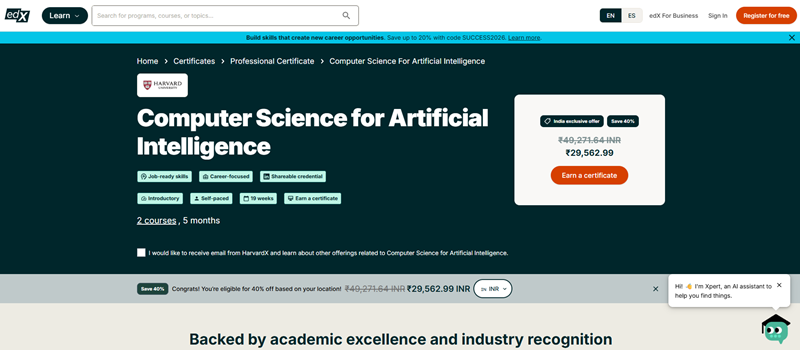
Specs: Provider: Harvard University | Duration: 19 weeks across two courses (edX estimates about 5 months) | Certificate: Earn a certificate | Level: Introductory | Format: Self-paced | Courses: 2 | Skills: Python, algorithms, machine learning, and artificial intelligence | Flexibility: Progress at your own speed | Study Time: 7 to 22 hours per week
Computer Science for Artificial Intelligence is our Top Recommendation because it joins two well-matched Harvard courses. CS50 introduces programming, algorithms, data structures, and problem-solving. The second course applies that foundation to artificial intelligence with Python, including graph search, classification, optimization, machine learning, and reinforcement learning.
Beginners who want a clear route from computer science fundamentals to applied AI will get the most value from this program. Its projects turn theory into working code. The workload is the main challenge, especially for first-time programmers, and free audit access does not include the verified program certificate.
What will You Learn?
- Computer Science Basics: Build a durable foundation in programming, algorithms, data structures, abstraction, and efficient problem-solving across several languages.
- Graph Search Methods: Apply breadth-first, depth-first, and other search techniques to find solutions across structured artificial intelligence problems.
- Machine Learning Foundations: Explain classification, optimization, and reinforcement learning concepts that support modern intelligent systems and automated decision-making.
- Python AI Projects: Use Python libraries to implement practical artificial intelligence programs while connecting theoretical algorithms with working code.
- Intelligent System Design: Combine search, knowledge representation, uncertainty, and learning methods to design systems that choose useful actions.
Pricing:
Free to Enroll
👉 How to Enroll in Computer Science for Artificial Intelligence?
- Open the official program page using the button below.
- Review the program schedule, certificate requirements, and individual course options.
- Create an edX account, choose your enrollment option, and begin with CS50.
2) Analytics: Essential Tools and Methods (Georgia Tech)
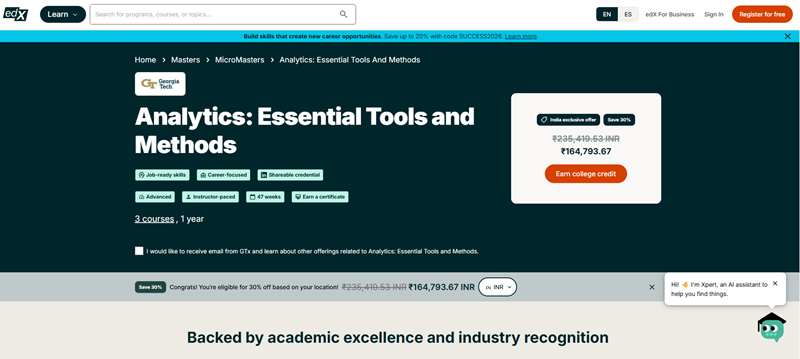
Specs: Duration: About 1 year | Certificate on Completion: Yes | Level: Advanced | Format: Instructor-led | Courses: 3 | Study Time: 9 to 11 hours per week
Analytics: Essential Tools and Methods is designed for learners who want graduate-level training in analytical modeling, computing, and business data analysis. The program covers Python, R, SQL, numerical methods, data processing, visualization, and the practical use of analytical models in business decisions.
Choose this program if you already have a solid quantitative background and can keep up with scheduled assignments and exams. It offers more academic depth than a short introductory certificate, but that depth comes with a long timeline, an advanced curriculum, a demanding workload, and fixed deadlines.
What will You Learn?
- Analytical Modeling: Select suitable models for business problems, test assumptions, and interpret results without overlooking important practical limitations.
- Computing for Analysis: Combine Python, R, SQL, and Jupyter notebooks to process data and implement repeatable analytical workflows.
- Data Pipeline Design: Use appropriate modern tools to move information through collection, preprocessing, storage, analysis, and interactive visualization reliably.
- Business Analytics: Translate model outputs into clear, evidence-based recommendations that support operational planning, resource allocation, and strategic decisions.
- Mathematical Foundations: Use numerical linear algebra, optimization, algorithms, and data structures to understand how modern analytical software works.
Pricing:
Free to Enroll
👉 How to Enroll in Analytics: Essential Tools and Methods?
- Open the Georgia Tech MicroMasters program page.
- Review the scheduled course dates, prerequisites, workload, and certificate requirements.
- Create an edX account and enroll in the full program or an available individual course.
3) Data Science (Harvard University)
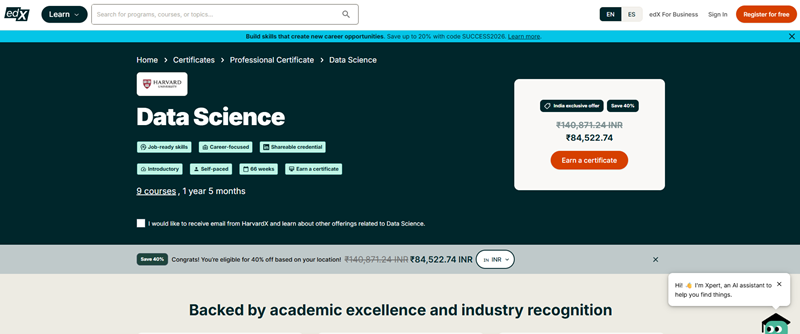
Specs: Duration: About 17 months | Certificate on Completion: Yes | Level: Introductory | Format: Self-paced | Courses: 9 | Study Time: 2 to 3 hours per week
Harvard’s Data Science Professional Certificate builds an R-based foundation through probability, statistical inference, data wrangling, visualization, regression, machine learning, and a capstone. It also introduces practical tools such as Unix or Linux, Git, GitHub, and RStudio.
This program is a good match for beginners who want an academically structured data science path built around real case studies. The weekly workload can fit around a job. The trade-off is the 17-month timeline, and anyone seeking a Python-first curriculum should compare the IBM options instead.
What will You Learn?
- R Programming: Write reusable R code for cleaning, transforming, analyzing, and communicating complex data across realistic research questions.
- Statistical Reasoning: Apply probability, inference, regression, and modeling methods to answer real questions while communicating uncertainty clearly and responsibly.
- Tidyverse Workflows: Use dplyr and ggplot2 to wrangle datasets, create visualizations, and reveal meaningful patterns for clear interpretation.
- Reproducible Tools: Organize projects with Unix, Linux, Git, GitHub, and RStudio so analyses remain fully traceable and repeatable.
- Machine Learning Capstone: Build and evaluate predictive models, then integrate the program’s methods in a complete real-world data project.
Pricing:
Free to Enroll
👉 How to Enroll in Data Science?
- Open the Harvard Data Science program page.
- Compare the complete certificate with available individual course options.
- Create an edX account and begin with the recommended introductory course.
4) The Science of Happiness (UC Berkeley)
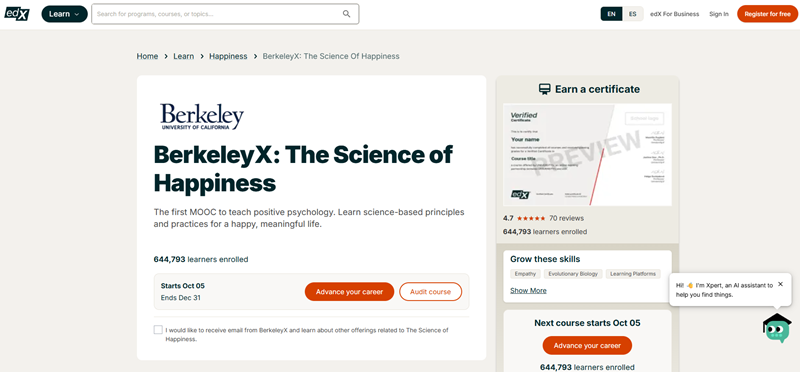
Specs: Duration: 11 weeks | Certificate on Completion: Yes | Level: Introductory | Format: Self-paced | Study Time: 4 to 5 hours per week
The Science of Happiness introduces positive psychology through research on social connection, kindness, mindfulness, gratitude, community, and meaningful activity. It combines academic ideas with practical exercises that help learners observe how daily habits can influence personal well-being.
Choose this course for personal development rather than a technical career credential. It requires no prior experience, and the audit track provides limited-time access to course materials. Its verified certificate may carry less direct job value than a technical or business certificate.
What will You Learn?
- Happiness Science: Define happiness through positive psychology and explain why well-being influences relationships, health, personal choices, and daily behavior.
- Social Connection: Examine how close relationships, kindness, cooperation, and community participation support lasting happiness for individuals and groups.
- Mindful Habits: Practice attention and mindfulness techniques that help manage emotions, reduce unhelpful thinking, and strengthen everyday awareness.
- Prosocial Practices: Apply gratitude, compassion, generosity, and awe exercises while tracking how these activities affect everyday well-being over time.
- Evidence Evaluation: Interpret psychological research on happiness, recognize common misconceptions, and choose practices supported by credible current findings.
Pricing:
Free to Enroll
👉 How to Enroll in The Science of Happiness?
- Open the UC Berkeley course page.
- Choose the audit track or the verified certificate track.
- Create an edX account and start the available course session.
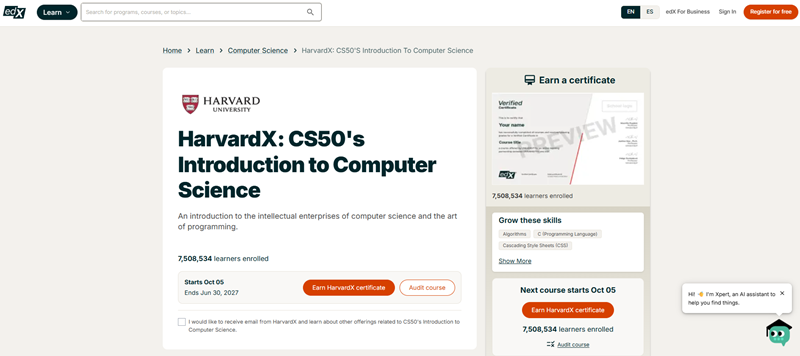
5) CS50’s Introduction to Computer Science (Harvard University)
Specs: Duration: 12 weeks | Certificate on Completion: Yes | Level: Introductory | Format: Self-paced | Study Time: 6 to 18 hours per week | Prerequisites: None
CS50’s Introduction to Computer Science teaches computational thinking and programming through C, Python, SQL, JavaScript, HTML, and CSS. Learners study algorithms, data structures, abstraction, security, software engineering, and web development before completing a final programming project.
CS50 works well for beginners who want a broad computer science foundation before specializing in AI, cybersecurity, data science, or web development. No programming experience is required. Still, its problem sets demand sustained effort, and the upper workload estimate makes this a poor choice for anyone seeking a light introduction.
What will You Learn?
- Algorithmic Thinking: Break complex problems into smaller steps, compare possible solutions, and select algorithms that use resources efficiently.
- C Programming: Write, compile, debug, and improve C programs while understanding memory, data types, pointers, and low-level behavior.
- Python and SQL: Build practical programs with Python and query relational databases using SQL to solve structured, real-world problems.
- Web Development: Create interactive pages with HTML, CSS, and JavaScript while applying secure software engineering principles and thoughtful design.
- Data Structures: Use arrays, linked structures, trees, hash tables, and graphs to organize information for efficient access and processing.
- Final Programming Project: Plan, implement, test, and present an original project that demonstrates technical judgment and independent problem-solving.
Pricing:
Free to Enroll
👉 How to Enroll in CS50’s Introduction to Computer Science?
- Open the CS50 course page.
- Choose the audit option or verified certificate track.
- Create an edX account and begin the self-paced course.
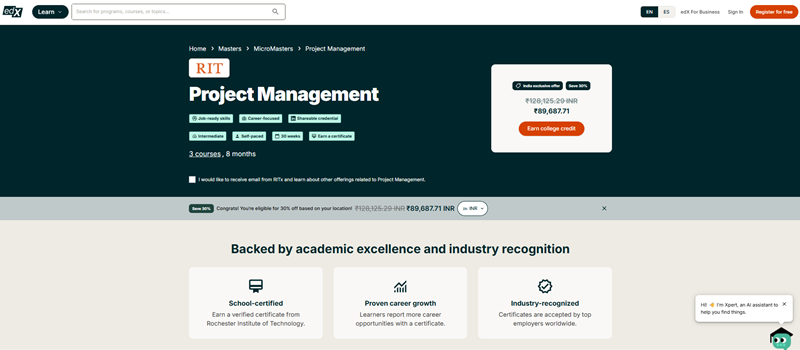
6) Project Management (RIT)
Specs: Duration: About 8 months | Certificate on Completion: Yes | Level: Intermediate | Format: Self-paced | Courses: 3 | Study Time: 8 to 12 hours per week
RIT’s Project Management MicroMasters covers the complete project life cycle, including initiation, planning, execution, control, and closing. It also teaches leadership, customer expectations, global project issues, and the trade-offs among time, cost, and scope.
RIT’s program makes sense for working project managers who want graduate-level study. Eligible learners may apply the credential toward selected RIT graduate programs after admission. It is not a casual introduction: prior experience is expected, and the weekly workload is substantial.
What will You Learn?
- Project Life Cycle: Manage initiation, planning, execution, monitoring, control, and closing activities across a complete project from start to finish.
- Constraint Balancing: Balance time, cost, scope, quality, and stakeholder expectations when project conditions or priorities change unexpectedly during delivery.
- Industry Practices: Apply established project management methods across technology, business, engineering, and other organizational settings with appropriate adaptation.
- Team Leadership: Guide project teams through communication, motivation, conflict resolution, and behavioral challenges that influence consistent, successful delivery.
- Global Project Context: Evaluate cultural, legal, regulatory, technology, and infrastructure factors that affect projects operating across international environments.
Pricing:
Free to Enroll
👉 How to Enroll in Project Management?
- Open the RIT MicroMasters program page.
- Review the experience requirements, course sequence, workload, and certificate terms.
- Create an edX account and enroll in the complete program or an available individual course.
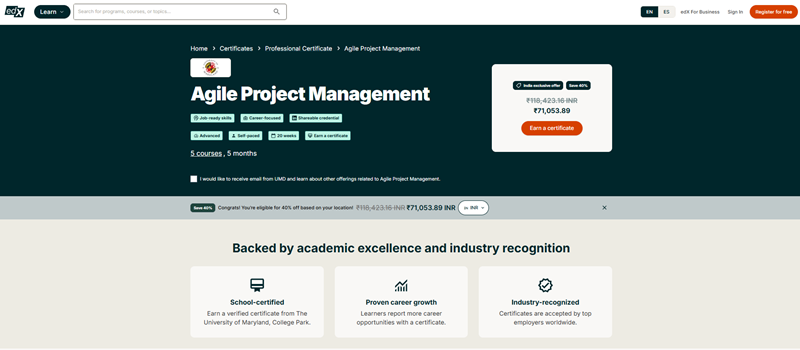
7) Agile Project Management (University of Maryland)
Specs: Duration: About 5 months | Certificate on Completion: Yes | Level: Advanced | Format: Self-paced | Courses: 5 | Study Time: 2 to 3 hours per week
Agile Project Management explains how Scrum, Lean Kanban, and related frameworks can improve project delivery. The program moves beyond basic terminology to sprint planning, innovation, leadership, problem-solving, and results-based controls for projects and programs.
The certificate is aimed at experienced managers, engineers, designers, and team leads who want to use Agile methods beyond a single software setting. Its weekly schedule is flexible, but the material is advanced. Complete beginners may need a basic project management course first.
What will You Learn?
- Scrum Mechanics: Design and facilitate Scrum projects while clearly understanding roles, events, artifacts, sprint planning, reviews, and retrospectives.
- Scaled Frameworks: Compare Scrum with SAFe, Disciplined Agile, LeSS, and hybrid approaches to choose methods for larger organizations.
- Lean and Kanban: Use lean flow, Kanban visualization, and work-in-progress limits to improve delivery speed and expose process bottlenecks.
- Agile Controls: Apply results-based controls that reduce project failure risks, support adaptation, and improve closing decisions with clearer evidence.
- Agile Leadership: Lead teams through innovation, continuous improvement, and problem-solving practices that strengthen ownership, collaboration, and measurable project benefits.
Pricing:
Free to Enroll
👉 How to Enroll in Agile Project Management?
- Open the University of Maryland program page.
- Review the advanced level, course order, certificate requirements, and PDU terms.
- Create an edX account and enroll in the full program or an available course.
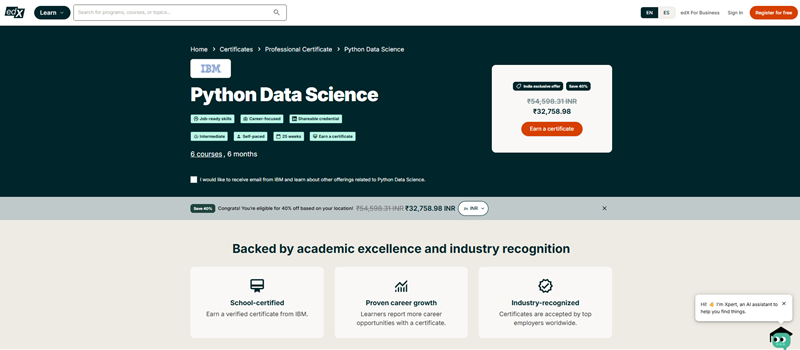
8) Python Data Science (IBM)
Specs: Duration: About 6 months | Certificate on Completion: Yes | Level: Intermediate | Format: Self-paced | Courses: 6 | Study Time: 3 to 5 hours per week
IBM’s Python Data Science certificate focuses on Python tools used in data analysis and machine learning. It covers Jupyter notebooks, pandas, NumPy, Matplotlib, Folium, Seaborn, SciPy, scikit-learn, and a capstone that brings the workflow together.
This is the more focused IBM option for learners who already have some technical experience and want to study data science with Python. It covers analysis, visualization, machine learning, and project work without the broader foundation in IBM’s ten-course certificate. Learners who also need SQL and data science methodology should choose the wider program.
What will You Learn?
- Python Foundations: Write reliable Python programs with variables, functions, collections, and control flow for common data science tasks.
- Jupyter Workflow: Use Jupyter notebooks in IBM Cloud to document, run, revise, and share iterative data analysis work.
- Data Analysis Libraries: Clean, transform, and examine datasets with pandas and NumPy while answering clear, practical analytical questions.
- Data Visualization: Create informative charts and maps with Matplotlib, Seaborn, and Folium to communicate patterns and findings effectively.
- Machine Learning: Build and evaluate models with SciPy and scikit-learn while understanding essential supervised learning methods for prediction tasks.
- Capstone Problem-Solving: Integrate Python, analysis, visualization, and machine learning skills to solve a realistic business problem from beginning to end.
Pricing:
Free to Enroll
👉 How to Enroll in Python Data Science?
- Open the IBM Python Data Science program page.
- Compare the full certificate with the available individual course options.
- Create an edX account and begin with Python Basics for Data Science.
9) IBM Data Science (IBM)
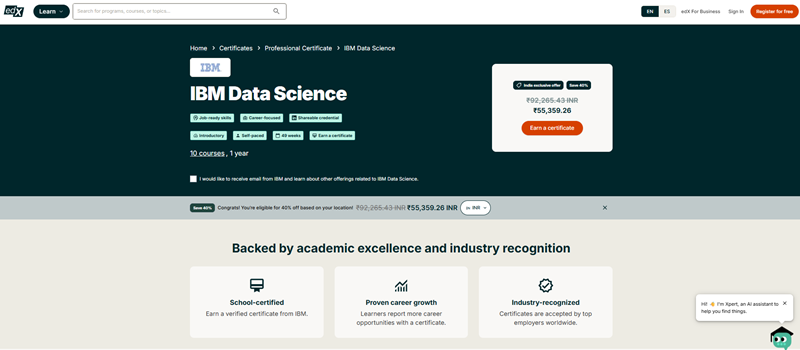
Specs: Duration: About 1 year | Certificate on Completion: Yes | Level: Introductory | Format: Self-paced | Courses: 10 | Study Time: 3 to 6 hours per week
IBM Data Science provides a broader foundation than the Python Data Science program. Its ten courses cover data science concepts, tools, methods, SQL, Python, analysis, visualization, machine learning, and a capstone project.
Choose this broader IBM path if you want a complete introduction before selecting a specialty. You will use Jupyter notebooks, GitHub, APIs, relational databases, and Python libraries. Its breadth also makes it a longer commitment: the ten-course program takes much more time than IBM’s focused Python certificate and requires verified enrollment.
What will You Learn?
- Data Science Method: Frame analytical questions, collect relevant data, prepare evidence, and follow a repeatable process for drawing useful conclusions.
- Python Data Handling: Use Python, pandas, and NumPy to clean, transform, combine, and explore structured datasets for analysis.
- SQL Queries: Write SQL statements to retrieve, filter, join, aggregate, and efficiently manage information stored in relational databases.
- Visualization and Communication: Build charts with Matplotlib and Seaborn, then explain findings in language stakeholders can understand and use.
- Machine Learning Models: Train and evaluate scikit-learn models while recognizing suitable metrics, validation methods, and limitations in predictive analysis.
- Professional Data Tools: Work with Jupyter notebooks, IBM watsonx, GitHub, and APIs while completing a practical capstone project.
Pricing:
Free to Enroll
👉 How to Enroll in IBM Data Science?
- Open the IBM Data Science program page.
- Review the ten-course order, estimated workload, and certificate requirements.
- Create an edX account and begin with the introductory data science course.
10) Digital Marketing Strategy (The University of Edinburgh)
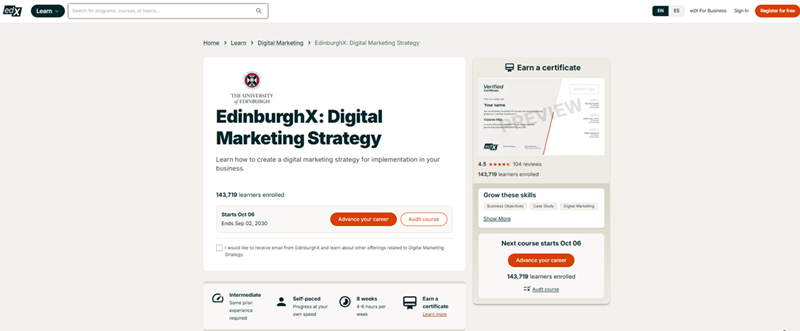
Specs: Duration: 8 weeks | Certificate on Completion: Yes | Level: Intermediate | Format: Self-paced | Study Time: 4 to 6 hours per week | Prerequisites: None
Digital Marketing Strategy from the University of Edinburgh explains how digital technologies affect products, value propositions, and customer decisions. Case studies connect marketing activity with business objectives, while the curriculum covers digital policy, consumer personas, competitor analysis, and strategy development.
This course suits marketers, business owners, and managers who understand basic marketing and want a strategy-focused curriculum. The final project produces a digital marketing plan. Although edX labels the course intermediate, it lists no formal prerequisite. Learners seeking detailed training in paid advertising or marketing analytics may find its scope too broad.
What will You Learn?
- Digital Marketing Role: Explain why digital marketing matters and connect online activities with broader business objectives and customer expectations.
- Digital Landscape: Evaluate how technologies reshape products, value propositions, customer behavior, marketing opportunities, and business risks across competitive markets.
- Content Development: Create original digital content that supports clear campaign goals, brand positioning, customer needs, and measurable business outcomes.
- Consumer Personas: Build evidence-based customer personas from demographics, behaviors, motivations, and online needs to guide more focused marketing decisions.
- Competitor Analysis: Conduct a structured competitor audit, compare market approaches, and identify useful opportunities for differentiating a digital strategy.
- Strategy Project: Develop a complete digital marketing strategy that connects audience insights, competitive evidence, channels, content, and defined business objectives.
Pricing:
Free to Enroll
👉 How to Enroll in Digital Marketing Strategy?
- Visit below enroll now button to access course page.
- Choose the audit option or the Premium certificate track.
- Create an edX account and begin the self-paced course.
11) Computer Science for Web Programming (Harvard University)
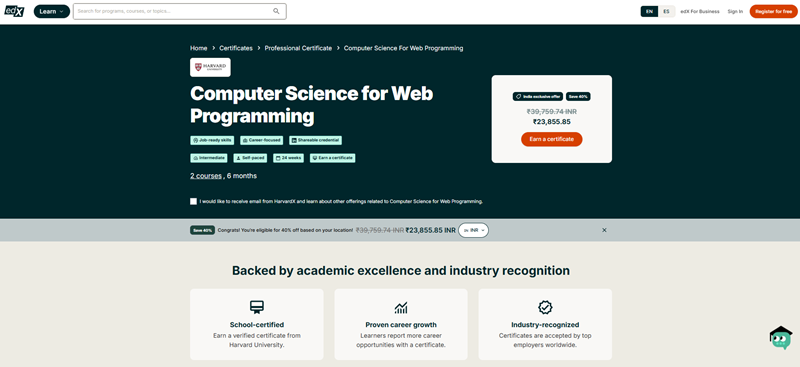
Specs: Duration: About 6 months | Certificate on Completion: Yes | Level: Intermediate | Format: Self-paced | Courses: 2 | Study Time: 6 to 14 hours per week
Computer Science for Web Programming combines CS50 with Harvard’s web programming course. The sequence starts with broad computer science concepts and then moves into Python, Django, SQL, JavaScript, Git, APIs, testing, scalability, security, HTML, and CSS.
This two-course certificate makes sense for learners who want both programming fundamentals and practical full-stack web skills. It goes much further than a short web tutorial. Expect a demanding workload, and note that the second course assumes knowledge from CS50 or equivalent programming experience.
What will You Learn?
- Web Foundations: Build accessible page structures and responsive layouts using modern HTML and CSS standards for reliable browser presentation.
- Version Control: Manage source changes with Git, organize collaborative work, and recover earlier code safely during development projects.
- Django Back Ends: Create server-side applications with Python and Django, including routes, models, forms, authentication, and database interactions.
- SQL and Models: Design relational data structures, write SQL queries, and manage schema changes through Django models and migrations.
- Interactive Interfaces: Develop client-side behavior with JavaScript, APIs, and user-interface techniques that keep applications responsive and understandable for users.
- Production Readiness: Test applications, automate integration and deployment, improve scalability, and address common security risks before public release.
Pricing:
Free to Enroll
👉 How to Enroll in Computer Science for Web Programming?
- Open the Harvard professional certificate page.
- Review the two-course order, workload, audit options, and certificate requirements.
- Create an edX account and begin with CS50 unless you already meet the prerequisite.
12) CS50’s Introduction to Cybersecurity (Harvard University)
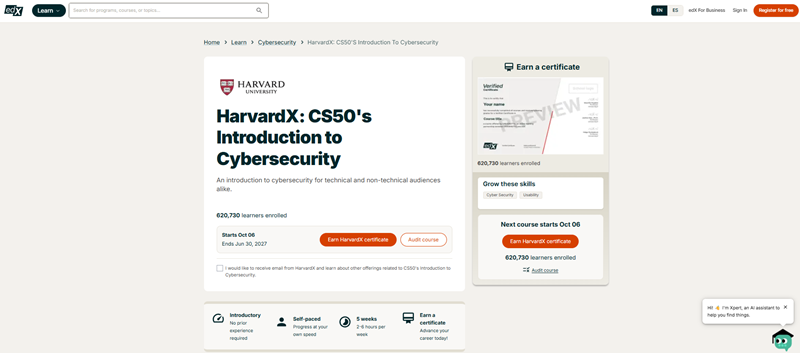
Specs: Duration: 5 weeks | Certificate on Completion: Yes | Level: Introductory | Format: Self-paced | Study Time: 2 to 6 hours per week | Prerequisites: None
CS50’s Introduction to Cybersecurity explains how to protect accounts, data, devices, systems, and software. Topics include phishing, passwords, authentication, malware, denial-of-service attacks, SQL injection, firewalls, encryption, cookies, privacy, and secure deletion.
Because the explanations do not assume a technical background, this course works well as a first cybersecurity class. Assignments use realistic situations and frame security as a balance among risk, cost, and usability. Its five-week format does not provide the depth needed for advanced security roles.
What will You Learn?
- Threat Recognition: Identify phishing, social engineering, malware, botnets, and denial-of-service attacks affecting common digital systems at home and work.
- Account Protection: Compare passwords, passcodes, biometrics, single sign-on, password managers, and multi-factor authentication to strengthen practical access control.
- System Defense: Explain firewalls, proxies, port scanning, automatic updates, and secure software choices that reduce common attack opportunities.
- Cryptography Basics: Use hashing, salting, encryption, digital signatures, and secure deletion concepts to protect information appropriately in practice.
- Web Security: Recognize SQL injection, cookies, sessions, buffer overflows, and ransomware while carefully evaluating prevention and recovery trade-offs.
- Privacy and Usability: Evaluate anonymization, de-identification, tracking, and operating-system controls while balancing security protections with users’ convenience needs.
Pricing:
Free to Enroll
👉 How to Enroll in CS50’s Introduction to Cybersecurity?
- Open the Harvard cybersecurity course page.
- Select the audit option or the verified certificate track.
- Create an edX account and begin the self-paced course.
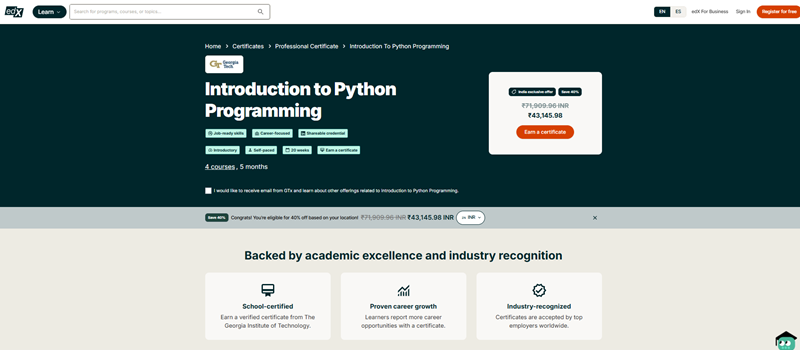
13) Introduction to Python Programming (Georgia Tech)
Specs: Duration: About 5 months | Certificate on Completion: Yes | Level: Introductory | Format: Self-paced | Courses: 4 | Study Time: 9 to 10 hours per week
Georgia Tech’s Introduction to Python Programming teaches computing through four connected courses. It begins with variables, operators, and the code-writing cycle, then moves through control structures, data structures, files, objects, and algorithms.
Complete beginners get a structured sequence of short videos, examples, practice problems, and regular feedback. That format offers more guidance than a single introductory class. The drawback is the 9-to-10-hour weekly workload, which may be difficult to manage alongside a full-time job.
What will You Learn?
- Programming Cycle: Write code, execute programs, interpret results, find errors, and revise solutions through a disciplined development cycle.
- Python Fundamentals: Use variables, mathematical operators, logical expressions, and Boolean arithmetic to create clear beginner programs with confidence.
- Control Structures: Develop dynamic programs using conditionals, loops, functions, libraries, and error handling for dependable execution in Python.
- Core Data Structures: Organize and manipulate information with strings, lists, dictionaries, and files while choosing appropriate operations for each.
- Objects and Algorithms: Apply object-oriented programming concepts and introductory algorithms to design larger solutions effectively from reusable software components.
Pricing:
Free to Enroll
👉 How to Enroll in Introduction to Python Programming?
- Open the Georgia Tech professional certificate page.
- Review the four-course sequence, weekly workload, and certificate requirements.
- Create an edX account and begin with the fundamentals course.
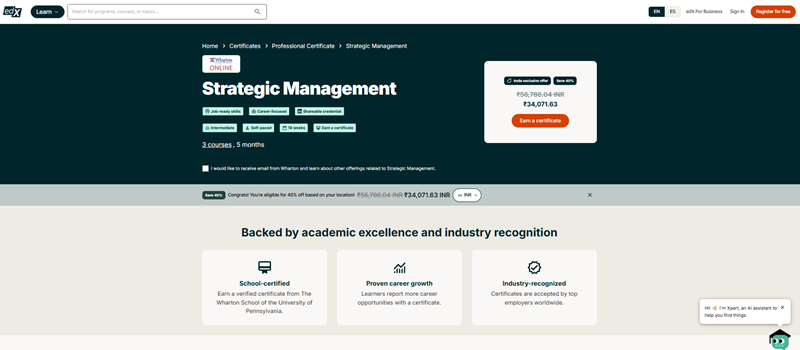
14) Strategic Management (Wharton)
Specs: Duration: About 5 months | Certificate on Completion: Yes | Level: Intermediate | Format: Self-paced | Courses: 3 | Study Time: 2 to 4 hours per week
Wharton’s Strategic Management certificate examines competitive advantage and connected strategy. The courses help learners define what makes a business different, refine a strategy, build ongoing customer relationships, and complete a capstone that applies the main ideas.
Managers, entrepreneurs, and professionals who influence business direction will find this program most relevant. Its light weekly schedule is easier to fit around work than the graduate-level project programs. The curriculum stays tightly focused on strategy, so it does not replace broader training in finance, operations, or general management.
What will You Learn?
- Competitive Advantage: Identify what makes a business distinctive and determine whether its position can remain defensible against competitors over time.
- Strategy Refinement: Adjust strategic choices to strengthen market positioning, improve profitability, and align activities around a coherent advantage.
- Connected Strategy: Use recognition, request, response, and repeat processes to create continuing relationships instead of isolated transactions with customers.
- Customer Segmentation: Create a portfolio of connected strategies that responds to different customer needs, behaviors, and relationship patterns.
- Business Model Innovation: Move beyond traditional customer interactions by designing models that create recurring value for both customers and firms.
- Strategic Capstone: Integrate competitive advantage and connected strategy concepts while solving a structured business challenge in the final project.
Pricing:
Free to Enroll
👉 How to Enroll in Strategic Management?
- Open the Wharton professional certificate page.
- Review the three-course sequence, workload, and certificate requirements.
- Create an edX account and begin with Business Strategy from Wharton.
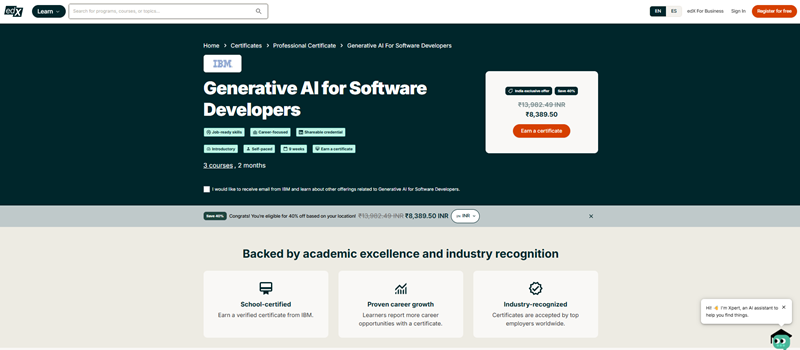
15) Generative AI for Software Developers (IBM)
Specs: Duration: About 2 months | Certificate on Completion: Yes | Level: Introductory | Format: Self-paced | Courses: 3 | Study Time: 1 to 3 hours per week
IBM’s Generative AI for Software Developers introduces generative AI, prompt engineering, and AI-assisted software work. Learners study common model types and use AI tools to create code snippets, scripts, test cases, and small applications.
Working developers can use this short program to explore large language models in everyday coding tasks. The low weekly workload makes the subject easy to sample. It is not a complete software engineering or machine learning curriculum, and every piece of AI-generated code still needs careful human review and testing.
What will You Learn?
- Generative AI Uses: Identify practical applications for text, code, images, audio, and video while comparing common model capabilities and limitations.
- Prompt Engineering: Write, test, and refine prompts using established techniques that guide models toward more relevant and reliable outputs.
- AI-Assisted Coding: Generate code snippets, scripts, and application components with AI tools while reviewing every output for correctness.
- Automated Testing: Create test cases with generative AI, then validate coverage, edge conditions, expected behavior, and possible failures.
- LLM Software Solutions: Develop software workflows with large language models and AI-powered tools that improve productivity without replacing human review.
Pricing:
Free to Enroll
👉 How to Enroll in Generative AI for Software Developers?
- Open the IBM generative AI certificate page.
- Review the three included courses, workload, and certificate requirements.
- Create an edX account and begin with Introduction to Generative AI.
What is edX?
edX is an online learning platform that offers courses and certificate programs from universities, colleges, and companies. Subjects include computer science, artificial intelligence, data science, business, engineering, cybersecurity, languages, and personal development. Courses may be self-paced or follow an instructor-led schedule.
Many edX courses provide an audit option that lets you study selected materials without paying. A verified certificate, graded assessment, or complete professional program normally requires payment. Course access, schedules, and certificate rules vary, so review the current enrollment page before choosing a track.
Why Choose edX for Online Learning?
edX gives learners access to courses and programs from recognized universities and companies. You can choose short courses, Professional Certificates, or graduate-level MicroMasters programs. Many courses provide flexible schedules and an audit option for selected materials. edX is most useful when you choose a course that matches your level, available study time, career goal, and budget for a verified certificate.
- Recognized Providers: Learn from universities and companies clearly identified on each course page.
- Flexible Formats: Choose between self-paced learning and instructor-led schedules.
- Different Program Levels: Select introductory courses, professional programs, or graduate-level study.
- Audit Options: Explore selected course materials without paying when an audit track is available.
How Did We Choose the Best FREE edX Courses with Certificates?

We reviewed the official edX page for every course and program in this guide. We compared the curriculum, provider, level, duration, weekly workload, format, certificate requirements, and audit options, then checked whether each choice serves a clear learning goal. We left out ratings when edX did not provide a reliable current score.
- Course Content: The syllabus should teach useful skills through clear lessons, exercises, or projects.
- Provider: The issuing university or company should be clearly named on the edX page.
- Learner Fit: The level, prerequisites, and workload should match the intended audience.
- Certificate Terms: The page should explain whether the audit includes a certificate and what learners must complete.
- Access Terms: We separated free audit access from graded assessments, verified certificates, and complete programs.
- Practical Value: The course should support a clear career, study, project, or personal-development goal.
How to Enroll in EdX Free Courses
You can study some edX courses without paying when an audit option is available. Audit access may provide videos, readings, and selected practice materials for a limited period. It usually excludes graded assignments and the verified certificate. The enrollment screen can vary by course, so confirm that the audit option is available before creating your study plan.
- Open the official edX page for the course you want to study.
- Select the enrollment button and sign in or create an edX account.
- Choose the audit option when it appears on the enrollment screen.
- Review the access period and confirm which lessons and assignments are included.
- Upgrade only if you need graded work or a verified certificate.
How long do edX courses take?
edX course length depends on the format and subject. A single course may take several weeks, while a Professional Certificate can require several months. The programs in this guide range from short courses of about six to twelve weeks to the Harvard Data Science certificate, which lists about 17 months. Always compare the weekly workload as well as the total duration.
Is edX certification valuable?
An edX certificate can be valuable when the course teaches skills that match your job, study, or project goal. It can show that you completed structured learning from the named university or company. However, a certificate does not guarantee employment or replace required experience, licensing, or a degree. Its value increases when you can support it with projects, code, reports, or other work samples.
Verdict
Among these edX options, Computer Science for Artificial Intelligence (Harvard University) is our Top Recommendation for learners who want a structured path from computer science fundamentals to applied AI. Choose Analytics: Essential Tools and Methods for advanced graduate-level analytics, or Data Science (Harvard University) for an R-based path through statistics, visualization, and machine learning.
