
Customer Material Info Record [CMIR] in SAP: VD51 Tcode
 Jessica Blake
⚡ Smart Summary
Customer-Material Info Record in SAP, created with transaction VD51, maps a customer’s own material number to your internal material code. This resource explains the purpose of the record, its key fields, and the VD51, VD52, and VD53 transactions.
What Is a Customer-Material Info Record?
Sometimes a customer refers to a material by a layman name rather than its technical name in a purchase order. There is therefore a need to map the customer’s material name to your own material code, and this mapping is called a Customer-Material Info Record, often shortened to CMIR.
The record is maintained for a specific customer within a sales area, which means a combination of sales organization and distribution channel. Once it exists, SAP can recognize the customer’s material number during order entry and automatically substitute your internal material, along with any customer-specific data stored in the record. It is created with transaction VD51, while VD52 and VD53 are used to change and display it. As part of the sales and distribution master data, the record sits alongside the customer master and material master and is read during sales order processing. The record is optional, but it is a practical way to keep ordering simple for the customer and accurate for your team.
Why Use a Customer-Material Info Record?
A customer-material info record solves a common problem in sales: customers rarely use your material numbers. It stores customer-specific information that SAP applies automatically during order processing. The main benefits include:
- Order in the customer’s language: The customer can order using their own material number, and SAP finds the correct material automatically.
- Fewer order errors: Because the mapping is stored once, sales staff do not have to translate part numbers manually on every order.
- Customer-specific delivery data: Delivery plant, delivery priority, and minimum or partial delivery rules can be defaulted per customer.
- Faster order entry: The system copies the stored data into the sales document, which speeds up processing.
- Better communication: Documents such as delivery notes can show the customer’s own material description.
In short, the record makes ordering easier for the customer and more reliable for your sales team, especially when the same product is sold to many customers who each use a different part number.
How to Create Customer Material Info Record
Follow these steps in transaction VD51 to create the record for a customer and sales area.
Step 1) Enter the T-Code.
- Enter T-Code VD51 in the command bar.
- Enter the customer code, sales organization, and distribution channel.
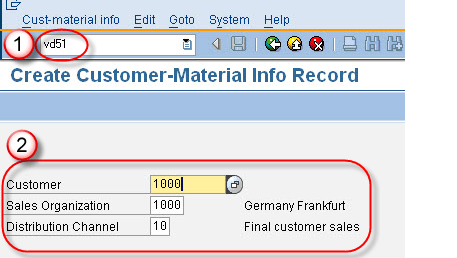
Press the Enter button, and the next screen will appear.
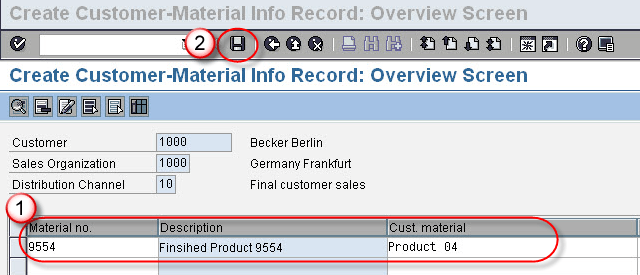
Step 2) Enter the information.
- Enter the material number and the customer material.
- Click on the Save button.
Step 3) Check the message.
A message “Customer-Material info was saved” is displayed.

Also Check:- Create Customer Master Data: SAP XD01
Key Fields in a Customer-Material Info Record
When you create the record in VD51, you maintain it for a specific customer and sales area. Beyond the basic mapping, several fields let you tailor how orders for that customer behave:
- Customer Material Number: The identifier the customer uses for the product; this is the core of the record.
- Material: Your internal material code that the customer number maps to.
- Plant: The default delivering plant for this customer and material.
- Delivery Priority: The priority applied when the order is processed and scheduled.
- Minimum Delivery Quantity: The smallest quantity allowed for a delivery of this item.
- Partial Delivery / Item Usage: Rules that control whether partial deliveries are allowed for the customer.
These fields are optional, so maintain only the ones your process needs and leave the rest blank to inherit standard behavior. The customer material number and your internal material are the essential pair, while the delivery-related fields are useful when a customer has special shipping requirements.
VD51, VD52, and VD53: Create, Change, and Display
SAP provides three transaction codes to manage the customer-material info record across its life cycle. Each one opens the same record in a different mode, which keeps changes controlled and traceable. Because all three point to the same underlying data, the record you create in VD51 is immediately available in VD52 and VD53, so choosing the right transaction is mainly about intent.
| T-Code | Action | When to use it |
|---|---|---|
| VD51 | Create | Set up a new customer-material info record |
| VD52 | Change | Update fields such as delivery data or the customer material number |
| VD53 | Display | View the record without making any changes |
As a rule, display the record first with VD53 to confirm the current values, and switch to VD52 only when an update is genuinely required. This habit prevents accidental changes to live customer data. In many projects, display access through VD53 is granted widely, while change access through VD52 is restricted to a smaller group of data owners.
