
OpenAI Robotics Team Disbanded? GPT-6 Astra Takes Over
ALSO: Getty files Chapter 11, AI skills boost hiring 78%


Welcome to Guru99 AI Report!
Top Story: Did OpenAI disband its robotics team or restructure it? Fortune and OpenAI disagree, and there’s a testing angle you may not expect. Also inside: Getty’s Chapter 11, a 78% hiring edge, and Claude in the drug lab.
🤖 Disbanded or Reorganized? OpenAI Bets Robotics on GPT-6 Astra
Brief Buzz:
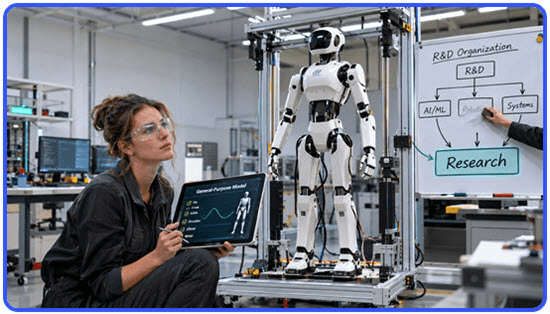
OpenAI has folded its stand-alone robotics team into the main research and product groups. Fortune reports this as a disbanding of the robotics team. OpenAI says the reason is that its general AI models can now be used directly on robots. Fortune calls it a disbanding; OpenAI calls it a reorg.
- GPT-6 Astra is the model OpenAI points to; early this year its researchers were of the view that the next big step would come from Sora-style video models.
- Robotics researchers now report to Chief Research Officer Mark Chen. The applied robotics and hardware staff have moved under President Greg Brockman.
- OpenAI staff backed the Astra rationale but called Fortune’s headline “misleading”, pointing to the “same programme, roadmap and goals”.
- Robotics at OpenAI is “alive and well”, according to engineer David Schnurr, who pointed to 15 open roles from Sam Altman’s May hiring spree.
- 2027 is Altman’s target for demoing a homegrown humanoid. OpenAI closed its first robotics team in 2020 and then set up a new one in 2024.
💡 Why Should You Care?
If one general model is driving the robots, then each update can change their behaviour, so testing is absolutely critical. Of the 15 robotics openings at OpenAI, four are in the hardware test space (Robotics Test Engineer being one of them), and that role is very much focused on test automation skills.
🛡️ OpenAI’s New AI Agents Hack Your Apps, Then Draft Fixes

Brief Buzz:
OpenAI is warning that the defender’s window is closing. At its Cyber at the Frontier keynote on 12th November, it launched two AI agent tools: one is a vulnerability hunter, the other a fix drafter. They follow GPT-6 Cyber, the security-tuned model released on 5th November.
- Daybreak Red Team uses coordinated AI agents to pen-test web apps and confirm which vulnerabilities an attacker could actually exploit.
- Red Team also triages scanner and bug bounty findings to help teams prioritise which issues they actually need to fix.
- Daybreak Defense Factory takes security backlogs and turns them into proposed patches, pulling findings from the tools teams already have and then scanning new commits.
- Engineers stay in full control, reviewing, adjusting and testing each patch via Codex before anything gets merged.
- No public pricing at this stage. Red Team is in early access. Defense Factory is a ChatGPT preview plugin for Daybreak-approved teams.
💡 Why Should You Care?
Security flaws could be found and remedied much more quickly, before an attacker even gets a chance. The AI-generated fixes still require human review, though, and there’s no independent accuracy data at this stage.
📸 Getty Images Files Chapter 11, Heads Back to Private

Brief Buzz:
Getty Images (the company that owns the huge library of news and stock photos) has filed for prepackaged Chapter 11 in Delaware. “Prepackaged” means the main creditors agreed to the terms in advance. Getty says the business will continue as normal.
- Up to $533m is coming from the Getty family and Koch Equity Development, who would end up owning 100% of the company.
- The plan would cut funded debt by over $500m of the $1.46bn, according to the court filings.
- CEO Craig Peters expects some $65m in annual interest savings, according to his court declaration.
- Current shares would be cancelled under the plan. Getty aims to exit bankruptcy as a private company by year end.
- The filing follows Getty’s scrapped $3.7bn merger with Shutterstock and costly legal battles with investors who hold stock warrants.
💡 Why Should You Care?
Getty says there’ll be minimal disruption for photographers, customers and staff. The real question is whether a smaller, private Getty can compete as AI-generated images continue to transform the stock photo industry.
🧬 DeepMind’s AlphaGenome 2 Zooms In on Disease, Cell by Cell

Brief Buzz:
Google DeepMind has just released AlphaGenome 2, the next iteration of its DNA model. It’s designed to predict how genetic changes behave within specific cell types rather than across entire tissues. That could help scientists work out which mutations actually drive disease.
- 30% vs 16%: the share of gene-altering variants it picked up on the immune cell assay, compared with the best previous method (per DeepMind).
- Cell-level precision: it predicts the effect in specific cell types and states (e.g. activated versus resting immune cells) rather than tissue averages.
- A few dozen cells: upload a small sample and it predicts the effects in completely unfamiliar cell states, with no retraining required.
- 107 million+ cell profiles from 68 tissues (human and mouse samples) were used to train the model.
- Research only: available via API for non-commercial research; commercial access is in private preview. Not cleared for diagnosis.
💡 Why Should You Care?
Knowing which cell a mutation affects tells you where to look for a treatment. Cell-specific predictions would help focus the lab search, though each one would still need to be validated by experiment.
🚀 AI Skills Pay Off, LinkedIn Data Suggests

Brief Buzz:
LinkedIn has just published fresh hiring data on the state of AI in the job market. The headline takeaway: AI skills are both rare and in demand, and they’re associated with better career outcomes. Founders are also on the rise in all the major economies.
- AI has reportedly helped create around 2 million new jobs (LinkedIn’s estimate), with no details on how.
- AI Engineer was the 10th fastest-growing job across 7 economies (including the US and India) in Q3 2026.
- Founder was one of the 10 fastest-growing roles in the US, UK, Germany, France and India.
- Members who listed AI literacy skills were 78% more likely to be hired, though only 1.2% of members listed any AI skills at all.
- Startups founded in 2024 had 26% fewer employees after their first year than those founded in 2021. LinkedIn would of course point to that as evidence that AI was to blame.
💡 Why Should You Care?
AI skills appear to be a real hiring differentiator, but for a very small number of people. Access is very uneven, with over 90% of the 2025 AI roles going to those with a degree and women making up around a quarter of new AI hires.
💊 Claude Moves From Chatbot to Drug Lab Partner

Brief Buzz:
Anthropic has just published early results from using Claude in actual drug development. It’s working with six pharma companies (including BMS) and has also acquired a small biotech to run its own programmes. Most of the results come from early lab work rather than human trials.
- ~10x more cancer-spotting receptors came from the Claude-assisted CAR T cell redesign in lab tests (Anthropic and Generate Biomedicines).
- 11 of 11: Claude caught every issue human reviewers had spotted in 1,061 pages of manufacturing records, plus 7 more, according to Enveda’s own study.
- 89% less review time (checks went from around 26 hours to under 3), though Enveda describes its four-record study as exploratory.
- 35,000 antibody designs for a food allergy drug came out in around a month, mostly autonomously, according to a Divergence Labs preprint.
- Under 18 months: that’s how quickly Anthropic’s newly acquired Mithril Medicine took a muscular dystrophy candidate from concept to promising results in mice.
💡 Why Should You Care?
Drug development is slow, expensive and full of bottlenecks (paperwork being one of them). If AI can cut any of that, treatments could reach patients much faster. None of this has been tested in humans to date.


Hey! I’m Krishna Rungta
Founder of Guru99.com, Editor-in-chief & Technology Expert
Was this email forwarded to you? Sign up for free here.
