
VBA Comparison Operators: Not equal, Less than or Equal to
 Editorial Team
⚡ Smart Summary
VBA Comparison Operators test one value against another and return True or False. This page defines the six operators, shows them inside an If statement, explains how text and dates are compared, and lists the mistakes that produce wrong results.
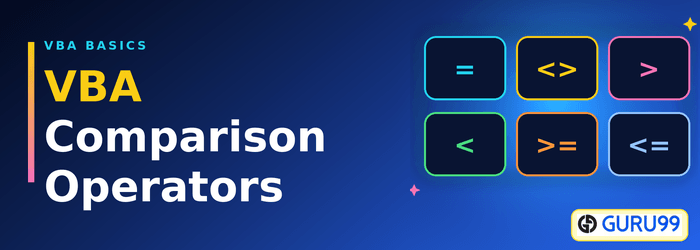
VBA Comparison Operators
These are operators that are used to compare values. Comparison operators include equal to, less than, greater than and not equal to.
Comparison operators are used to compare values for validation purposes. Let’s say you are developing a simple point of sale application. In this application, you want to validate the values entered before you post. In such cases, you can use comparison operators. This operator will check against the negative numbers or to ensure that the amount paid does not exceed the billed amount. Comparison operators come in handy in such situations.
Every comparison returns one of two values, True or False, and never a number. That result is what an If statement acts on.
The following table lists the comparison operators defined in VBA.
| Operator | Description |
|---|---|
| = | Equal: checks if two values are equal. It is also used as an assignment operator |
| < | Less than: checks if the value on the left is smaller than the value on the right |
| > | Greater than: checks if the value on the left is larger than the value on the right |
| <> | Not equal to: checks if two values are different from each other |
| <= | Less than or equal to: checks if the value on the left is smaller than or the same as the value on the right |
| >= | Greater than or equal to: checks if the value on the left is larger than or the same as the value on the right |
Seeing each operator applied to two variables makes the returned result easier to predict.
VBA Comparison Operators with Example
The following table shows Excel VBA Comparison Operators with examples and output.
| S/N | Operator | Example | Output |
|---|---|---|---|
| 1 | = | If x = z Then | Returns true if they are equal, else it returns false |
| 2 | < | If x < z Then | Returns true if x is less than z, else it returns false |
| 3 | > | If x > z Then | Returns true if x is greater than z, else it returns false |
| 4 | <> | If x <> z Then | Returns true if they are not equal, else it returns false |
| 5 | <= | If x <= z Then | Returns true if x is less than or equal to z, else it returns false |
| 6 | >= | If x >= z Then | Returns true if x is greater than or equal to z, else it returns false |
Example source code
Equal Comparison Operator
If 2 = 1 Then
    MsgBox "True", vbOKOnly, "Equal Operator"
Else
    MsgBox "False", vbOKOnly, "Equal Operator"
End If
HERE,
- “If 2 = 1 Then… Else… End If” uses the if statement to evaluate the condition “2 = 1”
- “MsgBox…” Is a built-in function that displays a message box.
- The first parameter “True” or “False” is what will be displayed in the message box. In our example, 2 is not equal to 1, therefore, it will show “false” in the msg box.
- The second parameter “vbOKOnly” is the button that is displayed in the message box
- The third parameter “Equal Operator” is the title of the message box.
Executing the above code gives the following results

That single test is the simplest form. Real macros combine comparisons and branch between several outcomes.
How to Use Comparison Operators in an If Statement
A comparison operator is rarely useful on its own. Its True or False result is fed to a decision structure, and the If statement is the one you will use most. The example below grades a score held in cell A1 and writes the outcome next to it.
Sub GradeScore()
    Dim Score As Long

    Score = Sheet1.Range("A1").Value

    If Score >= 90 Then
        Sheet1.Range("B1").Value = "Distinction"
    ElseIf Score >= 50 Then
        Sheet1.Range("B1").Value = "Pass"
    ElseIf Score < 0 Then
        MsgBox "A score cannot be negative", vbCritical, "Invalid Entry"
    Else
        Sheet1.Range("B1").Value = "Fail"
    End If
End Sub
The macro reads the score once, then tests it against three conditions in order. Four points explain why it behaves the way it does.
- Order matters: VBA stops at the first branch that returns True. Placing Score >= 50 before Score >= 90 would label every high score as a pass.
- Else is the catch-all: Any value that fails every earlier test falls through to Else, so no input is left unhandled.
- No chaining: VBA cannot read 0 <= Score <= 100. Write If Score >= 0 And Score <= 100 Then using the logical operators instead.
- Same test, other structures: The identical condition drives Do While and Select Case, so the operators transfer to every loop you write.
💡 Tip: Declare the variable with a numeric type, as shown with Dim Score As Long. If the value stays a Variant holding text, “9” > “10” returns True because the comparison is done character by character.
Comparing Text and Dates in VBA
Numbers compare exactly as arithmetic suggests, but text and dates follow their own rules, and both surprise beginners.
Strings are compared one character at a time using their sort position, so “Apple” < “Banana” returns True. By default the comparison is case sensitive, which means “guru99” = “Guru99” returns False. Placing Option Compare Text at the top of the module makes every string comparison in that module ignore case. For a single test without changing the module, use StrComp with the vbTextCompare argument.
Dates are stored as serial numbers counted from 30 December 1899, so they compare directly with the same six operators. Writing If DueDate < Date Then correctly detects an overdue item, because Date returns the current system date as the same kind of serial number. The one trap is a date held as text: “01/02/2026” read from an imported file is a string, not a date, and compares alphabetically. Convert it with CDate before testing it.
Knowing the rules for each type removes most surprises, but a few errors still catch experienced developers.
Common Mistakes When Comparing Values in VBA
The five problems below account for most comparisons that return an unexpected result.
- Assignment mistaken for comparison: Outside a condition, x = 5 stores 5 in x. Inside If, the same symbols test equality. VBA has no separate == operator, so read the context carefully.
- Testing Double values for exact equality: Stored precision means 0.1 + 0.2 = 0.3 returns False. Compare the rounded difference instead, for example If Abs(a – b) < 0.000001 Then.
- Comparing anything with Null: Null is not equal to anything, not even another Null. Test with IsNull rather than = Null.
- Comparing text against a number: A cell holding “100” as text is not equal to the number 100. Convert with CLng or CDbl before the test.
- Reading .Text instead of .Value: The .Text property returns what is displayed, which is truncated by column width and formatting. Always compare .Value.
