
10 Best Free Secure Email Services Providers (2026)
 Editorial Team
Disclosure: Guru99 is reader-supported. We may earn a commission when you buy through links on this page. Learn more

Secure email services can still deliver weak privacy, unreliable filtering, cramped storage, confusing encryption controls, hidden trial limits, and inconsistent recipient access. Those problems lead to missed messages, exposed details, failed replies, or an unexpected bill. Important distinctions between TLS, end-to-end encryption, and ordinary account security often remain buried. A careful comparison clarifies what each service protects, where its free access ends, and how to choose an inbox that brings confidence, control, and forward progress.
I spent 57+ hours researching 25+ email tools, checking encryption, free access, storage, authentication, recipient workflows, protocols, privacy policies, and recurring user concerns. My in-depth research shortlisted 10 Best Free Secure Email Services Providers options. This backed-by-research guide compares firsthand evaluation, features, pros and cons, and plan limits, helping readers continue today with clearer expectations. Read more…

Zoho Mail is a secure email hosting service provider. It easy to manage group aliases, add users, and set up policies to moderate email content. It is one of the most top-rated tools for business email.
Best Free Encrypted Email Service Providers: Most Secure!
| Email Providers | Storage Space | Two-Factor Authentication | Email Alias | Free Trial | Link |
|---|---|---|---|---|---|
👍 Zoho Mail |
100 GB storage | Yes | Yes | 15-Day Free Trial | Learn More |
 ProtonMail |
500 MB Free Storage | Yes | Yes | Lifetime Free Basic Plan | Learn More |
 Gmail |
30 GB Storage | Yes | Yes | 14-Day Free Trial | Learn More |
 SecureMyEmail |
Existing inbox | Yes | No | 30-Day Free Trial | Learn More |
 SMTP |
Unlimited Emails | Yes | Yes | 30-Days Free Trial | Learn More |
 Campaign Monitor |
Unlimited Emails | Yes | Yes | 30-Day Free Trial | Learn More |
 HubSpot |
2 GB Storage | Yes | Yes | Lifetime Free Basic Plan | Learn More |
1) Zoho Mail
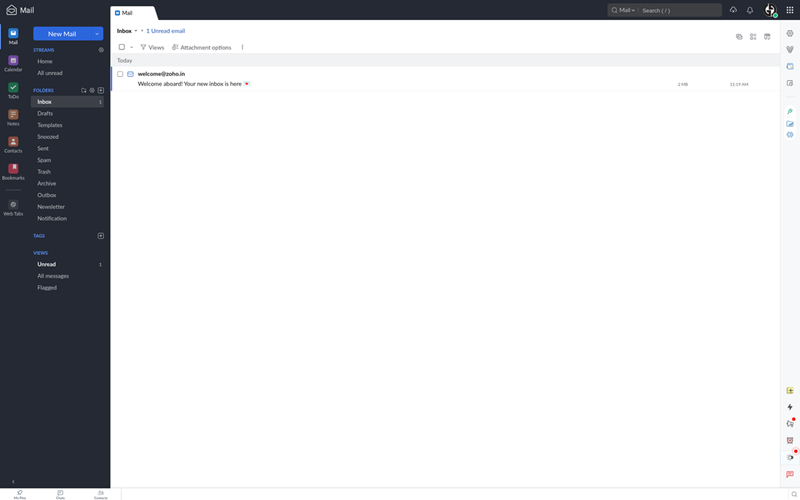
Zoho Mail gives eligible small teams ad-free email on one custom domain. Its regional free plan supports five users with 5 GB each, while the admin console manages addresses, aliases, policies, authentication, and recovery from one place.
TLS and AES-256 protect messages in transit and at rest. OpenPGP, S/MIME, and SecurePass add stronger options, although availability varies by paid plan. The free tier also omits IMAP, POP, and ActiveSync, so it works best for teams comfortable with Zoho webmail and mobile applications daily now.
Features:
- Custom Domain: Eligible free accounts host one owned domain for five users, giving small teams consistent company addresses without an immediate mailbox subscription.
- Admin Console: Administrators create accounts, aliases, groups, policies, and recovery settings from one console instead of maintaining a separate business mail server.
- SecurePass: SecurePass can send protected messages with access limits, expiry controls, and revocation when ordinary email delivery offers insufficient recipient control.
- Mail Encryption: Zoho applies TLS 1.2 or 1.3 in transit and AES-256 at rest, with OpenPGP and S/MIME available under applicable plans.
- Mobile Apps: Android and iOS applications provide mail, calendar, contacts, notifications, and offline access when employees work away from a desktop browser.
- Domain Security: SPF, DKIM, and DMARC guidance helps administrators authenticate outgoing mail, reduce spoofing, and improve delivery across major receiving providers worldwide.
- Protocol Limits: The free tier excludes IMAP, POP, and ActiveSync, so common third-party desktop clients require a paid plan or another provider.
Pros
Cons
How to Get It Free?
- Open Zoho Mail through the tracked link, create an administrator account, and select the free plan when it appears for your region. Save recovery details before continuing.
- Add a domain you own, publish the displayed verification record, and wait for confirmation. Then create up to five users with clear recovery and administrator roles.
- Publish SPF, DKIM, and DMARC records, enable multifactor authentication, and test delivery with several outside providers before moving customer conversations or public contact addresses.
Free plan: 5 users with 5 GB each
2) Proton Mail
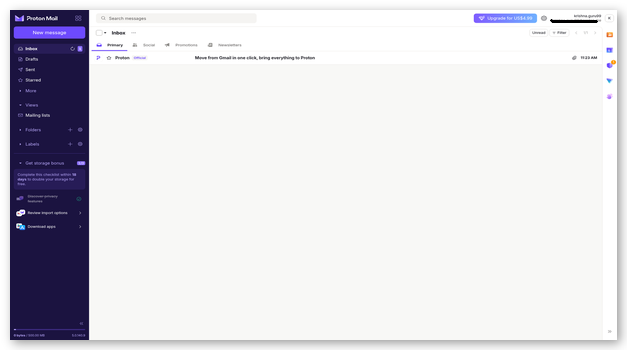
Proton Mail provides an ad-free personal inbox with end-to-end encryption between compatible users and zero-access encryption for stored messages. The free plan starts with 500 MB and can reach 1 GB after completing the listed account actions.
Free users receive one address, 150 messages daily, 25 MB attachments, and password-protected mail for outside recipients. Custom domains and Proton Mail Bridge require payment. This trade-off suits privacy-focused users who accept modest storage and browser or Proton application access instead of ordinary third-party desktop-client protocols for email.
Features:
- Encrypted Inbox: End-to-end encryption protects compatible conversations, while zero-access encryption prevents routine provider access to message contents stored on secure Proton servers.
- Secure Links: Password-protected messages can reach outside recipients through an encrypted web view when their existing provider does not support compatible encryption.
- Free Storage: The free account begins with 500 MB and can unlock 1 GB after completing Proton onboarding actions within the stated period.
- Alias Protection: Ten hide-my-email aliases help users separate registrations from their main address and disable exposed aliases after spam or unwanted contact.
- Open Apps: Web, desktop, Android, and iOS applications keep encrypted mail accessible across common devices without advertisements displayed inside the daily inbox.
- Daily Limit: Free accounts can send up to 150 messages daily, which suits personal communication but may constrain outreach or high-volume business workflows.
- Bridge Access: Proton Mail Bridge connects supported desktop clients through IMAP and SMTP, but the feature requires an eligible paid account subscription.
Pros
Cons
How to Get It Free?
- Open Proton Mail through the tracked link, choose the permanent free account, create a strong password, and save the recovery method in a secure location.
- Complete the displayed onboarding checklist within its deadline to expand storage from 500 MB to 1 GB. Confirm the larger quota before importing older mail.
- Enable two-factor authentication, test a password-protected message with an outside recipient, and review the 150-message daily limit before relying on the account for work.
Free plan: 500 MB, unlockable to 1 GB
3) Gmail
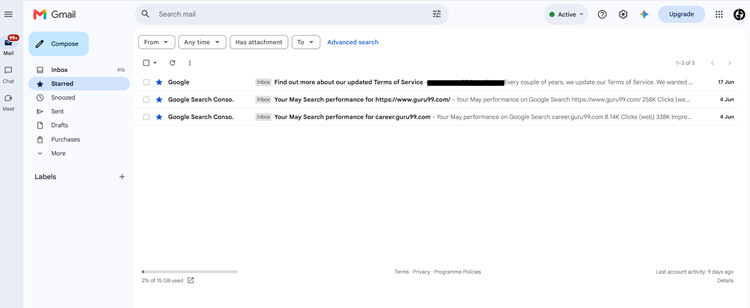
Gmail combines a familiar interface with search, labels, spam filtering, and 15 GB shared across Gmail, Drive, and Photos. Every Gmail account uses TLS automatically when the receiving service supports it, protecting messages during transit.
Free consumer Gmail does not provide native end-to-end encryption or custom-domain hosting. Work and school editions may add S/MIME or client-side encryption under eligible configurations. Google Workspace offers a 14-day business trial, but billing details are required. Gmail fits users prioritizing convenience and ecosystem integration over provider-blind mailbox encryption.
Features:
- TLS Protection: Gmail automatically uses TLS for all accounts when the recipient service supports it, reducing interception and tampering during message transport.
- Spam Filtering: Automated filters identify common phishing, malware, and junk messages before they reach the inbox, although users must still inspect suspicious requests.
- Fast Search: Operators, labels, dates, senders, and attachment types help users locate older conversations without maintaining complex nested folder hierarchies over time.
- Shared Storage: A free Google account includes 15 GB shared among Gmail, Drive, and Photos, so files elsewhere reduce available mailbox space.
- Mobile Apps: Android and iOS applications provide offline reading, multiple accounts, notifications, calendar access, and integrated meeting tools for everyday mobile work.
- Advanced Encryption: Eligible work or school accounts can support S/MIME or client-side encryption, while ordinary free consumer Gmail relies on standard protections.
- Workspace Trial: Google Workspace provides a 14-day business trial with custom-domain email and administration for up to ten users after billing setup.
Pros
Cons
How to Get It Free?
- Create a free Google account, add a recovery email or phone number, and review the 15 GB shared storage allowance before importing large attachments.
- Run the Security Checkup, enable two-step verification or a passkey, inspect active sessions, and remove unnecessary third-party access before daily use.
- Send test messages to several outside providers and inspect the security indicator. Start Workspace only if custom-domain mail is worth the paid renewal after 14 days.
Free personal account / 14-day Workspace trial
4) SecureMyEmail
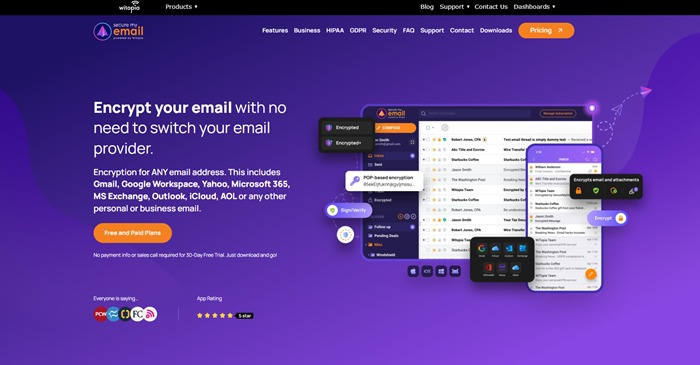
SecureMyEmail adds end-to-end and zero-knowledge encryption to an existing IMAP mailbox instead of replacing the provider. One eligible Gmail.com, Yahoo.com, or Microsoft consumer address can remain free, while paid plans cover additional addresses.
Encryption happens on the user device, and recipients can open protected messages without creating an account or installing software. Applications support Windows, macOS, Android, and iOS. POP mailboxes are unsupported, and the service adds no storage. It suits users who want stronger email privacy while keeping a familiar existing address.
Features:
- Existing Address: SecureMyEmail adds encryption to supported IMAP accounts, letting users keep an established address instead of migrating contacts to another mailbox provider.
- Device Encryption: Messages are encrypted on the sender device before transmission, supporting a zero-knowledge design that limits server access to readable content.
- Outside Recipients: Recipients can open encrypted mail without creating a SecureMyEmail account, installing software, or remembering a separate secure message access password.
- User Keys: Users retain control of their OpenPGP keys, reducing dependence on a provider-held decryption key for protected conversations and file attachments.
- Cross-Platform Apps: Applications for Windows, macOS, Android, and iOS provide encrypted sending and reading across common personal and professional workplace devices securely.
- Free Address: One eligible Gmail.com, Yahoo.com, or Microsoft consumer address can use the service free, while business and additional addresses require payment.
- IMAP Requirement: The service needs an IMAP-compatible mailbox and does not support POP accounts, which limits compatibility with older or restricted providers.
Pros
Cons
How to Get It Free?
- Open SecureMyEmail through the tracked link and register one eligible Gmail.com, Yahoo.com, or Microsoft consumer address for the permanent single-account free option.
- Install the application on a supported device, connect the IMAP mailbox, and store the recovery details or private-key backup outside the email account.
- Send one protected message to an outside recipient, confirm account-free opening and reply behavior, then verify ordinary unencrypted mail still works as expected.
One address free / 30-day paid trial
5) SMTP.com
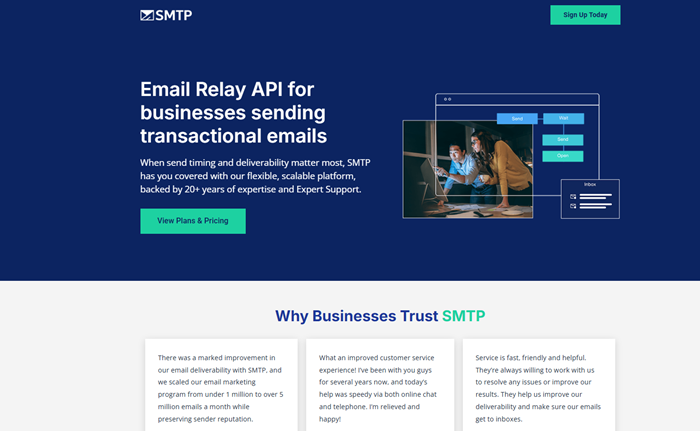
SMTP.com is an email delivery service for applications, websites, receipts, alerts, and other transactional messages. It supplies SMTP relay and API connections, authentication guidance, reporting, and delivery infrastructure rather than an inbox employees read each day.
The service should not be compared with a free personal mailbox or end-to-end encrypted provider. A permanent free plan was not confirmed, and promotional trial terms can vary by landing page. Teams should verify the current allowance, payment requirement, sending limits, and renewal price before entering production credentials.
Features:
- SMTP Relay: Applications and websites send transactional messages through authenticated relay credentials instead of operating and maintaining their own outbound mail server.
- REST API: Developers can connect software through an API when direct application integration offers better control than traditional SMTP credentials and ports.
- Delivery Reports: Dashboards and logs help operators inspect accepted mail, bounces, complaints, and delivery patterns while diagnosing recurring application email messaging failures.
- Domain Authentication: SPF, DKIM, and DMARC configuration helps authenticate sending domains, protect reputation, and reduce spoofing across major receiving email providers globally.
- IP Options: Plan-dependent shared or dedicated IP arrangements let higher-volume senders choose isolation, although reputation still depends on responsible, consistent sending practices.
- TLS Transport: TLS can protect messages during transport between compatible systems, but it does not create provider-blind end-to-end encryption for message contents.
- No Inbox: SMTP.com does not replace employee mailboxes, personal webmail, calendars, or stored conversations, so organizations need another service for replies.
Pros
Cons
How to Get It Free?
- Open the tracked SMTP.com page and inspect the current evaluation offer. Confirm its duration, message allowance, payment requirement, renewal price, and cancellation method before registering.
- Create a separate test sending domain, publish the displayed SPF and DKIM records, and keep production credentials outside the trial until authentication passes.
- Connect one staging application, send low-volume tests to several mailbox providers, inspect delivery and bounce logs, then cancel before renewal if the service is unsuitable.
Current trial terms vary
6) Campaign Monitor
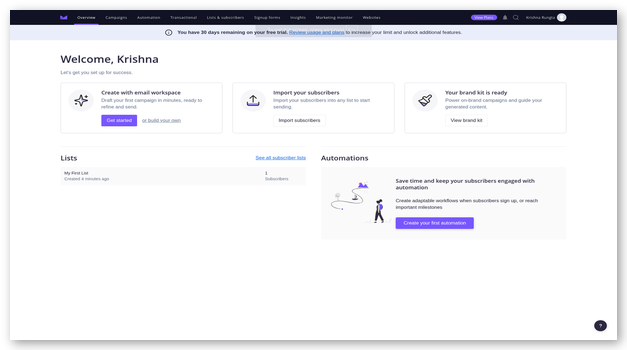
Campaign Monitor is a marketing email platform, not a private employee inbox. It builds subscriber campaigns with templates, segmentation, journeys, testing, analytics, and unsubscribe controls. Free test sends can reach five recipients, with a daily cap on unique test recipients.
A current 30-day trial lists a 500-email limit, although paid access is required for larger campaign delivery. Domain authentication and two-factor security help protect accounts and sender identity. The service suits teams evaluating campaign creation, but it does not replace secure conversational mail or provide end-to-end message encryption.
Features:
- Campaign Builder: A visual editor combines templates, branded content, buttons, images, and responsive layouts without requiring every campaign marketer to write HTML.
- Segmentation: Audience filters organize subscribers by profile and behavior, helping teams send more relevant campaigns instead of identical messages to every contact.
- Customer Journeys: Automation can send scheduled sequences after selected triggers, supporting onboarding, reminders, and follow-up messages without repeated manual email campaign launches.
- Campaign Analytics: Reports track opens, clicks, bounces, unsubscribes, and delivery activity so marketers can compare campaign results and diagnose subscriber list-quality problems.
- A/B Testing: Teams can compare selected subject lines or campaign variations before using the stronger option for a larger targeted audience segment.
- Domain Authentication: Sender-domain authentication helps receiving services verify campaigns and reduces the risk of spoofed email messages using an organization brand name.
- AI Assistance: AI writing features can suggest or revise campaign copy, but marketers must check accuracy, privacy, tone, and regulatory requirements before sending.
Pros
Cons
How to Get It Free?
- Create a Campaign Monitor account through the tracked link and confirm whether the current 30-day, 500-email trial appears before adding billing information or importing contacts.
- Build a small campaign with test content, authenticate a controlled sending domain, and send previews to no more than five internal recipients for free review.
- Check layout, links, unsubscribe behavior, and authentication across devices. Export any useful assets and cancel before renewal if paid campaign sending is unnecessary.
30-day trial with 500-email limit
7) Mailfence
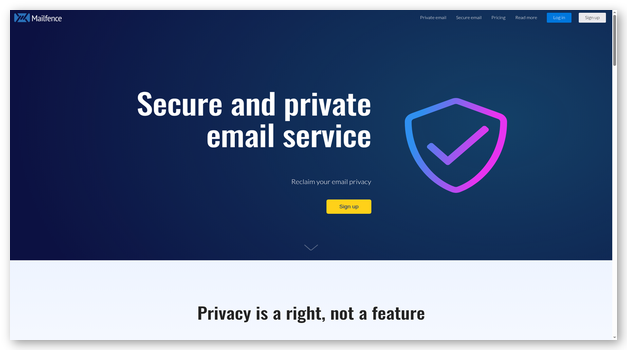
Mailfence combines a private mailbox with integrated OpenPGP encryption, digital signatures, calendars, contacts, groups, and document storage. Its permanent free plan provides 500 MB for email and 500 MB for documents without requiring a payment card.
Free accounts carry strict sending limits and omit IMAP, POP, SMTP, custom domains, and ActiveSync. They can also be suspended after prolonged inactivity under the published policy. Mailfence suits light personal use and OpenPGP learners who accept browser or mobile-app access, modest storage, and regular account sign-ins each year.
Features:
- OpenPGP Mail: Integrated OpenPGP tools encrypt compatible messages and attachments, while digital signatures help recipients confirm sender identity and complete message integrity.
- Free Storage: The permanent free plan includes 500 MB for email and another 500 MB for documents, calendars, contacts, and related account data.
- Productivity Suite: Calendars, contacts, groups, and document storage sit beside the mailbox, reducing the need for separate lightweight personal collaboration software services.
- Two-Factor Security: Two-factor authentication adds a second sign-in requirement, reducing account takeover risk when a password is stolen, exposed, or reused elsewhere.
- Mobile Access: Mobile applications and browser access keep mail available on common devices, while standard third-party protocols remain restricted on the free plan.
- Sending Limits: Free users face hourly, per-message, and daily recipient restrictions, making the plan unsuitable for outreach or other sustained high-volume communication.
- Inactivity Policy: A free account may be suspended after seven months without sign-in and deleted five months later, so occasional access remains important.
Pros
Cons
How to Get It Free?
- Create a Mailfence free account through the tracked link, record recovery information, and confirm the separate 500 MB allowances for email and documents.
- Enable two-factor authentication, generate or import an OpenPGP key, and store a protected backup outside the mailbox before encrypting important conversations.
- Test encrypted and ordinary messages with trusted contacts, review the sending limits, and sign in regularly so the published inactivity policy does not affect the account.
Free plan: 500 MB mail and 500 MB documents
8) Startmail
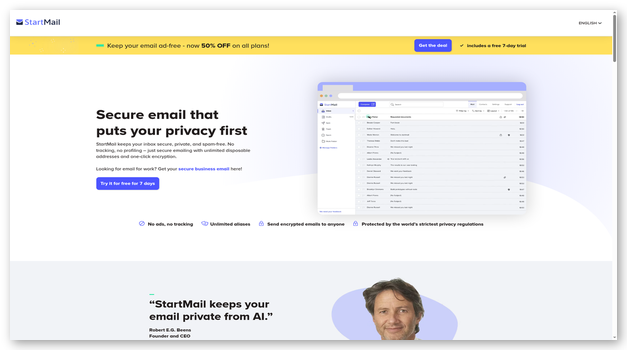
StartMail is a paid privacy-focused mailbox with 20 GB on Personal accounts and 30 GB on Business accounts. It offers unlimited aliases, no advertising, tracker blocking, IMAP access, and one-click password or PGP encryption for sensitive messages.
There is no permanent free plan. The seven-day trial requires payment details and includes full trial features, so users should record the renewal date before importing mail. POP3 is unsupported, and the service relies on web access or compatible IMAP clients rather than a broad suite of native applications.
Features:
- Unlimited Aliases: Users create disposable or purpose-specific aliases that forward into one inbox, helping isolate registrations and disable exposed addresses after unwanted mail.
- Private Inbox: StartMail avoids advertising and tracking-based inbox profiling, supporting users who prefer a private subscription-funded service instead of an ad-funded account.
- Message Encryption: One-click password protection and PGP options help secure sensitive messages and attachments, including conversations with recipients using another email provider.
- Tracker Blocking: Privacy controls can block common tracking pixels, reducing outside sender visibility into message opens, device details, and other engagement signals.
- IMAP Access: Paid accounts work with compatible IMAP clients, letting users keep familiar desktop or mobile applications instead of relying only on webmail.
- Mailbox Storage: Personal plans include 20 GB and Business plans include 30 GB, providing more room than many permanent free privacy mailboxes.
- No POP3: POP3 is not supported, so users with older download-only workflows must switch to IMAP or browser access during mailbox migration.
Pros
Cons
How to Get It Free?
- Open StartMail through the tracked link, choose Personal or Business, and begin the seven-day trial. Record the renewal date before entering payment details.
- Create test aliases, enable tracker protection, and send password-protected mail to an outside account without importing the entire existing mailbox.
- Test webmail and one preferred IMAP client, export anything important, then cancel before renewal if the privacy controls do not justify the subscription.
7-day free trial
9) Hushmail
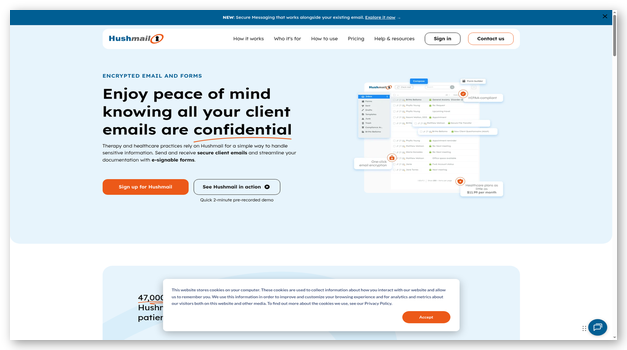
Hushmail combines encrypted email with healthcare-focused plans, Business Associate Agreements, secure forms, and plan-dependent electronic signatures. Healthcare Basic starts with encrypted mail and 10 GB storage, while higher tiers add forms, scheduling, templates, and larger allowances.
A 14-day Hushmail for Healthcare trial is available, but no permanent free mailbox was confirmed. Recipients can open protected messages with supported identity accounts, and teams may use Hushmail alongside existing email. The strongest compliance value is tied to paid healthcare plans, not an unrestricted consumer free tier today.
Features:
- Encrypted Mail: Users send and receive encrypted messages and attachments, while recipients can open protected content through supported secure identity authentication methods.
- Healthcare BAA: Eligible healthcare plans include a Business Associate Agreement, helping covered organizations document important legal responsibilities when handling protected health information.
- Secure Forms: Higher plans collect confidential information through hosted forms, keeping submissions alongside protected communication instead of ordinary unsecured public web forms.
- E-Signatures: Selected plans add electronic signatures and activity records for forms, supporting consent, intake, and other approval workflows within one service.
- Mailbox Storage: Healthcare Basic lists 10 GB per account, while higher plan levels provide additional storage capacity and more secure workflow features.
- Client Access: Webmail works on desktop and mobile, and compatible email applications can connect under supported paid subscription plan and account configurations.
- Security Controls: Two-step verification protects accounts, while higher administrative options can require stronger access rules across every user under a managed domain.
Pros
Cons
How to Get It Free?
- Open Hushmail and choose an eligible Healthcare plan offering the 14-day trial. Confirm the selected tier, storage, forms, billing, and renewal terms first.
- Create a test address, enable two-step verification, and send an encrypted message to an outside recipient using no real patient or client information.
- Evaluate forms, signatures, client access, and administrative controls included in that tier. Export test material and cancel before renewal if the service is unsuitable.
14-day healthcare trial
10) Outlook
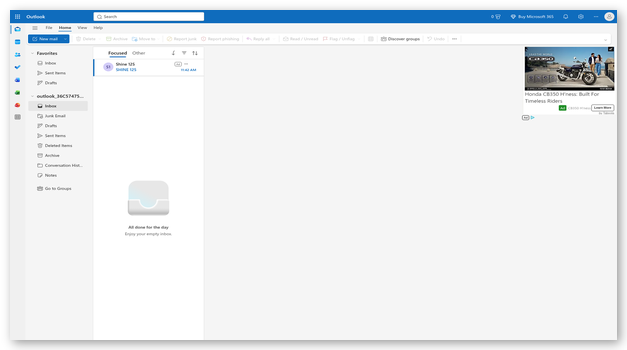
Outlook.com provides a free personal mailbox with 15 GB of email storage, 5 GB of cloud storage, calendar, contacts, web access, and mobile applications. Microsoft applies transport security, spam filtering, malware detection, and account protection across the service.
The free account does not host a company domain or provide provider-blind end-to-end encryption. Microsoft 365 business plans add custom email, administration, identity controls, and a 30-day trial under applicable terms. Outlook suits users already working with Windows and Microsoft applications who value integration over privacy-first encryption.
Features:
- Free Mailbox: A free personal account provides 15 GB for email plus 5 GB of separate cloud storage for files and attachments.
- Security Filtering: Microsoft filters common spam, phishing, and malware, although users still need to inspect unexpected attachments, payment requests, and sign-in prompts.
- Calendar Tools: Integrated calendars, contacts, tasks, and meeting invitations keep daily communication and scheduling within one unified account across all supported devices.
- Mobile Access: Outlook applications on Android and iOS combine email, calendars, search, notifications, and multiple accounts for convenient mobile work every day.
- Transport Security: TLS protects messages in transit when the receiving system supports compatible encryption, but it is not complete end-to-end content encryption.
- Business Trial: Eligible Microsoft 365 business plans provide a 30-day trial with custom-domain mail, administration, identity controls, and connected workplace collaboration applications.
- Ecosystem Links: Outlook connects with OneDrive, Office applications, Teams, and Windows, reducing application switching for users already committed to Microsoft services and workflows.
Pros
Cons
How to Get It Free?
- Create a free Microsoft account, choose an Outlook.com address, and add recovery information. Review the separate 15 GB email and 5 GB cloud allowances.
- Enable two-step verification or a passkey, inspect recent sign-ins, and send security tests to outside providers before moving important conversations.
- Use Microsoft 365 only when custom-domain email is necessary. Record the 30-day trial renewal date and export messages before cancellation if payment is unwanted.
Free personal account / 30-day Microsoft 365 trial
Feature Comparison Table: Top Secure Email Services Providers
What Is a Secure Email Service?
A secure email service protects accounts, stored messages, or message delivery beyond ordinary password access. Features may include multifactor authentication, encrypted storage, transport encryption, end-to-end encryption, aliases, tracking protection, and safe recovery. These protections are not identical. TLS secures mail during transfer, while end-to-end encryption limits who can read the content. Some products host complete mailboxes, while others add encryption to an existing account. Readers should identify their threat model before choosing a provider or enabling sensitive workflows for users.
How Does End-to-End Email Encryption Work?
End-to-end encryption turns a message into unreadable data on the sender side and restores it only for the intended recipient. The provider should not hold the only key that can reveal the content. Compatible users may exchange keys automatically, while outside recipients often open a protected web page or enter a password. Encryption does not hide every detail. Providers may still process metadata, account activity, and delivery information. Recovery settings also matter because losing private keys can make protected messages permanently unreadable.
Is TLS Encryption Enough for Everyday Email?
TLS is valuable because it protects email while servers exchange it, reducing interception and tampering during transport. It is widely supported and should remain enabled. However, TLS usually ends when a message reaches the provider, so the provider may still access stored content. It also depends on both sending and receiving systems supporting secure transport. TLS is suitable for ordinary communication, but highly sensitive records may need end-to-end encryption, access expiry, recipient authentication, or a regulated workflow with documented administrative controls.
What Features Should You Check Before Choosing Secure Email?
Review these areas before moving important email accounts.
- Encryption Scope: Confirm whether protection covers transit, stored mail, subject lines, attachments, and messages sent to outside providers.
- Account Security: Look for multifactor authentication, passkeys, session controls, recovery options, login alerts, and administrator enforcement.
- Free Limits: Review storage, daily sending, recipient counts, inactivity rules, aliases, domains, protocols, and trial renewal conditions.
- Recipient Experience: Test whether outside contacts need an account, password, application, identity login, or expiring secure link.
- Data Portability: Verify message export, key backup, forwarding, migration, cancellation, and domain transfer before publishing a new address.
Are Free Secure Email Services Safe for Sensitive Information?
Yes, some free services provide meaningful encryption and strong account security. Safety still depends on configuration, recipient behavior, recovery practices, device protection, and the provider plan. A free tier may remove custom domains, desktop protocols, administrator controls, or compliance agreements. Users should enable multifactor authentication, protect recovery codes, update devices, and verify recipients before sending highly sensitive personal content. Medical, legal, financial, or regulated records may require a paid plan, written agreement, retention policy, audit controls, or professional compliance review.
Can You Use a Custom Domain with Free Secure Email?
Yes, but permanent free custom-domain hosting is uncommon and may be limited by region. The organization must own the domain and control its DNS records. The provider then requests verification before creating mailboxes. SPF, DKIM, and DMARC should follow to protect sender identity and delivery. Some privacy services reserve custom domains for paid plans, while encryption add-ons may protect an existing custom-domain IMAP account. Always separate domain compatibility from mailbox hosting because those are different capabilities and recurring service costs.
How Can You Move to a Secure Email Provider Safely?
A measured migration preserves mail, keys, contacts, and replies.
- Inventory: Record every mailbox, alias, group, application sender, forwarding rule, archive, protocol, and recovery method.
- Prepare: Verify the domain, configure authentication, back up encryption keys, and test recovery before changing mail delivery.
- Pilot: Move one low-risk account and test old mail, outside recipients, mobile access, exports, and encrypted replies.
- Migrate: Transfer remaining accounts in batches while keeping the former provider active during delivery and recovery checks.
- Confirm: Test incoming and outgoing mail, update applications, preserve exports, then cancel only after every address works.
How Can AI Improve Secure Email Workflows?
AI can summarize long threads, suggest replies, classify messages, flag suspicious patterns, and help users search large inboxes. These functions may save time, but they introduce another data-processing layer. Administrators should check whether message content reaches external models, how long prompts remain stored, and whether organizational data trains future systems. Sensitive contracts, health details, payment instructions, and credentials deserve extra caution. Human review remains necessary because generated text can misunderstand context, invent facts, or send confidential information to the wrong recipient.
How Do We Select the Best Free Secure Email Services Providers?

Guru99 reviews current plans, official documentation, security design, and recurring user feedback to separate permanent free mailboxes from trials, encryption add-ons, marketing platforms, and delivery infrastructure accurately.
- Free Access: We verify whether access remains free, requires payment details, converts after a deadline, or applies only to one address. Our team records storage, sending, recipient, region, and inactivity limits.
- Encryption Scope: Our team distinguishes TLS, encrypted storage, OpenPGP, password-protected links, and true end-to-end workflows. The researchers check whether subject lines, attachments, outside recipients, and provider access receive the same protection.
- Account Protection: The researchers review multifactor authentication, passkeys, recovery, session controls, spam filtering, malware checks, aliases, and tracker blocking. The team also notes when stronger controls require a paid plan.
- Daily Usability: The team examines webmail, mobile applications, desktop access, search, calendars, contacts, notifications, and recipient steps. Our testers consider whether beginners can send and recover protected messages without confusing setup.
- Domain Controls: Our testers compare custom domains, SPF, DKIM, DMARC, administration, APIs, aliases, and migration tools. Our experts separate mailbox hosting from services that only encrypt, market, or relay messages.
- Privacy and Compliance: Our experts review provider jurisdiction, data handling, encryption keys, audit options, retention, and available agreements. The experts avoid treating general security claims as automatic proof of HIPAA, GDPR, or industry compliance.
- Evidence Quality: The experts prioritize current official pricing, plan tables, help pages, and security documents, then compare recurring professional and user feedback. Unverified promotions, isolated complaints, and unsupported numbers never become factual recommendations or public promises.
How Can You Troubleshoot Common Secure Email Problems?
Secure email failures often involve authentication, encryption keys, DNS, recipient access, storage, or client compatibility. Preserve working settings and exports while checking each cause carefully.
Issue: An outside recipient cannot open an encrypted message after receiving the secure notification.
Solution: The sender should verify the recipient address, identity method, expiry time, password channel, browser support, and resend policy.
Issue: A desktop application rejects credentials although the secure web inbox still opens normally.
Solution: The user should confirm plan-level IMAP access, modern authentication, application passwords, supported ports, and encryption requirements.
Issue: Messages started reaching spam after the organization changed its domain or email provider.
Solution: The administrator should inspect SPF, DKIM, DMARC, MX records, list quality, sending reputation, and recent volume changes.
Issue: Encrypted mail became unreadable after a device reset or account recovery attempt.
Solution: The user should restore the correct private-key backup and avoid generating replacement keys before preserving existing encrypted records.
Issue: A free mailbox stopped sending because storage or daily recipient limits were reached.
Solution: The user should remove safe-to-delete files, export older messages, wait for limit reset, or compare an appropriate paid tier.
Issue: The trial renewed before the team completed security testing and migration planning.
Solution: The account owner should preserve cancellation evidence, contact billing support, export messages, and review refund terms without deleting active accounts.
What Happens When a Free Secure Email Account Becomes Inactive?
Inactive-account rules vary. A provider may suspend sign-in, remove stored mail, reclaim an address, or restrict recovery after warning periods. Trial accounts may stop working or convert to paid service when billing begins. Keep recovery details current and sign in regularly. Export important messages, contacts, encryption keys, and calendars before deadlines. Owning a custom domain improves portability because the public address can move elsewhere, but the old provider may still hold archives that require separate export and deletion steps later.
What Future Trends Will Shape Secure Email Services?
Secure email will adopt more passkeys, automatic phishing detection, encrypted search, privacy-preserving AI, and stronger sender authentication. Providers will face pressure to explain model training, metadata use, recovery access, and lawful requests more clearly. Client-side encryption may become easier for ordinary teams, while receiving systems reject poorly authenticated domains more aggressively. Buyers should still favor portable formats, exportable keys, clear retention, open standards, and understandable account recovery. New features matter only when users can verify protection and recover their own records.
Verdict
After comparing encryption, free access, storage, recipient workflows, and account controls, I found these three services addressed distinct needs more convincingly than the rest.
- Zoho Mail: I preferred its eligible five-user custom-domain plan, central administration, and SecurePass controls for small teams comfortable with Zoho applications.
- Proton Mail: Its end-to-end encryption, private storage, secure outside-recipient links, and ad-free applications stood out for personal communication.
- Gmail: I valued its search, spam filtering, device coverage, and familiar interface for users who prioritize convenience over provider-blind encryption.
FAQs
Zoho Mail is a secure email hosting service provider. It easy to manage group aliases, add users, and set up policies to moderate email content. It is one of the most top-rated tools for business email.
