
Scrum Master Tutorial for Beginners
 Editorial Team
⚡ Smart Summary
Scrum Master is the accountability inside a Scrum Team for coaching self-management, protecting the team from distraction, causing impediments to be removed, and making every Scrum event productive and properly timeboxed.
What is Scrum Master?
A Scrum Master is a person who helps other people to understand Scrum and serves the project team by removing obstacles. The role also helps in simplifying project complexities.
The Scrum Master also needs to make sure that the team works based on the core values of Scrum, and is often considered a coach for the team, helping it do the best work it possibly can. The Scrum Master also ensures that the Scrum adoption is successful in the enterprise.
Guide note: the 2020 Scrum Guide renames the development team as Developers and makes the Scrum Master accountable for team effectiveness.
Scrum Master Responsibilities
The Scrum Master acts as the heart of the Scrum project, and needs to perform responsibilities like:
- Scrum Master needs to assure that team meets its business objectives
- Scrum Master fosters a collaborative environment in the team
- The Scrum Master does the planning, team backlog grooming, sprint demo, and sprint retrospective.
- Guides Scrum processes and helps to maintain the integrity of Scrum values
- Promote improved engineering practices like TDD, automated testing, and continuous integration.
- Making sure that every stakeholder should be present at the meeting at the given time
- Work with other team members to ensure that dependencies and risks are distributed across Scrum teams.
- Conducting feasibility studies, writing & validating specifications.
What is NOT the role of the Scrum Master?
The Scrum Master is not a project manager. Both roles are different in the Agile process. A Scrum Master will not guide a team in every phase of development, is neither responsible for any technical decision nor for managing the business with clients, and will never lead the team or make decisions on behalf of the team.
Scrum Master Skills
The Scrum Master is a very important person in the Agile Scrum process, and should have multiple skills, including technical, Scrum process, and soft skills.
A Scrum Master must know different techniques and practices to manage self-organizing teams, and should show honesty, integrity, trust, and respect for the team. Expertise in Agile, IT coaching, and presentation is expected. Moreover, a Scrum Master should be able to schedule meetings in such a way that it does not affect the regular work of the team members.
Characteristics of Scrum Master
The diagram below gathers the traits teams expect.

Following are important characteristics of a Scrum Master:
Servant-Leader: Servant leadership is a social leadership style. A Scrum Master acts as a servant leader to attain project objectives through service to others. The 2020 Scrum Guide restates this as a "true leader who serves".
Morale booster: The Scrum Master also acts as a morale booster by encouraging the team to do their work more effectively.
Facilitator: A Scrum Master plays the role of facilitator, helping the team to understand their common project-related objective and assisting the team in achieving these objectives while remaining neutral.
Coach: Scrum Masters coach the team to become self-organized and also guide them on the path of continuous improvement.
Agent: A Scrum Master also plays the role of an agent, which helps to make the necessary changes allowing a better implementation of Scrum.
Mentor: The Scrum Master should share knowledge, experiences, and even opinions, just like a mentor.
Remover of obstacles: Scrum Masters should remove all the obstacles preventing the team from working in the best conditions. The 2020 Guide words this as causing the removal of impediments.
Manager of the framework: The Scrum Master is also responsible for the framework within which the team works.
Observer: The Scrum Master needs to constantly observe everything, even the team members’ smallest activities.
What does a Scrum Master do all day?
Activity 1: Capacity and velocity planning using spreadsheet and Jira.
Activity 2: Determine implementable stories available with points remaining from the sprint review.
Activity 3: Review previous sprint velocity along with the team.
Activity 4: Estimating teams’ capacity
Activity 5: Calculating the number of points completed by the team
Activity 6: The team member provides all known tasks and estimates task effort within an hour. Scrum Master should ensure tasks given to members are never above their capacity.
Activity 7: Scrum Master also needs to ensure that the tasks are never more than 16 hours long. If a task is bigger than that, the team should be asked to break it down.
The above is just a small sample of a Scrum Master’s many activities.
Scrum Master Best Practices
- Scrum Master should listen to all the queries of developers, project manager, and owner to understand their issues.
- The Scrum Master should entrust unwavering faith in team members that they will complete the allocated work.
- Scrum Masters should avoid multitasking in their work
- Give respect even to the most junior team member and listen to everyone’s perspective.
- Show genuine appreciation to the team for their successful accomplishments
Why is the Scrum Master’s role difficult?
First of all, management of large-size self-organizing teams is not an easy task. It needs lots of willpower, and a Scrum Master often needs to manage conflicts between team members and the project manager.
A Scrum Master may head the entire Scrum management project and still remain without any formal power. The role also needs learning about motivation, communication, behavioral economics, and a whole host of other social science, which surely needs lots of time outside of the job.
Certified Scrum Master
In order to become a professional Scrum Master, you need to clear the Certified Scrum Master exam known as CSM. This certificate helps the candidate to understand Scrum values, practices, and applications, and provides a level of knowledge and expertise.
Prerequisite for CSM Certification Training
Scrum Alliance sets no formal eligibility criteria, but it is always advisable that you should have some understanding of the Scrum principles and possess a working knowledge of the overall Scrum process.
Current requirement: a 16-hour CSM course taught by a Certified Scrum Trainer is now mandatory before Scrum Alliance releases the test.
What are the benefits of a Scrum Master certification?
Here, are some benefits of having a CSM certificate
- Helps you to grow your career by staying relevant and marketable across all industry sectors
- A CSM program is designed to teach enhanced skills for better implementation of Scrum
- CSM certification also provides an opportunity to stand out among the global Scrum community.
- This training helps a person to learn about the work environment, which is useful for the company’s growth.
- The CSM certification helps the professional to engage with a Scrum expert.
- With this certification, the person will get access to local groups, networks and a two-year membership with Scrum Alliance.
CSM Course objectives
- Scrum basics and core values
- Should able to start using Scrum with complete ease
- Learn how to know when to implement Scrum
- Scrum meetings, including the Sprint Retrospective, Sprint Review, and Release Planning.
- How the Scrum framework differs from other approaches such as Waterfall and the wider Agile family Scrum belongs to
- Scrum artifacts like Product and Sprint Backlog, and Burndown Charts
How to Become a Certified Scrum Master
After completing training, a Scrum certification candidate needs to-
Step 1) Complete the online evaluation exam. This exam covers topics like Scrum technology, practices, and principles. It holds 50 multiple-choice questions, runs one hour, and needs 74 per cent to pass.
Step 2) After successful completion of the exam the candidate will receive the Certified Scrum Master certification from Scrum Alliance.
Step 3) The candidate becomes an official member of Scrum Alliance and can work as a professional Scrum Master.
Scrum Master Career Progression
The path below shows where the role leads.
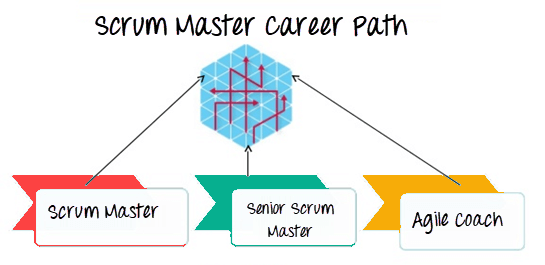
There are many opportunities for growth in a career as a Scrum Master
1. Scrum Master
It is the first rank any person will get after completing the CSM certificate. It usually lasts between one and five years, and the holder needs to perform all the assigned roles of a Scrum Master.
2. Senior Scrum Master
From Scrum Master you progress to Senior Scrum Master. To become a Senior Scrum Master, one should gather advanced knowledge of Scrum best practices and how to implement them in teams.
3. Agile Coach
From Senior Scrum Master you transition to Agile Coach. To become an Agile Coach, you need five years or more of knowledge as a Scrum Master and at least one year of experience mentoring and coaching.
