
Python Rename File and Directory using os.rename()
 Editorial Team
⚡ Smart Summary
Python renames files and directories with os.rename(). Here you will learn os.rename(), os.renames(), shutil.move(), and pathlib Path.rename(), plus how to rename a directory and batch-rename multiple files with clear examples.

Python Rename File
Python rename() file is a method used to rename a file or a directory in Python programming. The Python rename() file method can be declared by passing two arguments named src (Source) and dst (Destination).
Syntax
This is the syntax for os.rename() method
os.rename(src, dst)
Parameters
src: Source is the name of the file or directory. It should must already exist.
dst: Destination is the new name of the file or directory you want to change.
Example:
import os
os.rename('guru99.txt','career.guru99.txt')
Let’s look at example in detail
You can rename the original file, we have changed the file name from “Guru99.txt” to “Career.guru99.txt.”
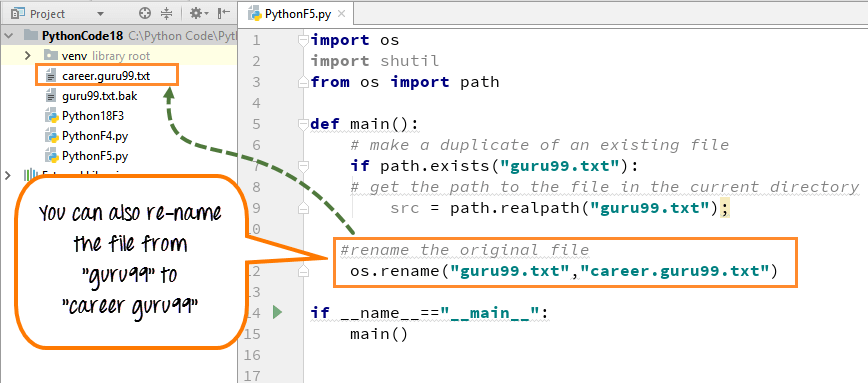
- To rename “guru99.txt” file, we going to use “rename function” in the OS module
- So when the code is executed, you can observe that a new file “career.guru99.txt” is created on the right side of the panel, which we renamed for our original file.
Here is the complete code
import os
import shutil
from os import path

def main():
	# make a duplicate of an existing file
    if path.exists("guru99.txt"):
	# get the path to the file in the current directory
        src = path.realpath("guru99.txt");

	# rename the original file
        os.rename('guru99.txt','career.guru99.txt')

if __name__ == "__main__":
    main()
How to Rename a Directory in Python
The os.rename() method also renames directories, not just files. Pass the current folder name as the source and the new name as the destination.
import os
os.rename("old_directory", "new_directory")
If the source directory does not exist, Python raises a FileNotFoundError, so it is good practice to check the path first.
Rename a File Using os.renames()
The os.renames() method renames a file and automatically creates any missing intermediate directories in the destination path. It also removes empty directories left behind in the source path.
import os
os.renames("guru99.txt", "archive/2024/career.txt")
Here the folders archive and 2024 are created automatically if they do not already exist.
Rename a File Using shutil.move()
The shutil.move() function moves a file to a new location, which effectively renames it when the destination is the same directory.
import shutil
shutil.move("guru99.txt", "career.guru99.txt")
Unlike os.rename(), shutil.move() can also move a file across different file systems or drives.
Rename a File Using the pathlib Module
In Python 3.4 and later, the pathlib module offers an object-oriented Path.rename() method for renaming files.
from pathlib import Path

file = Path("guru99.txt")
file.rename("career.guru99.txt")
The rename() method returns a new Path object that points to the renamed file.
How to Rename Multiple Files in Python
To rename many files at once, loop over the files in a directory with os.listdir() and call os.rename() for each one. The example below adds a numbered prefix to every file.
import os

folder = "myfiles"
for count, filename in enumerate(os.listdir(folder)):
    new_name = f"file_{count}.txt"
    os.rename(os.path.join(folder, filename), os.path.join(folder, new_name))
Using os.path.join() keeps the code working correctly on any operating system.
