
Python 2D Arrays: Two-Dimensional List Examples
 Editorial Team
⚡ Smart Summary
Python 2D Array is an array placed inside another array, forming rows and columns like a table. The examples below show how to create, access, insert, update, delete, and size 2D arrays.
What is a Two Dimensional Array in Python?
Array is a data structure used to store elements. An array can only store similar types of elements. A Two Dimensional is defined as an Array inside the Array. The index of the array starts with 0 and ends with a size of array minus 1. We can create ‘n’ number of arrays in an array.
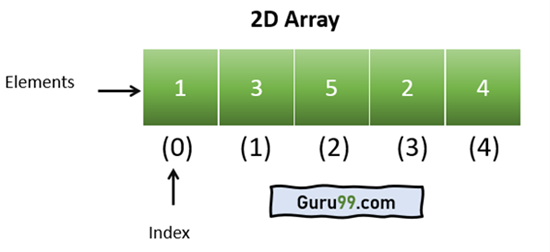
In the above image, we can see that an index uniquely identifies each array element.
How to Create Array in Python?
We can create a two-dimensional array(list) with rows and columns.
Syntax:
[[r1,r2,r3,..,rn],[c1,c2,c3,.......,cn]]
Where,
r stands for rows and c stands for columns
Example: Following is the example for creating
2D array with 4 rows and 5 columns
array=[[23,45,43,23,45],[45,67,54,32,45],[89,90,87,65,44],[23,45,67,32,10]]
#display
print(array)
Output:
[[23, 45, 43, 23, 45], [45, 67, 54, 32, 45], [89, 90, 87, 65, 44], [23, 45, 67, 32, 10]]
Accessing the values
We can access the values using index position
Syntax:
We can get row value using [] operator
array[row index]
We can get column value using [][]
Array[row index][column index]
where,
- array is an input array
- row index is the row index position starts from 0
- column index is the column index position starts from 0 in a row.
Example:
In this example we are going to access the values using index positions
#creare 2D array with 4 rows and 5 columns
array=[[23,45,43,23,45],[45,67,54,32,45],[89,90,87,65,44],[23,45,67,32,10]]

#display
print(array)

#get the first row
print(array[0])

#get the third row
print(array[2])

#get the first row third element
print(array[0][2])

#get the third row forth element
print(array[2][3])
Output:
[[23, 45, 43, 23, 45], [45, 67, 54, 32, 45], [89, 90, 87, 65, 44], [23, 45, 67, 32, 10]]
[23, 45, 43, 23, 45]
[89, 90, 87, 65, 44]
43
65
We can also access elements using for loop
Syntax:
for rows in the array:
  for columns in rows:
    print(columns)
where,
- rows are used to iterate the row by row
- columns is used to iterate the values present in each row.
Example:
Creare 2D array with 4 rows and 5 columns
array=[[23,45,43,23,45],[45,67,54,32,45],[89,90,87,65,44],[23,45,67,32,10]]

#use for loop to iterate the array
for rows in array:
 for columns in rows:
   print(columns,end=" ")
   print()
Output:
23 45 43 23 45
45 67 54 32 45
89 90 87 65 44
23 45 67 32 10
Inserting the values into the two-dimensional array
Here we are going to insert values into two dimensional array using insert() function
Syntax:
array.insert(index,[values])
where,
- the array is the input array
- the index is the row position to insert a particular row
- value are the values to be inserted into the array
Example: Insert to values in the array
#Create 2D array with 4 rows and 5 columns
array=[[23,45,43,23,45],[45,67,54,32,45],[89,90,87,65,44],[23,45,67,32,10]]

#insert the row at 5 th position
array.insert(2, [1,2,3,4,5])

#insert the row at 6 th position
array.insert(2, [1,2,3,4,5])

#insert the row at 7 th position
array.insert(2, [1,2,3,4,5])

#display
print(array)
Output:
[[23, 45, 43, 23, 45], [45, 67, 54, 32, 45], [1, 2, 3, 4, 5], [1, 2, 3, 4, 5], [1, 2, 3, 4, 5], [89, 90, 87, 65, 44], [23, 45, 67, 32, 10]]
Updating the values into the two-dimensional array
Here are two methods for updating values in the 2-D array(list).
You can update rows by using the following syntax
array[row_index]= [values]
You can update column values inside rows by using the following syntax
array[row_index][column_index]= [values]
Example:
#creare 2D array with 4 rows and 5 columns
array=[[23,45,43,23,45],[45,67,54,32,45],[89,90,87,65,44],[23,45,67,32,10]]

#update row values in the 3rd row
array[2]=[0,3,5,6,7]

#update row values in the 5th row
array[2]=[0,3,5,6,7]

#update the first row , third column
array[0][2]=100

#update the second row , third column
array[1][2]=400

#display
print(array)
Output:
[[23, 45, 100, 23, 45], [45, 67, 400, 32, 45], [0, 3, 5, 6, 7], [23, 45, 67, 32, 10]]
Deleting the values from two-dimensional array
You can delete rows using the del function
Syntax:
del array[index]
where,
- the array is the input array
- index refers to the row index
Example:
#creare 2D array with 4 rows and 5 columns
array=[[23,45,43,23,45],[45,67,54,32,45],[89,90,87,65,44],[23,45,67,32,10]]

#delete row values in the 3rd row
del array[2]

#delete row values in the 2nd row
del array[1]

#display
print(array)
Output:
[[23, 45, 43, 23, 45], [23, 45, 67, 32, 10]]
Get the size of two-dimensional array
You can get the size of the two-dimensional array using the line() function. It will return the number of rows in the array
Syntax:
len(array)
Example:
Get the length of the two-dimensional array
#creare 2D array with 4 rows and 5 columns
array=[[23,45,43,23,45],[45,67,54,32,45],[89,90,87,65,44],[23,45,67,32,10]]
#display
print(len(array))
Output:
4
Important Python Array (List) Methods
Here are some important Array(list) Methods
| Method | Description | Syntax | Example |
|---|---|---|---|
| Append(): | This method helps us to add an element at the end to an existing array. | array.append(value) |
# Adding an element using append method to the end of an array array=[1,2,3] array.append(4) print(array)
Output: [1,2,3,4] |
| Clear(): | This method helps us to remove all the elements present in an array | array.clear() |
# Removing all the elements from an array array=[1,2,3]
array.clear()
Output: [] |
| Copy(): | This method helps us to copy the contents of an array to a new array | array1=array.copy() |
#Copying the elements from an array to a new array array=[1,2,3] array1=[]
array1=array.copy()
  print(array1)
Output: [1,2,3] |
| Count(): | This method helps us to count the no.of occurences of a an specified element in an array | array.count(element) |
#Counting the no of times an element is present in an array array=[1,2,3]
print(array.count(8))
Output: 0 |
| Extend(): | This method helps us to extend an array beyond it’s consisting elements. | array.extend(array1) |
#Extending an existing array with another array array=[1,2,3] array1=[4,5,6] array.extend(array1) print(array)
Output: [1,2,3,4,5,6] |
| Index(): | This method helps us to find the index of an element in an array | array.index(element) |
#returing the index an element in an array array=[1,2,3]
print(array.index(3))
Output: 2 |
| Insert(): | This method helps us to insert elements into an array at specified index. | array.insert(index,element) |
#Inserting an element at a specified index into an array array=[1,2,3]
array.insert(2,4)
  print(array)
Output: [1,2,4,3] |
| Pop(): | This method helps us to remove an element at specified index | array.pop(index) |
#Removing an element at specified index through pop method
array=[1,2,3]
array.pop(2)
  print(array)
Output: [1,2] |
| Remove(): | This method helps us to remove an particular matching element in an array. | array.remove(element) |
array=[1,2,3]
array.remove(2)
  print(array)
Output: [1,3] |
| Reverse(): | This method helps is to reverse the elements in an array. | array.reverse() |
array=[1,2,3,4]
array.reverse()
  print(array)
Output: [4,3,2,1] |
