
Nvidia Backs OpenAI’s $105B Ohio Data Center Deal
ALSO: Anthropic’s 43.5% lead, Mistral’s 3B safety model


Welcome to Guru99 AI Report!
Top Story: Welcome back. A $105B handshake between Nvidia and OpenAI has critics whispering “circular financing,” while businesses are choosing cheaper AI over the most powerful. There’s a lot moving beneath the headlines this week – here’s what actually matters, and why.
⚡ Nvidia Guarantees $105B for OpenAI’s Ohio Data Center
Brief Buzz:
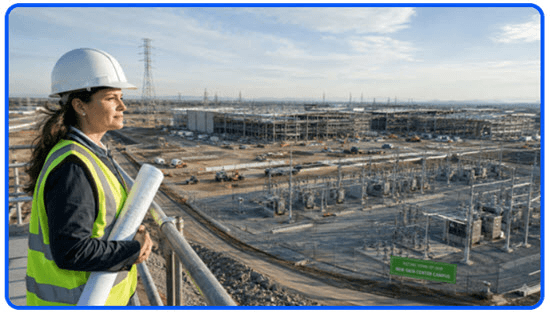
Nvidia is guaranteeing up to $105 billion to help OpenAI lease a giant data center in Ohio. SoftBank’s SB Energy will build it on a former uranium-enrichment site. OpenAI signed a 20-year lease. The campus could become one of the world’s largest for AI.
- Nvidia backstops defined portions of lease and power payments – not construction, and not the chips.
- SB Energy (SoftBank-backed) will build, own, and run the site; Nvidia is also investing $1.5 billion in it.
- The campus targets up to 8 gigawatts of compute, powered by at least 10 GW of new generation SoftBank will build.
- OpenAI projects 35,000 construction jobs through 2032 and 2,500 permanent roles, with the first 800 MW live by 2028.
- Nvidia becomes the exclusive chip supplier, on top of its $30 billion direct stake in OpenAI.
💡 Why Should You Care?
AI’s giants can’t fund these mega-projects alone, so suppliers like Nvidia backstop their customers’ bills. Critics call it “circular financing”; Nvidia says OpenAI just pays the lease. The buildout only gets pricier.
🔐 Tech Giants Unite to Decentralize AI Power

Brief Buzz:
At this week’s Confidential Computing Summit in San Francisco, leaders from Google, Microsoft, AMD, and Intel joined the Linux Foundation and co-host Opaque to champion “sovereign AI” – an open-source push to keep enterprises in control of their own data as autonomous agents go mainstream.
- Speakers warned that leaning on just one or two AI providers creates a fragile system with a single “off-switch” – and pitched open-source alternatives instead.
- Four priorities emerged: protect what agents remember, root trust in hardware at the chip level, give every agent a verified identity and audit trail, and let enterprises hold their own encryption keys.
- The Linux Foundation unveiled plans for an Agent Name Service (ANS) that extends the internet’s DNS to give AI agents verifiable, tamper-resistant identities.
- Opaque CEO Aaron Fulkerson’s pitch: stop paying for AI with your data – “optimize for freedom.”
💡 Why Should You Care?
If your company uses AI, this is about who controls your most sensitive data. “Sovereign AI” could mean keeping your secrets in-house instead of handing them to a handful of tech giants.
🧾 Reddit’s SaaS Kill List Comes With an Asterisk

Brief Buzz:
A r/ClaudeAI thread asking what software people had replaced with their own code drew 263 comments and a long roll call of cancelled subscriptions – plus one viral cautionary tale the thread itself then picked apart.
- The top comment: one commenter says their org swapped a $2,500/month project-management license for $12,500/month in tokens
- Replies called it an implementation problem, not a verdict – one builder said the job should cost $200/month
- Self-reported wins ran from a $95/year utility to a claimed $3M annual license replaced in a month
- Named targets recurred – Supermetrics, HubSpot, Asana, Jira, Adobe – matching Retool’s own survey of at-risk categories
- The loudest pushback wasn’t cost: audit trails, indemnification, pen testing and SOC compliance all move in-house
💡 Why Should You Care?
None of these numbers are audited – they’re strangers describing their own invoices. Useful as a signal about where pricing pressure is landing; useless as a business case.
🛡️ Mistral’s Tiny Safety Model Rivals Models 7x Bigger

Brief Buzz:
Mistral just released Shieldstral, a small AI safety tool. It checks text and images against rules you write in plain English. No retraining needed. It’s free, open-weight, and runs on a single 16GB GPU. Mistral says it rivals safety models seven times its size.
- 3 billion parameters, yet it matches guardrail models up to 7x larger on text-safety benchmarks.
- You write moderation policies as plain-language yes/no questions at inference time – no retraining per use case.
- It returns a continuous safety score, so you set your own thresholds instead of a fixed block/allow switch.
- Released open-weight under Apache 2.0, running on a single 16GB NVIDIA GPU – cheap enough for small teams.
- Its real edge is multimodal moderation (text + images), where Mistral claims state-of-the-art results.
💡 Why Should You Care?
Safer AI usually means expensive, rigid filters. Shieldstral makes strong moderation cheap and customizable – letting small teams deploy AI responsibly without a giant compute bill or a retraining cycle.
📊 Anthropic Widens AI Lead, but Fable 5 Stalls

Brief Buzz:
Anthropic is pulling further ahead in business AI adoption. But companies aren’t rushing to its priciest, most powerful model. Ramp’s latest spending data shows businesses want capable AI – without the sky-high token bill. Efficiency, not raw power, is winning.
- 43.5% of U.S. businesses now pay for Anthropic, versus 39.7% for OpenAI – Anthropic’s widest lead yet on Ramp’s index.
- Fable 5, Anthropic’s most capable model, drew just 6% of tokens businesses bought from Anthropic.
- OpenAI’s flagship GPT-5.6 Sol, by contrast, made up 25% of OpenAI tokens – far higher uptake.
- xAI logged its fastest growth since July 2025, up 0.94 points to 4% of businesses.
- Open-source and Chinese-model platforms rose to 6.1% of AI-spending firms, chipping at the leaders’ growth.
💡 Why Should You Care?
The takeaway: businesses will pay for AI – but not at any price. For everyday tasks, cheaper “good enough” models increasingly win.
🧬 Amodei: Only Real Cures, Not Marketing, Win AI Trust

Brief Buzz:
Anthropic CEO Dario Amodei rarely posts on X. This weekend he did — firing back at investor Gavin Baker in a rare thread after Baker said his AI risk warnings had backfired. Amodei’s reply: the public’s issue with AI is a crisis of trust, and only real results fix it.
- Baker argued Amodei has “lost the argument” on AI rules, fueling U.S. backlash against data centers.
- He denied being too gloomy, pointing to his upbeat essay Machines of Loving Grace as proof of balance.
- He said promising an AI cancer cure is now a cliché – “actually curing cancer” is what moves opinion.
- He called the regulation-vs-open-AI trade-off a “false choice,” saying Anthropic’s rules slow big labs but spare small ones.
- An Anthropic staffer flatly denied a rumor Baker relayed – that Amodei wants the firm as the world’s “only private company.”
💡 Why Should You Care?
How AI companies rebuild public trust will shape the regulation they face – and whether the medical breakthroughs they keep promising actually arrive.


Hey! I’m Krishna Rungta
Founder of Guru99.com, Editor-in-chief & Technology Expert
Was this email forwarded to you? Sign up for free here.
