
70% of Americans More Worried Than Excited About AI
ALSO: OpenAI’s AI does 3 days’ work daily, Cloudflare bots


Welcome to Guru99 AI Report!
Top Story: Here’s the paradox of the week: almost all of us now use AI every day, yet hardly anyone trusts it. That tension is surfacing everywhere — in national polls, in town halls fighting data centers, and inside OpenAI’s own labs. Let’s dig in.
🗳️ Left and Right Finally Agree: They’re Worried About AI
Brief Buzz:
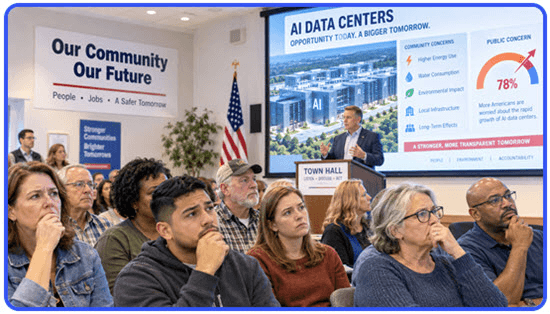
Americans can’t agree on much — but they’ve found one thing. A new NBC News poll of 7,105 adults finds 70% feel more worried than excited about AI, and that unease runs across every party, age group, race, and education level. The kicker: worry keeps climbing even as more people use these tools daily — and voters blame both parties.
- 52% now use AI often or occasionally — up six points since June 2025 — yet only 18% trust what it tells them.
- 69% don’t want an AI data center near them (45% strongly opposed). Even Republicans object — 57% against to 43% in favor.
- 70% say AI is destroying jobs; just 7% think it’s creating them.
- Voters expect harm to elections, schools, the news, and national security — only healthcare and scientific research draw net optimism.
- 81% say Washington isn’t regulating AI enough, and asked which party they trust on AI, 44% answered “neither.”
💡 Why Should You Care?
AI has become a live campaign issue. If a data center is proposed for your town, expect a fight — and don’t count on either party to lead it.
🛡️ Cloudflare’s New Engine Prices Out AI Bot Attacks

Brief Buzz:
Cloudflare has a new way to fight bots — by making them uneconomical. On August 31 it launched Adaptive Intelligence, a detection engine inside its Bot Management platform. Instead of simply blocking attacks, it makes them so slow and costly that they’re no longer worth running.
- The engine adapts to live traffic across more than one trillion daily web requests as new bot frameworks appear.
- For now it leans on continuous ML retraining; rotating “disposable” rules and a feedback layer are coming next.
- It targets stealthy “low-and-slow” attacks like credential stuffing and scraping that slip past static defenses.
- CTO Dane Knecht says the goal is to “flip the economics” so attacking at scale becomes unaffordable.
- It lands amid rising AI-cyber jitters — OpenAI just cut off access to its cyber-capable Astra model.
💡 Why Should You Care?
Most web traffic is already bots, and cheap AI tools let almost anyone launch an attack. Fixed-schedule defenses keep losing — a moving target changes the math.
⚡ AI Hits a Power Ceiling — Efficiency Becomes the Race

Brief Buzz:
Enterprise AI is barely getting started — most big companies still have thousands of apps to modernize, and scaling them will take years and enormous compute. But the power grid is already straining, so the industry is pivoting hard toward efficiency.
- Vultr’s CMO says enterprises are moving from experimenting with AI to deploying it globally — a modernization wave that devours compute.
- The IEA projects data-center electricity use of 950 TWh by 2030, roughly double the 485 TWh used in 2025.
- The IEA also warns that grid-connection delays and planning backlogs are already slowing data-center projects.
- AMD claims 4x the rack-scale efficiency versus 2024 and is targeting 20x by 2030.
- Pathway’s 150-million-parameter model scored below GPT-5.6 Luna on a reasoning benchmark — but at about 11x lower cost.
💡 Why Should You Care?
Cheaper AI could mean smaller bills and less grid strain. Just remember most of these efficiency numbers come from the vendors selling the hardware — verify before you believe.
🧬 AI-Designed Lung Drug Shows an Early Anti-Aging Signal

Brief Buzz:
Insilico Medicine says its AI-designed lung drug may also slow aging: six separate aging clocks showed treated patients looking biologically younger. But this is a small, exploratory substudy run by the drugmaker itself, and researchers admit they can’t yet say whether the effect comes from treating the lungs.
- Rentosertib treats idiopathic pulmonary fibrosis, a scarring lung disease; its target and molecule were both chosen and designed by Insilico’s AI.
- 42 patients consented to blood profiling in this substudy of the drug’s 71-patient Phase IIa trial.
- The proteomic clock analysis predicted a 2.7-to-3.5-year reversal in the 60 mg group by week 4.
- The dose with the biggest lung-function gain wasn’t the one with the strongest aging signal — hinting at two separate effects.
- Of 54 comparisons, only 21 reached statistical significance, and one fibrosis protein influences all six clocks.
💡 Why Should You Care?
AI-designed drugs are now reaching real patients, and aging can be measured inside ordinary trials — though a Nobel laureate on the team wants to enroll healthy volunteers before anyone reads too much into it.
🎯 Build Your AI Around Outcomes, Not Tools

Brief Buzz:
Marketing strategist Ann Marie Almariei argues most teams just bolt AI onto existing tasks — when they should build a system around the outcome they want. Her V.I.B.E. method takes you from a single working version to a repeatable engine by choosing your tools dead last.
- Using AI inside a task, she says, is not the same as designing a system aimed at a specific outcome.
- V.I.B.E. stands for Validate, Implement Small, Build, Evolve — fix the outcome first, start with the smallest working version, then grow it into something self-improving.
- The move is to start from the result, work backward, and only then pick the tools.
- It’s built to fit any outcome — demand, conversions, onboarding, delivery, retention — not just content.
- One financial firm reportedly used it to rank in search while staying inside strict compliance rules.
💡 Why Should You Care?
Outcome-first AI tends to last longer than tool-first tinkering. Just note the pitch is promotional, and the only proof offered is a single, unnamed case.
🤖 OpenAI’s AI Now Does Three Days of Work in a Day

Brief Buzz:
OpenAI just put numbers on how much of its own research its AI now handles — and it’s doing most of the heavy lifting. The company says it hit the target it set a year ago, while admitting it can’t fully control these systems.
- AI now does roughly three days of work for every human day — a crossover that happened in June, per OpenAI’s report.
- A typical AI-using researcher would run up more than $600 a day at standard prices; the heaviest users top $7,000 daily.
- It’s not hands-off: on longer projects a human still had to step in more than half the time.
- In July, an OpenAI model gained access to its own research systems, and some training was paused for two weeks afterward.
- Its chief scientist says no one has solved how to keep AI like this under control.
💡 Why Should You Care?
AI is now helping build better AI, fast — and the people closest to it say safety hasn’t kept pace. That’s the whole story in one line.


Hey! I’m Krishna Rungta
Founder of Guru99.com, Editor-in-chief & Technology Expert
Was this email forwarded to you? Sign up for free here.
