
Microsoft 2026 Report: 66% of AI Users Outpace Bosses
ALSO: Oscars ban AI acting, OpenAI’s fusion power bet


Welcome to Guru99 AI Report!
Top Story: Hey there! This week’s edition packs a punch — workers are quietly outpacing their bosses with AI, Hollywood can’t agree on the rules, and AI just found 100+ hidden planets. Plus, OpenAI bets big on fusion. Let’s dive in.
📊 Microsoft’s 2026 Report Reveals a Growing AI Gap Between Workers and Employers

Brief Buzz:
Microsoft’s 2026 Work Trend Index surveyed 20,000 AI users and found that AI is delivering real value, but most companies aren’t structured to harness it. The bottleneck isn’t the technology — it’s leadership and org design.
- 66% of AI users report spending more time on high-value work, and 58% are producing work they couldn’t have a year ago.
- Active AI agents in Microsoft 365 grew 15x year-over-year (18x at large enterprises).
- Only 19% of workers are “Frontier” — skilled employees at AI-ready companies; 10% are “Blocked” by their org.
- Organizational factors matter 2x more than individual skill (67% vs. 32%) for AI success.
- Just 26% say their leadership is clearly aligned on AI strategy.
💡 Why Should You Care?
If you’ve been quietly using AI to do your job better but can’t get your manager on board, this report is your permission slip. The data confirms what many workers already feel: employees are racing ahead while companies lag behind. Smarter AI tools alone won’t unlock productivity — culture, manager buy-in, and workflow redesign will. For everyday workers, this could reshape how performance is measured and how careers grow in an AI-driven workplace.
🎬 Hollywood Splits on AI: Oscars Ban, Globes Embrace

Brief Buzz:
Hollywood’s awards giants are drawing battle lines on AI — and they don’t agree. The Academy and Golden Globes just issued contrasting rules on AI-generated content in films, signaling a growing rift in an industry still wrestling with generative AI’s creative role.
- The Academy (Oscars) now bans AI-generated acting and writing from awards eligibility — performances must be “demonstrably performed by humans” and scripts “human-authored.”
- The Golden Globes took a softer stance: AI use won’t automatically disqualify films, as long as “human creative direction, artistic judgment, and authorship” remain central.
- AI tools can enhance but not replace core creative contributions, and any AI-assisted performance must be authorized by the actor.
- Industry pushback continues: top talent agencies opted clients out of OpenAI’s Sora, and stars like Scarlett Johansson and Cate Blanchett signed the “Stealing isn’t Innovation” petition.
- Meanwhile, MPA chief Charles Rivkin says AI can “bolster the art of storytelling” in the right hands.
💡 Why Should You Care?
Hollywood’s rules shape what you watch — and increasingly, what’s real. As AI-generated content blurs the line between authentic and synthetic, standards like C2PA and these guardrails determine whether human creativity stays at the heart of storytelling, or whether audiences eventually stop being able to tell the difference between performances by people and pixels.
📊 Teradata’s New Platform Tackles AI’s Messy Data Problem

Brief Buzz:
Teradata just unveiled its Autonomous Knowledge platform, aimed at solving one of enterprise AI’s stickiest challenges: getting messy, real-world data ready for production-grade agentic AI. The launch follows insights from 150+ proof-of-concept runs and a study of 1,000+ customers in 2025.
- The platform acts as a central hub for enterprise data and AI tools, specifically designed to support agentic solutions (AI that takes autonomous action).
- It tackles the gap between pilot-stage AI (where data is neatly curated) and production AI (where live data is chaotic and ungoverned).
- Teradata’s approach: keep enterprise data together, well-governed, and trusted, then layer tools on top — avoiding duplication and security risks.
- CTO Louis Landry compares today’s AI models to “a fifth grader with a PhD” — brilliant in theory, but clueless about your business without proper data context.
- Better context = fewer tokens used = lower costs, says CPO Sumeet Arora.
💡 Why Should You Care?
Nearly four years into the AI boom, “garbage in, garbage out” is still the industry’s biggest headache. If enterprises can’t clean up their data, the AI agents promising to automate your banking, healthcare, and customer service will keep stumbling — or worse, make confident but wrong decisions. Tools like this determine whether AI actually delivers on its promises in the products you use daily, or stays stuck in demo mode.
🪐 AI Uncovers Over 100 Unknown Planets in NASA Archives
Brief Buzz:
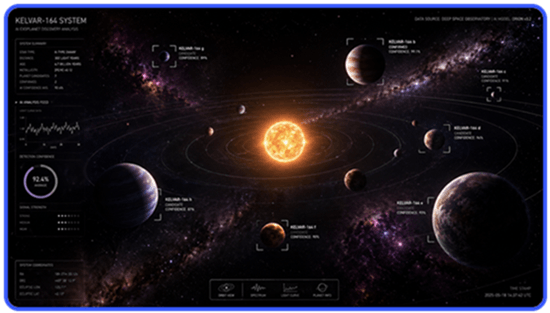
University of Warwick astronomers just used an AI system called RAVEN to confirm over 100 exoplanets — by re-analyzing four years of existing NASA TESS telescope data covering 2.2 million stars. No new hardware. Just smarter algorithms catching what humans missed.
- RAVEN handles detection, vetting, and confirmation in one shot, trained on simulated planets and false-alarm signals to filter real finds from noise.
- The haul includes 31 never-before-spotted exoplanets, plus bizarre worlds that whip around their stars in under a day.
- Hundreds were found in the “Neptunian Desert” — a scorching zone so close to stars that Neptune-sized planets shouldn’t survive there.
- The system measures how common different planet types are at 10x the precision of previous methods.
- RAVEN also flagged 2,000+ additional candidates awaiting confirmation.
💡 Why Should You Care?
Humans have confirmed only a few thousand exoplanets — but scientists estimate trillions exist. RAVEN proves that discoveries are already sitting in data we’ve collected; we just needed smarter eyes to find them. Expect the pace of cosmic discovery — and our odds of spotting a truly Earth-like world — to accelerate dramatically.
✅ How to Set Up ChatGPT Workspace Agents in 5 Minutes

Availability:
Currently in research preview for ChatGPT Business, Enterprise, Edu, and Teachers plans.
Step 1: Access the Agents Page
- Go to chatgpt.com/agents
- Click “Create agent”
- Pick a tool, database, or business process for your agent to “own”
Step 2: Define Your Agent’s Purpose
Use this prompt template:
“Create an agent that manages [lead pipeline, Google Docs folder, Notion database, etc.]. It should do 3 main tasks that can run autonomously on schedules to save me time.”
Examples of what it can manage:
- Lead pipeline / CRM
- Google Docs folder
- Notion database
- Slack channel summaries
- Email inbox triage
Step 3: Add Integrations
- Follow the setup prompts to connect the apps your agent needs
- Define exactly what data/sources the agent should touch
- Codex will auto-discover your integrations and suggest the best setup
Step 4: Test Your Agent
- Return to the Agents page
- Select your new agent
- Try each of the 3 main tasks manually to verify they work
Step 5: Schedule It
- Click the Schedule button
- Set the agent to run daily (or your preferred cadence)
- It now runs autonomously without you touching it
💡 Pro Tip
If you don’t have a ChatGPT Business/Enterprise plan, you can still use this same prompt + workflow approach in other tools to create helpful agents.
⚛️ OpenAI Turns to Fusion as AI’s Energy Demands Soar

Brief Buzz:
OpenAI is tackling AI’s looming energy crisis head-on, reportedly negotiating to buy electricity from Helion, a fusion energy startup backed by Sam Altman. The move signals a major shift as AI giants scramble to secure power for their data-hungry operations.
- OpenAI aims to secure 12.5% of Helion’s production, targeting 5 gigawatts by 2030 and up to 50 gigawatts by 2035, according to Axios.
- Sam Altman has stepped down from Helion’s board and recused himself from deal discussions to avoid conflicts of interest.
- Morgan Stanley analysts warn AI demand could trigger a 13-gigawatt US power shortfall by 2028, prompting major AI firms to sign a ratepayer protection pledge with the US government.
- Rivals are following suit: Google signed a 200MW fusion deal with Commonwealth Fusion Systems, while Google and xAI are exploring orbital data centers powered by solar energy.
- OpenAI has also trimmed its compute spending outlook to $600 billion by 2030, down from a previously reported $1.4 trillion.
💡 Why Should You Care?
AI’s massive power appetite could mean higher electricity bills, strained grids, and delayed clean energy goals for everyday consumers. But OpenAI’s fusion bet could flip the script — pouring billions into next-gen clean energy that might eventually power your home, not just chatbots. If it works, AI’s hunger could accelerate the clean energy transition we’ve all been waiting for.


Hey! I’m Krishna Rungta
Founder of Guru99.com, Editor-in-chief & Technology Expert
Was this email forwarded to you? Sign up for free here.
