
Guru99 AI Report News Letter Current Edition

AI Apps Hit 3.8B Downloads, Overtake Streaming in 2025

ALSO: Thiel’s $140M ocean AI bet, 81% of CEOs fear AI

Guru99 AI Report

Welcome to Guru99 AI Report!

Top Story: Hey there! This week’s edition dives into why AI apps are quietly taking over your phone, what’s keeping CEOs up at night, and how Gen Z is rewriting the rules. Curious? Let’s dig in.

📱 The smartphone era is ending. The AI app era is here.
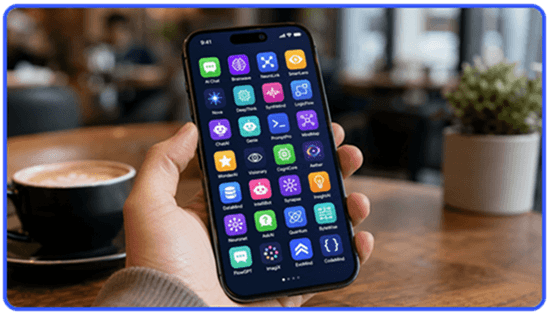
The smartphone era is ending. The AI app era is here.
Brief Buzz: Generative AI has officially taken over your phone. According to Sensor Tower’s 2026 State of Mobile report, AI apps are no longer a niche curiosity — they’ve leapfrogged streaming, shopping, and music to become the second most-downloaded app category globally, trailing only social media.
  • GenAI downloads exploded from 213M in 2022 to 3.8B in 2025 — an 18x jump, with year-over-year growth of 148%.
  • In-app purchases tripled to over $5 billion, helping non-game apps ($85.6B) finally surpass gaming in IAP revenue.
  • Users spent 48 billion hours inside GenAI apps in 2025 — roughly 10x more than in 2023.
  • ChatGPT crossed $1B in global IAP, joining only TikTok and Google One in that exclusive club.
  • AI assistants are crushing AI image/video generators — signaling people want practical help, not novelty.
💡 Why Should You Care?
AI assistants are quietly becoming the everyday utility your phone is built around — chipping away at search, shopping research, and even social scrolling. The downloads, dollars, and hours spent show this isn’t hype; it’s a behavior shift. If you haven’t picked an AI sidekick yet, you’re rapidly joining the minority.

📊 The AI Pressure Cooker: Inside the Boardroom Anxiety Gripping CEOs

The AI Pressure Cooker: Inside the Boardroom Anxiety Gripping CEOs
Brief Buzz: A new global study of 900 CEOs by Harris Poll and Dataiku reveals that executives are caught in an AI pressure cooker — racing to deploy the tech while fearing the consequences of getting it wrong. The “capability overhang” gap between what AI can do and what businesses can reliably deploy is widening.
  • 81% of CEOs fear that botched AI deployments could cost them their jobs this year.
  • 75% believe a fellow CEO will be ousted over a failed AI rollout, while 62% face board pressure for measurable AI outcomes.
  • 56% admit competitors have stronger AI strategies than their own.
  • 79% worry about legal risks, and 51% have delayed rollouts due to regulatory concerns.
  • 34% refuse to let AI make decisions without human approval.
💡 Why Should You Care?
This boardroom anxiety directly shapes your workplace, your services, and your data. When CEOs rush AI adoption to please boards, you may encounter half-baked chatbots, opaque automated decisions affecting loans or hiring, and weaker accountability when things go wrong. But when they hesitate, companies risk falling behind — potentially affecting jobs and innovation. The bigger question, as one executive put it: should we “slow down to speed up” and thoughtfully decide what AI should actually change about how we work and live?

⚡ Gen Z Just Broke the AI Rulebook!

Gen Z Just Broke the AI Rulebook
Brief Buzz: A new Gallup poll reveals a striking contradiction: Gen Z uses AI more than any other generation, yet trusts it the least. This “resistance paradox” is reshaping how brands, educators, and employers think about AI adoption among the digital-native cohort.
  • 79% of Gen Z uses AI tools regularly, but only 31% trust the information these tools provide.
  • Concerns center on misinformation, job displacement, and authenticity loss in creative work.
  • Gen Z favors AI for productivity tasks (research, summarizing) but resists it in personal and emotional contexts.
  • Many fear AI is eroding critical thinking skills and homogenizing online culture.
  • Despite skepticism, AI fluency is becoming a workplace expectation they can’t avoid. Read the full findings in Gallup’s Gen Z research report.
💡 Why Should You Care?
This paradox matters because Gen Z is previewing the future of human-AI relationships. Their skepticism could pressure tech companies toward greater transparency, safety, and ethical design — benefiting everyone. For employers, marketers, and educators, ignoring this nuanced stance means losing relevance with the next wave of consumers and workers. The takeaway? Healthy skepticism alongside heavy use may actually be the smartest way to coexist with AI.

🔬 Inside the quantum-AI revolution reshaping biology

Inside the quantum-AI revolution reshaping biology
Brief Buzz: At IBM’s Think conference, CEO Arvind Krishna spotlighted quantum computing’s growing role in accelerating AI and scientific breakthroughs. Partnering with the Cleveland Clinic and Riken, IBM showcased a biological milestone that could reshape how we understand disease and develop life-saving drugs.
  • IBM simulated protein complexes spanning 12,635 atoms — a massive jump from just 10 atoms in October 2024 — using two quantum computers paired with two of the world’s most powerful supercomputers.
  • Krishna says quantum won’t replace AI or CPUs within three years, but will crack problems they can’t, like modeling complex molecules.
  • Mapping proteins in 3D helps researchers design drugs that bind precisely, potentially transforming therapies for diseases ranging from infections to chronic illness.
  • Quantum could also speed up identifying which treatments work against harmful microbes — critical, since infections remain a top global killer.
💡 Why Should You Care?
Proteins are the workhorses of your body, and understanding their shape is key to developing better drugs faster. This leap means treatments for cancer, infections, and rare diseases could arrive sooner and work more effectively. While quantum computing isn’t on your laptop anytime soon — hardware costs remain steep — its real-world impact is already touching medicine, and eventually, your healthcare.

🚀 ChatGPT Images 2.0 Is Here — 5 Prompts You’ll Want to Try Today

ChatGPT Images 2.0 Is Here — 5 Prompts You'll Want to Try Today
Head over to ChatGPT and sign up for an account. Click the ‘+’ icon, then choose ‘Create Image’, and pick any Image template to get a base prompt. Alternatively, you can type in your own prompt instead.

Below are five distinct use cases along with their prompts:

1. Email Sequence Template

“Create a polished email sequence template for [company name]”

2. Multi-page Brand Kit

“Create a polished multi-page (multiple images) brand kit for [enter brand name]”

3. Scan Anything Clear

“[upload old paper with writing] Scan this image and get rid of all the creases”

4. Whiteboard Infographics

“[Upload infographic] convert this infographic into a handwritten whiteboard infographic suitable for LinkedIn in ratio 9:16”

5. Text Rendering

“A vintage 1950s dinner menu board listing featuring [main content/text]. Use [font style] typography with [design details like colors, textures, layout].”

💡 Pro Tip
When crafting your prompts, be as specific as possible with details like style, ratio, color palette, and intended use case — the more context you provide, ChatGPT Images 2.0 delivers sharper, more on-brand results. For best output, always include the target platform (LinkedIn, Instagram, print, etc.) so the AI can optimize dimensions and visual tone accordingly.

⚓ Thiel-backed startup takes AI infrastructure offshore

Thiel-backed startup takes AI infrastructure offshore
Brief Buzz: Peter Thiel is making waves — literally. The billionaire just led a $140M Series B for Panthalassa, an Oregon-based startup building autonomous floating compute structures powered entirely by ocean waves, valuing the company at nearly $1B.
  • Each 85-meter steel node bobs in the open ocean, converting wave motion into electricity for onboard AI chips, all naturally cooled by seawater.
  • Nodes steer themselves to remote waters using only their hull shape (no engines) and beam AI results back via SpaceX’s Starlink.
  • The raise will finish a pilot factory near Portland and deploy the first wave-powered compute nodes in the Pacific, with commercial rollout in 2027.
  • Thiel told the Financial Times that “extraterrestrial solutions to compute are no longer science fiction” and that Panthalassa has “opened the ocean frontier.”
💡 Why Should You Care?
AI data centers are facing growing public backlash for guzzling power, water, and land — and communities are pushing back hard. Ocean-based compute sidesteps the grid entirely and uses free seawater for cooling. While space-based alternatives remain a distant dream, the sea could realistically become AI’s next frontier, meaning your future ChatGPT queries might run on a buoy bobbing in the Pacific.
Krishna Rungta
Facebook LinkedIn Twitter/X

Hey! I’m Krishna Rungta

Founder of Guru99.com, Editor-in-chief & Technology Expert

Was this email forwarded to you? Sign up for free here.

Summarize this post with:
