
13 BEST Agile Project Management Software (2026)
 Editorial Team

Have you ever felt lost choosing the right tool to manage your projects effectively? Using the wrong or low-quality software testing tools can quickly derail even the most promising projects. Poor-quality tools often lead to missed deadlines, disorganized workflows, limited collaboration, inaccurate progress tracking, budget overruns, and team frustration. False methods or unverified tools can also produce misleading insights, causing poor decision-making and productivity loss. On the other hand, reliable and well-tested apps bring clarity, automation, and efficiency, helping teams deliver projects faster and more accurately.
After spending over 132 hours testing and analyzing 38+ project management tools, I’ve carefully shortlisted the best Agile project management software for this guide. My recommendations are backed-by hands-on experience and real-world usage to ensure accuracy and trust. This article covers each tool’s key features, pros and cons, and pricing details to help you make informed choices. I encourage you to read through the complete list and discover which tool best fits your workflow. Read more…

Miro is a powerful Agile project management platform designed for collaborative teams. It enables seamless sprint planning, retrospectives, and workflow visualization through interactive boards.
Best Agile Project Management Software (Free & Paid)
|
 |
 |
 |
|
| Name | Miro | Zoho Projects | Monday.com | Quickbase |
| Features | ✔️ Kanban boards with assignments & comments ✔️ 300+ ready-to-use templates for Agile workflows |
✔️ Easy-to-use interface that facilitates seamless navigation. ✔️ Built-in timer to expedite client billing |
✔️ Manage everything in one workspace ✔️ Set up in minutes |
✔️ No-code builder for custom agile project apps ✔️ Real-time Gantt, timeline, and portfolio views |
| Price | Lifetime Free Plan | Lifetime Free Basic Plan | Lifetime Free Basic Plan | 30-Day Free Trial |
| Review/Rating |  4.9 4.9 |
4.8 |
4.7 |
4.5 |
| Link | Visit website | Visit website | Visit website | Visit website |
1) Miro
Miro is an incredibly versatile agile collaboration platform that turns ideas into visual workflows. Its infinite canvas and AI-powered templates make sprint planning, retrospectives, and roadmapping feel effortless. When I started using Miro, I was amazed by how quickly it let me build a complete sprint board and visualize dependencies across multiple projects.
In one instance, I used its AI tools to summarize team feedback from a retrospective — it instantly highlighted key insights and next steps. That intuitive experience convinced me that Miro is perfect for distributed teams needing clarity and collaboration in one shared space.
Time Tracking: Yes
Accounts Management: Yes
Task Management: Yes
Real-time Reporting: Yes
Free Trial: Life Time Free Basic Plan
Features:
- Kanban Boards: Miro’s Kanban boards make tracking sprint progress intuitive and collaborative. You can assign tasks, add comments, and tag stakeholders for follow-ups. I like how this feature visualizes priorities, helping agile teams stay synchronized in real time.
- Agile Visualization: This feature enables you to plan and monitor your projects using Gantt charts, timelines, and Kanban boards. It helps visualize sprint progress and release cycles. You can quickly adjust plans, ensuring seamless adaptation to agile changes.
- Roadmaps: With Miro’s shared workspaces, you can build detailed project roadmaps that align teams from ideation to delivery. It keeps all updates centralized. This helps ensure no one loses track of evolving milestones or sprint goals.
- Retrospectives: This feature fosters continuous improvement by enabling structured team retrospectives. You can collect feedback after each sprint and convert insights into actionable steps. I have used it to enhance communication transparency and boost team accountability.
- Dependency Mapping: Miro offers a visual dependency mapping tool that simplifies complex project relationships. It lets you view cross-project dependencies, including those from Azure and Jira. This visibility minimizes blockers and enhances resource coordination.
- Agile Templates: With over 300 agile templates, you can jumpstart sprint planning, OKRs, and project tracking. The ready-made templates for PERT, milestone planning, and retrospectives save time and standardize workflow consistency across teams.
Pros
Cons
Pricing:
- Price: Plans start at $8/user/month or $16/user/month.
- Free Trial: Free plan available with 3 editable boards and basic features.
Lifetime Free Basic Plan
2) Zoho Projects
Zoho Projects is a powerful agile project management tool that helps streamline task tracking, team collaboration, and time management. Its built-in time tracker and free basic plan make it an excellent choice for small teams starting their agile journey. I’ve used Zoho Projects to manage multiple sprints, and I truly appreciate how its reports and Gantt charts simplify project timelines and dependencies.
In one project, exporting detailed reports in CSV and PDF gave me quick insights into resource utilization and billing accuracy. This level of flexibility and control makes Zoho Projects ideal for dynamic, fast-moving development environments.

Time Tracking: Yes
Accounts Management: Yes
Task Management: Yes
Real-time Reporting: Yes
Free Trial: Life Time Free Basic Plan
Features:
- Task Management: For task management, you get a work breakdown structure, issue management, and a universal add tab for quickly adding new users. It also provides different task views, Gantt charts, dependencies, recurrence, reminders, sprints, and more.
- Ease of use: This project management software has a user-friendly interface with easy navigation. It has project templates for standardized workflows in similar projects, streamlining processes. Additionally, mobile apps for iOS, Android, and iPad enable convenient on-the-go project management.
- Customization and reports: This free project management app has extensive customization options for custom fields, views, and statuses. You get a comprehensive dashboard offering detailed reports on project progress and performance indicators.
- Automation: It lets you create intelligent blueprints, trigger-based workflows, and custom rules. Automating repetitive actions, such as task creation and reminders, helps minimize manual effort and human error across agile teams.
- Integration: Zoho Projects integrates with Zoho apps, Google, and Microsoft apps, fostering collaboration across platforms. It also has web tabs that provide quick access to third-party applications.
- Collaboration Tools: This feature includes interactive feeds, discussion forums, and group chats for transparent team communication. You can centralize all updates, share files, and keep your team aligned on project milestones.
Pros
Cons
Pricing:
- Price: Plans start at $5 a month.
- Free Trial: Lifetime Free Plan
Lifetime Free Plan
3) Monday.com
In my extensive experience, Monday.com stands out as a top-tier agile project management tool thanks to its intuitive, color-coded UI. I’ve found it exceptionally suitable for teams of all sizes, with a mobile app that enhances usability. Since its inception in 2014, I have seen Monday.com solidify its reputation for reliability in the agile project management arena.
It provides robust AES-256 encryption and facilitates the export of reports in both Excel and CSV formats. The project management statuses—add, edit, and done—are straightforward, and the instant notifications via desktop and email are a boon for keeping teams aligned. With its free plan, you get 5 GB of storage and support for 2 users, which I consider a great starting point for small teams.

Features:
- Custom workflows and reports: It lets you create a workflow for any part of the agile project without the help of coding building blocks. With Monday.com, you can make custom reports and visualize your project in different views, such as charts, Kanban, forms, and tables.
- Easy collaboration: Monday.com offers a shared workspace that is perfect for me, as it allows me to collaborate with my team anytime, anywhere. The colored timelines are helpful to easily identify tasks. I can sync the timelines with my calendar, allowing me to track the time of each project.
- Integrations: Monday.com integrates with Outlook, Microsoft Teams, Slack, Google Calendar, and more. It ensures data consistency across communication, file storage, and scheduling platforms. This connectivity eliminates context switching, keeping agile teams focused and productive.
- Templates: You can start quickly with pre-built templates for marketing, software development, sales, HR, and project management. These templates simplify setup and maintain consistency across similar agile projects, helping beginners get started in minutes.
- Other Features: This tool offers automation, analytics, and enhanced productivity features. You can customize dashboards, set role-based access, and manage workflows centrally. Its built-in privacy and data security controls provide reliable protection for enterprise users.
Pros
Cons
Pricing:
- Price: Plans start at $12 a month. 18% Discount on Yearly Payment.
- Free Trial: Lifetime Free Basic Plan
Lifetime Free Basic Plan
4) Quickbase
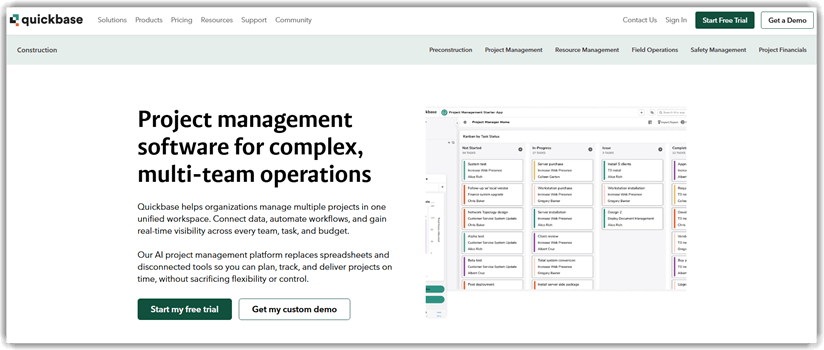
Quickbase is a flexible no-code agile project management platform that lets teams build their own project apps instead of bending their process to fit rigid software. It brings tasks, resources, budgets, and documents into one workspace, with Gantt and timeline views that show live project status. I’ve used Quickbase and found its drag-and-drop app builder and automated handoffs especially helpful for keeping multi-team projects moving without juggling spreadsheets.
When I set up a simple sprint tracker in Quickbase, it routed approvals, flagged overdue tasks, and rolled everything up into a single dashboard for stakeholders. Its 30-day free trial with no credit card required made it easy to test the setup with my team first, and role-based permissions kept sensitive budget data visible only to the people who needed it.
Features:
- No-Code Project Apps: I can build a custom agile project app in minutes by dragging in the fields, forms, and views my team actually uses. There’s no coding involved, so when our sprint process changes, I tweak the app myself instead of waiting on IT. Each team keeps its own workflow while all the project data stays connected in one place.
- Gantt and Timeline Views: I get live Gantt, timeline, and portfolio views that show exactly where every sprint, milestone, and dependency stands. I like that the timelines update the moment a task changes, so I never rebuild a status report by hand. It makes slipping work easy to spot before it delays a release.
- Workflow Automation: I set up automated task assignments, stage gates, and approval routing with simple drag-and-drop rules. Reminders and alerts fire on their own, so handoffs between developers, testers, and product owners don’t fall through the cracks. It takes a lot of repetitive admin work off my plate every sprint.
- Resource and Budget Tracking: I balance workloads with resource scheduling, skills matching, and availability calendars, and I can see who’s overloaded across projects. Budget vs. actuals update in real time, with alerts that warn me before costs drift. It helps me keep both people and spending on plan.
- Integrations: Quickbase connects with Salesforce, SAP, Oracle, Microsoft Teams, SharePoint, and Google Drive through native connectors and APIs. I use these connections to sync project updates across systems, so nobody re-enters the same data. It keeps every team working from the same, current information.
- Other Features: I also get a mobile app that works online or offline, role-based dashboards, version-controlled documents with audit trails, and AI-powered automation. Scheduled reports go straight to stakeholders. These features make it practical for distributed teams running complex, multi-site agile projects.
Pros
Cons
Pricing:
- Price: Plans start at $35 per user a month. Billed Annually.
- Free Trial: 30 Days Free Trial
30-Day Free Trial
5) ActivTrak
ActivTrak is a robust team productivity and agile tracking software that offers deep visibility into performance and workload balance. What impressed me most was how it identified underutilized resources and optimized team efficiency in real time. It’s free plan with 3 GB storage is quite generous for small teams starting their agile journey. I particularly liked how its drag-and-drop interface and AI-powered analytics simplify workload analysis.
During one project, I used ActivTrak to visualize task patterns and productivity levels, which revealed workflow inefficiencies that I could immediately address. With AES-256 encryption, MFA, and TLS security, it ensures data protection, while integration with tools like Slack, Azure, and Salesforce makes it a valuable companion for hybrid teams focused on measurable results.

Features:
- Workload Management: ActivTrak helps you identify workload imbalances to optimize team performance. It visually represents productivity trends and highlights underutilized or overburdened members. I have used this to balance test execution load and improve sprint efficiency across distributed QA teams.
- Visualization: This feature lets you view agile project activity in grid and list formats. You can track website and application usage to identify productivity patterns. It provides clear insight into where time and effort are being invested within agile workflows.
- Complete visibility: It provides complete visibility into your team’s productivity. ActivTrak lets you compare the on-site and remote employees’ efficiency and progress, and it helps identify disengagement, burnout, and much more.
- Integrations: It integrates with Salesforce, Slack, Azure, Zendesk, Zoom, Asana, ServiceNow, and more. These integrations extend workflow visibility across project and support systems. It is particularly useful for hybrid teams coordinating testing, development, and customer success.
- Other Features: ActivTrak includes detailed productivity summaries, coaching insights, and performance benchmarks. It allows personal analytics and goal-setting for self-improvement. The screenshot functionality also helps audit work patterns for process optimization and compliance tracking.
Pros
Cons
Pricing:
- Price: Plans start at $10 a month.
- Free Trial: Lifetime Free Basic Plan
Lifetime Free Basic Plan
6) ClickUp
I have discovered through my experience that ClickUp offers exceptional customization for agile project management. Thanks to its robust task and time management features, it’s particularly adept at fostering seamless collaboration across various business units. I’ve found the ability to create custom views, assign tasks, and efficiently manage priorities invaluable. What impresses me further is ClickUp’s commitment to accessibility, offering a free plan with 100MB storage and unlimited user capacity.
Despite being relatively new and founded in 2017, ClickUp competes on all fronts necessary for effective project management. Features like instant notifications, comprehensive reporting options, integration capabilities with Google Calendar, drag-and-drop functionality, custom reports, and rigorous AES-256 and 2FA encryption security measures, solidify its standing. In our toolkit, ClickUp has proven itself indispensable.

Features:
- Customizable tasks: This agile project management software has 35 ClickApps for customizing your task management. It helps you add custom-field data, assign sprint points, and much more. You can also use its filter and locate specific tasks instantly and sort jobs by project.
- Collaborate Easily: This feature lets your team co-create, edit, and track tasks in real time. You can view work through boards, lists, calendars, documents, and charts. It keeps distributed agile teams aligned and eliminates unnecessary communication delays.
- Real-time reporting: I believe ClickUp is a great way to get a task report on a daily basis by tracking the project progress in real-time with workload and box views. It is helpful to set milestones, measure goals, and view automatic active reports powered by machine learning.
- Integrations: ClickUp integrates with GitHub, GitLab, Figma, Slack, and Everhour. It also supports Dropbox, Webhooks, and API connections for advanced automation. These integrations make ClickUp adaptable to any agile software environment, from design to deployment.
- Templates: You can start projects quickly with pre-built templates across multiple departments. Templates for IT, HR, finance, marketing, and engineering streamline onboarding. They help teams maintain process consistency while minimizing setup time.
- Other Features: ClickUp offers automation triggers, whiteboards, reminders, and proofing tools. You can use slash commands for faster navigation and project edits. These productivity aids make multitasking smoother during testing and development cycles.
Pros
Cons
Pricing:
- Price: Plans start at $10 a month. 30% Discount on Yearly Payments.
- Free Trial: Lifetime Free Basic Plan
Lifetime Free Basic Plan
7) Smartsheet
As per my review, Smartsheet has changed how we handle projects. Founded in 2000, this agile tool increases business speed, helping teams align and complete tasks more efficiently. Its affordable onboarding is a game changer, offering versatility in report exports—PDF, HTML, Excel, and CSV—and keeping stakeholders updated with instant alerts.
With statuses ranging from hold to canceled, project tracking is transparent. Smartsheet doesn’t skimp on security either, offering robust features like user management and cutting-edge encryption. The automation of actions simplifies routine tasks, making budget planning a breeze. Plus, its free plan’s 500 MB storage is a great starting point for individuals.

Features:
- Stay on track: It has collaboration standardized key project elements that let you keep your agile projects on track. Smartsheet includes scalable options suitable for every individual. Moreover, it effortlessly connects with your company’s ecosystem.
- Real-time visibility: This agile project management tool offers real-time metrics, updated information on all tasks, and summarized project progress with rollups. You can visualize your project through Gantt, Card, Grid, and Calendar views, additionally, you get powerful analytics and reporting.
- Integrations: Smartsheet integrates smoothly with Salesforce, Slack, Microsoft, Tableau, Webex, and AWS. You can also connect it to DocuSign for approval workflows and Brandfolder for digital asset management. These integrations enhance cross-department communication and accelerate project turnaround.
- Pre-Built Templates: You can access a wide range of ready-to-use templates for industries like Construction, Engineering, Finance, and Technology. I find these templates save hours during onboarding. They provide structured frameworks that guide project setup without complexity.
- Other Features: Smartsheet offers unified and secure workflows that scale with your organization’s needs. It combines automation, control, and collaboration in one platform. You can set role-based access, monitor updates, and streamline enterprise governance seamlessly.
Pros
Cons
Pricing:
- Price: Plans start at $12 a month. Discount on Yearly Payment.
- Free Trial: 30 Days Free Trial
30-Days Free Trial
8) Wrike
Wrike excels as a cloud-based task management platform. I analyzed Wrike, which started in 2006 and has grown with my teams. It offers report-exporting options in PDF and Excel. I found its priority-setting features to be excellent. These features make our workflow more efficient.
The agile project management capabilities, bolstered by pre-built templates tailored for various sectors, have significantly streamlined our operations. Wrike’s project status updates, from new to completed or on hold, keep us informed, while its robust notification system and top-tier security measures, including 2FA, AES-256, and TLS 1.2 encryption, ensure we’re always ahead and secure.

Features:
- Reports and analytics: I found that Wrike offers real-time and custom interactive reports and statuses great for all kinds of agile projects. It provides up-to-date and accurate information that helps meet strict deadlines. Wrike also integrates with Tableau advanced analytics and data insights.
- Intuitive planning: With this best agile project management software, you gain complete control over your project. It comes with intuitive features that include customizable calendars, dashboards, and detailed analytics by Wrike Analyze. It also lets you view your projects on Kanban boards, Gantt charts, and tables.
- Integrations: Wrike integrates seamlessly with Salesforce, Slack, Microsoft Teams, GitHub, Jira, and SAML. It also connects with MediaValet and Tenovos for content and asset management. These integrations allow a unified agile environment that minimizes data fragmentation.
- Workload and Resource Management: Wrike provides visual workload charts that highlight team capacity and resource allocation. You can rebalance tasks instantly to avoid overburdening teams. This feature improves sprint efficiency and supports agile forecasting.
- Other Features: Wrike supports automation, proofing, cross-tagging, and budgeting tools to streamline workflows. You can centralize approvals, manage feedback, and automate recurring tasks. It also includes SSO and enterprise-level encryption for secure project management.
Pros
Cons
Pricing:
- Price: Plans start at $10/user per month.
- Free Trial: 14 Days Free Trial (Credit Card not Required)
14-Day Free Trial, No Credit Card Required
9) Jira Software
Jira Software has long been my go-to tool for agile project tracking and bug management. It’s one of the few platforms that balances custom workflows, Scrum boards, and detailed reports within one ecosystem. When I started using Jira, I was impressed by how effortlessly it integrated with my development tools, allowing me to move from issue creation to release management without friction.
In a recent project, organizing tasks by status — from “new” to “done” — helped my team stay perfectly aligned. The free basic plan also supports small teams, while its AES-256 encryption ensures every project remains secure.

Features:
- Custom workflows: It allows the creation of custom workflows of all sizes, which is helpful for building, testing, and releasing software. With Jira, you can create tasks, sub-tasks, spikes, and epics. Visualize your project using various views like Kanban, timeline, and calendar views.
- Reporting: Jira’s reporting suite gives you actionable insights into team performance. You can access burn-down charts, velocity reports, and sprint analytics. I have used it extensively to spot bottlenecks early and fine-tune sprint planning based on real-time metrics.
- Integrations: It integrates smoothly with Figma, Miro, Power BI, Zephyr, GitLab, and draw.io. This integration helps teams sync design, testing, and analytics workflows in one place. You can also connect it with CI/CD tools for automated tracking of code deployments.
- Automation Rules: You can automate repetitive actions like issue assignments, notifications, and workflow transitions. This feature saves time and enforces consistency, particularly in large teams handling multiple sprint cycles.
- Other Features: Jira offers Scrum and Kanban boards, project roadmaps, and cross-project reporting. It supports backlog management and sprint retrospectives to help teams continuously improve. You can even manage multiple projects simultaneously with granular permissions and visibility controls.
Pros
Cons
Pricing:
- Price: The paid plans start at $7.91/month
- Free Trial: Lifetime Free Basic Plan
Link: https://www.atlassian.com/software/jira
10) Asana
Asana stands out as one of the most reliable agile project management platforms for organizing sprints, tracking timelines, and automating workflows. Its drag-and-drop boards, intuitive timelines, and detailed dashboards make collaboration effortless. I’ve personally found its security standards — including 2FA, MFA, and 128-bit encryption — to be reassuring when managing confidential client data.
In one instance, I used Asana to plan multiple agile releases, where its instant alerts and automation helped the team maintain velocity. The free trial plan allowed me to explore its customizable dashboards and visual sprint tracking features. With seamless integrations into Jira, Slack, and Tableau, Asana is perfect for teams wanting structure, visibility, and productivity all in one place.

Features:
- Project management: Asana helps you manage agile workflows using custom fields, sprint boards, and task dependencies. You can visualize your work through timeline, list, calendar, and Kanban views. I often use these features to maintain sprint clarity and team accountability.
- Reporting: This feature allows you to create custom dashboards with interactive charts and metrics. You can filter results, monitor sprint velocity, and track blockers. I appreciate how quickly I can turn raw data into actionable insights for team retrospectives.
- Integrations: Asana integrates with Splunk, Salesforce, Tableau, Jira, Slack, and Workplace. These integrations bring data, communication, and analytics together in one place. It helps agile testers and developers stay aligned without switching between tools.
- Agile Sprint Planning: Asana supports backlog prioritization, sprint planning, and story-point estimation. Teams can visualize sprint goals in timeline or board views. It makes sprint management intuitive for both beginners and advanced agile practitioners.
- Other Features: You can automate repetitive actions, use pre-built templates, and control user access. It offers powerful administrative tools like SAML and role-based permissions. These features simplify management for large agile teams with complex reporting needs.
Pros
Cons
Pricing:
- Price: Plans start at $13.49 a month. 19% Discount on Yearly Payment.
- Free Trial: 30 Days Free Trial
Link: https://asana.com/
11) Kissflow
I evaluated Kissflow, and it is awesome for agile project management. Since 2012, it has been user-friendly. It supports digital and printable process audits. It allowed me to prioritize my tasks and delegate them seamlessly, which I found impressive. It excels at managing intricate decision branches. This allows for swift adaptations.
This tool tracks statuses like in-progress and completed and offers robust APIs for seamless cross-system integration. Additionally, its AES-256 encryption and the ability to export reports in Excel and CSV formats ensure data security and accessibility.

Features:
- Project management: You can visualize your project using various views like Kanban, timeline, and calendar views. It provides enterprise mobility and ad-hoc allocation of task responsibilities. This tool also offers real-time information on every process in a user-understandable summary format.
- Workflow efficiency: It has a simple interface and lets you create workflows without any code. Kissflow has an intuitive drag-and-drop feature, intuitive reports, and analytics and helps in improving the process.
- Integration: Kissflow integrates seamlessly with Salesforce, SAP, Oracle, DocuSign, IBM, and Dropbox. These integrations connect testing pipelines with business systems. You can automate data flow between QA, development, and management tools, reducing redundancy and improving visibility.
- Custom Role-Based Access Control: You can define permissions for testers, developers, and stakeholders. This feature ensures security and accountability while maintaining compliance across multiple testing environments.
- AI-Powered Analytics: It provides machine learning–based insights that identify workflow bottlenecks and predict delays. This predictive analysis is particularly useful in agile testing environments where speed and accuracy are crucial.
- Other Features: Kissflow offers analytics dashboards, custom reporting, and visual charts for real-time insight. It also includes time-tracking modules and ready-to-use templates for HR, procurement, and IT. I have used these templates to accelerate sprint planning and release tracking.
Pros
Cons
Pricing:
- Price: Plans start at $2500 per year
- Free Trial: 7 Days Free Trial
Download link: https://kissflow.com/workflow/
12) Targetprocess
As an expert in Agile methodologies, I’ve explored various Scrum team management tools, and Targetprocess stands out. Founded in 2007, it’s tailored for product owners, release train engineers, project managers, and agile coaches.
We appreciate how it streamlines sprint retrospectives, offering built-in tools to assess team happiness, organize feedback, and briefly summarize project highlights. It’s pre-built templates and clear project status indicators—such as “in progress” and “completed”—enhance efficiency. Additionally, Targetprocess’s free plan for individual users and its instant email notifications are noteworthy benefits for project management.

Features:
- Visibility and alignment: It offers end-to-end visibility into your projects, resources, and budgets. You can bring your team together to a single source of truth and work accordingly to meet the objectives. It lets you visualize your project using various views like list, timeline, and calendar views.
- Agility: You can use any combination of Scrum and Kanban and make your own pre-set work solution. It gives you the freedom to work with any process that fits your needs and lets you customize system terms.
- Integrations: Targetprocess integrates with Azure DevOps, HPE ALM, Jenkins, IBM RTC, ZenDesk, and ServiceNow. These integrations ensure smooth synchronization between development, testing, and support. It creates a cohesive environment where teams can collaborate without switching platforms.
- Portfolio Management: You can visualize relationships between epics, features, and initiatives in real time. It helps leadership teams assess dependencies and resource allocation across agile portfolios. This level of visibility strengthens alignment between strategy and execution.
- Other Features: It offers advanced visualization, risk management, and dependency tracking. You can ensure full traceability across user stories, defects, and releases. Its reporting tools also maintain consistency in KPIs and compliance data throughout agile projects.
Pros
Cons
Pricing:
- Price: Request a Quote from Sales
- Free Trial: 14 Days Free Trial
Download link: https://www.apptio.com/products/targetprocess/
13) Usersnap
Usersnap is a premier agile testing tool. During my research, I found it helps web developers capture bug screenshots and creates a clear line of communication between testers and developers. I particularly liked how Usersnap bridges the gap with clients and colleagues.
Operating flawlessly across all known web browsers without affecting site speed, it also supports single-page applications and robust 256-bit SSL encryption. The feature set enhances its utility, including the ability to export reports in multiple formats, instant email notifications, and tools for custom reporting and time tracking. Usersnap is, without a doubt, a tool that significantly streamlines the bug-reporting process.

Features:
- Bug Tracking: Usersnap simplifies visual bug tracking by allowing users to capture annotated screenshots directly within the app. You can highlight issues, comment visually, and attach console logs automatically. I find this feature essential for communicating UI or functional issues effectively across QA teams.
- Customer Feedback Collection: This feature enables in-app feedback collection through customizable widgets. You can gather user input on design, usability, and feature performance in real time. It helps prioritize improvements and validates product decisions early in the testing cycle.
- Visual Feedback Tool: Usersnap provides a point-and-click interface for collecting contextual feedback. You can annotate screens, highlight errors, and comment on specific UI elements. It reduces back-and-forth communication between testers, developers, and clients during agile sprints.
- Integrations: It integrates seamlessly with Jira, GitHub, Trello, Asana, Slack, and Azure DevOps. These integrations ensure that reported bugs and feedback flow directly into your project management system. It eliminates manual updates and improves cross-team transparency.
- User Testing Collaboration: This feature allows multiple stakeholders to collaborate on test feedback in real time. You can assign roles, discuss issues, and track resolution status. I have used it to improve testing velocity and reduce duplicate bug reports during release cycles.
- Other features: UserSnap offers surveys with flexible targeting and omnichannel experience. It also includes a request upvote board, labels, statistics, and web content accessibility.
Pros
Cons
Pricing:
- Price: Plans start at $49 a month. 31% Discount on Yearly Payment.
- Free Trial: 15 Days Free Trial
Download link: https://usersnap.com/#signup
Which Factors to Consider While Selecting the Agile Project Management Tool?
Don’t slog to choose the right tool. Get smart. Consider the following factors before you decide.
- Agile Project Management tools should allow for team management.
- Software rate.
- Software features meet your requirements.
- It should be able to generate basic reports like bug reports and activity reports.
- Tool Vendor support and update policy.
- The cost involved in training employees on software.
What are the Important Agile Tools and Techniques?
Important Agile tools are Zephyr, TestRail, Kanbanize, Backlog, JIRA, and Soap UI.
Important Agile techniques are as follows:
- Assess project progress, demonstrations, and retrospectives on a regular basis
- Arrange training sessions to ensure the business team has the skills needed to manage Agile activities.
- Break down your requirements into clear tasks that will make it much easier to evaluate the effort needed to complete the work.
- Create a blueprint of the project before your team starts working on it.
How do Agile Project Management Tools Help?
Agile development tools help you in building the right product as per customer needs. Agile testers can use these tools to monitor their projects constantly.
Why Trust Guru99?
At Guru99, our dedication to credibility is unwavering. Our editorial focus is on obtaining accurate, relevant, and objective information. Rigorous content creation and review guarantee informative and reliable resources to answer your questions. Explore our editorial policy.
FAQs
Verdict
In my experience with agile project management software, I have found these tools to be the most effective. They are robust, user-friendly, and offer comprehensive features that resolve issues efficiently. Check my verdict to see which tools I recommend and why they stand out.
- Miro: Miro is a versatile agile project management and collaboration platform designed to help teams plan, execute, and iterate more effectively.
- Zoho Projects: Zoho is a comprehensive agile project management software designed for businesses of all sizes.
- Monday.com: I found its color-coded workspace, custom workflows, and instant notifications especially effective for keeping agile teams aligned. It is straightforward to set up and works well for teams of all sizes.
Miro is a powerful Agile project management platform designed for collaborative teams. It enables seamless sprint planning, retrospectives, and workflow visualization through interactive boards.
