
What is C Programming Language?
 Benjamin Walker
⚡ Smart Summary
C Programming Language is a general-purpose, structured language created in 1972 by Dennis Ritchie at Bell Labs. It is machine-independent, fast, and forms the foundation for system software, operating systems, embedded firmware, and modern languages like C++, Java, and Python.
What is C Programming Language?
C is a general-purpose programming language that is extremely popular, simple, and flexible to use. It is a structured, machine-independent language used to write a huge range of applications — from operating systems such as Windows and Linux to complex programs like the Oracle database, Git, and the Python interpreter.
C is often called the foundation of modern programming. Once you know C, picking up other languages becomes much easier because most of them borrow its concepts. A basic understanding of computer memory also helps, because memory is central to almost every C program.
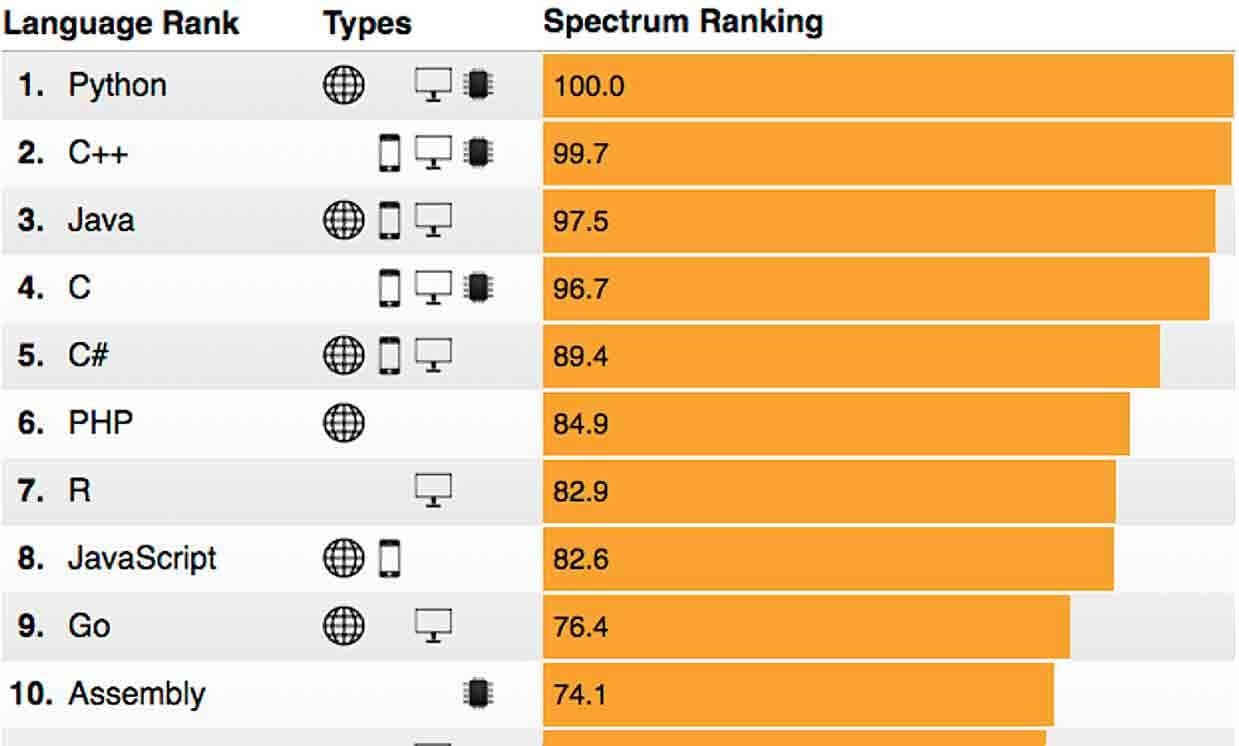
IEEE — top ten programming languages in 2018.
This guide walks through the basics of the C programming language: its history, basic commands, key applications, why it is still worth learning, and how its compilation model works.
History of C Language
C did not appear in isolation — it grew out of a chain of earlier system languages:
- ALGOL (1960): often called the father of programming languages. ALGOL introduced structured programming to the wider developer community and was widely adopted across European universities.
- BCPL (1967): Basic Combined Programming Language, designed by Martin Richards for writing system software.
- B (1970): introduced by Ken Thompson at AT&T Bell Laboratories. B inherited many BCPL features and was used to write early UNIX tools.

In 1972, Dennis Ritchie created C at Bell Laboratories. C drew the best ideas from ALGOL, BCPL, and B, and added new concepts that made it more expressive than any of its predecessors.
C is strongly associated with UNIX — much of the UNIX operating system itself was rewritten in C. As C spread beyond Bell Labs, commercial compilers appeared for many platforms, and the language evolved into multiple incompatible dialects. To restore consistency, the American National Standards Institute (ANSI) published a C standard in 1989, and the International Organization for Standardization (ISO) ratified it in 1990. The standardised version is widely called ANSI C.
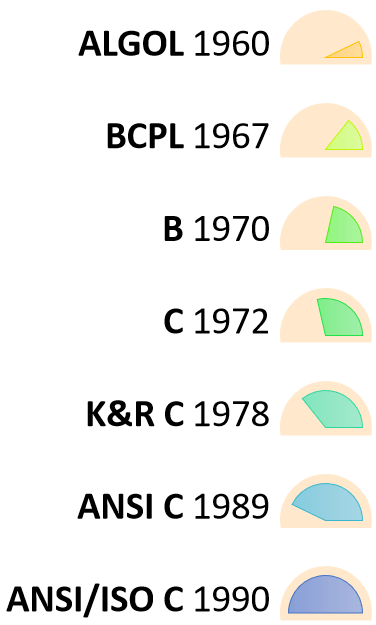
History of C.
Languages such as C++ and Java were developed directly from C, and many modern languages adopt its syntax and conventions. C therefore forms the foundation for a large share of today’s software.
C Basic Commands
The following commands form the skeleton of almost every C program.
| C basic command | Explanation |
|---|---|
#include <stdio.h> |
Includes the standard input-output header file from the C library before compilation. |
int main() |
The main function — execution of every C program begins here. |
{ |
Marks the beginning of the main function block. |
/* some_comments */ |
A comment. The compiler ignores everything between /* and */. |
printf("Hello, World!"); |
Prints output to the screen. |
getch(); |
Reads a single character from the keyboard (non-standard, mainly used with Turbo C). |
return 0; |
Terminates the main function and returns the value 0 to the operating system. |
} |
Marks the end of the main function block. |
Where is C Used? Key Applications
C runs in places most users never see, but its footprint is enormous. Common areas include:
- Embedded systems and microcontroller firmware.
- System-level applications and drivers.
- Desktop applications, including many Adobe products.
- Web browsers and their extensions — Google’s Chromium contains a large amount of C/C++ code.
- Databases — MySQL is one of the most popular databases written in C.
- Operating systems — Apple’s macOS (Darwin), Microsoft Windows, Linux, and historically Symbian were all built using C.
- Compilers, language runtimes, and interpreters.
- Internet of Things (IoT) devices and home automation firmware.
Why Learn C Language?
C is the base for many programming languages, so learning C makes every subsequent language easier to pick up. It introduces the same data types, operators, and control statements you will see in C++, Java, Python, and Go.
Key reasons to invest in C are:
- Speed: C compiles to native code and gives you fine-grained control over memory.
- Portability: programs written in C can be recompiled and run on virtually every platform.
- Structure: a C program is divided into modules, which makes it easier to test, maintain, and debug.
- Compact core: C has only 32 keywords, several data types, and a powerful built-in library.
- Extensibility: you can add your own functions to a library and call them as if they were built-in.
- Career value: embedded, kernel, and high-performance roles still demand strong C skills.
How C Programming Language Works
C is a compiled language. The compiler reads the source code and produces an object file that the machine can understand. The linker then combines one or more object files (and any libraries you reference) into a single executable that can be run on the target platform. The diagram below shows the full execution flow.

Many compilers are available — online and offline — and they all follow the same pipeline. Popular choices include:
- GCC — the GNU Compiler Collection, the de-facto standard on Linux and many embedded targets.
- Clang — the LLVM-based front-end, used by default on macOS.
- MinGW — Minimalist GNU for Windows, brings GCC to Windows users.
- Portable C compiler (pcc).
- Turbo C — the classic compiler still used in many academic courses.
Advantages and Disadvantages of C
The table below summarises the trade-offs you should weigh before choosing C for a new project.
| Advantages | Disadvantages |
|---|---|
| Fast, low-level access to memory and hardware. | Manual memory management invites bugs such as leaks and buffer overflows. |
| Portable across architectures and operating systems. | No built-in object orientation or generics. |
| Compact syntax with only 32 keywords. | No built-in safety net — undefined behaviour can crash silently. |
| Huge ecosystem of compilers, debuggers, and libraries. | Verbose for high-level application code compared with scripting languages. |
| Foundation for modern languages — skills transfer easily. | Slower productivity for tasks where managed languages would suffice. |
Best Practices When Writing C
The habits below keep C codebases readable, portable, and free of common memory bugs:
- Enable warnings: compile with
-Wall -Wextra -Werrorso subtle issues fail the build. - Initialise variables: never read from a variable that has not been assigned a value.
- Check return values:
malloc, file I/O, and system calls all signal errors via return codes. - Pair every
mallocwith afree: use static analysis or AddressSanitizer to catch leaks. - Prefer safer string functions: use
snprintfinstead ofsprintfandstrncpywith care. - Use header guards: protect every header with an
#ifndef / #define / #endifguard. - Lean on the standard: write portable ANSI/C99/C11 code unless you have a compelling reason to use compiler extensions.
