
SAP SPS Upgrade: Support Package Stack
 Jessica Blake
⚡ Smart Summary
Support Package and Stack Upgrade in SAP delivers bug fixes and enhancements through bundled SAP Notes. This article explains how SAP Notes, Support Packages, and Stacks (SPS) work together, plus the six SPAM steps that apply them safely.
What is a Support Package?
- When an SAP end user finds a bug in a SAP product, they report it to SAP Support. SAP developers analyse the bug and ship a correction. This correction is known as a SAP Note (sometimes referenced by its older abbreviation SNOTE).
- Over time, SAP collects related notes into a single delivery; that bundle is called a Support Package. A support package also includes enhancements to earlier versions of the product.
- In simple terms, a Support Package is a tested collection of SAP Notes for a given software component.
- Support Packages are applied to a SAP system using transaction SPAM (Support Package Manager).
What is a Support Package Stack (SPS)?
The Support Package Stack is a coordinated list of ABAP and Java Support Packages for every software component included in SAP NetWeaver. It is used to raise each software component of SAP NetWeaver to a defined Support Pack (SP) level.
A Support Package Stack — commonly referred to as the stack — bundles all required components and individual patches that have been tested together. SAP recommends applying the SPS as a unit rather than installing individual patches, unless a specific incident requires a targeted patch.
Visit the SAP Support Package Stacks page and select your NetWeaver release to check the current SPS level and the recommended target stack.
Support Package Stack Version Numbers
Every Support Package Stack has a release number and a stack number — for example, “SAP NetWeaver ’04 Support Package Stack 11.”
Each software component has its own sequence of Support Packages. The table below shows the technical name of each common component and the prefix that identifies its Support Packages.
| Component | Description | Support Package Prefix |
|---|---|---|
| SAP_APPL | SAP Application | SAPKH<rel><no> |
| SAP_BASIS | Basis | SAPKB<rel><no> |
| SAP_ABA | Application Basis | SAPKA<rel><no> |
| SAP_HR | Human Resources | SAPKE<rel><no> |
| SAP_SCM | Supply Chain Management | SAPKY<rel><no> |
| SAP_BW | Business Warehouse | SAPKW<rel><no> |
| SAP_CRM | Customer Relationship Management | SAPKU<rel><no> |
Prerequisites for Support Package Implementation
- Always apply Support Packages in client 000.
- Use a user with authorisations equivalent to DDIC or SAP* for the import.
- Open transaction SPAM and confirm that no previous Support Package import is incomplete. Do not start a new import until the previous one has finished successfully.
- Ensure that there is enough free space in the transport directory, located by default at
/usr/sap/trans. - Generate the target stack with SAP Maintenance Planner on the SAP Support Portal so that the queue is consistent and free of conflicts.
How to Upgrade the Support Package
The standard SPAM workflow consists of six steps. Follow each step in sequence on the source system before promoting through quality and production.
Step 1) Download Support Packages
Support Packages are available on the SAP Support Portal. Use the Maintenance Planner or the Software Center to download the .SAR files for the target stack.

Step 2) Load the Support Packages
Support packages can be loaded into SPAM in two ways:
- From the Application Server.
- From the Front End workstation.
From the Application Server:
- Download the support packages from the service marketplace and save them on the OS in
/usr/sap/trans. - Uncompress the archives using the SAPCAR executable:
sapcar -xvf <support-package-name>.SAR
After extraction, the resulting .PAT and .ATT files are stored in /usr/sap/trans/EPS/in. Load them into the SAP system using Support Package → Load Packages → From Application Server.

From the Front End: choose Support Package → Load Packages → From Front End and select the SAR files from your local workstation.

Step 3) Apply the SPAM/SAINT Update
A SPAM/SAINT update contains improvements to the Support Package Manager (SPAM) and the Add-On Installation Tool (SAINT). SAP releases one SPAM update per release. Installing the latest SPAM/SAINT update is mandatory before applying any Support Package.

Step 4) Define the Queue
The queue contains the Support Packages available for each SAP component installed in the system. The queue is built from the support packs loaded in Step 2.
- On the SPAM initial screen, choose Display / Define.
- SAP shows the list of installed software components (for example, SAP_BASIS, SAP_HR, SAP_BW).

Select the component you want to upgrade. The current queue appears with the Support Packages available for that component. To define the queue for another component, choose Other Component. When the queue meets the target, click Confirm Queue.


Step 5) Import the Queue
After the queue is defined, run the import to apply the selected Support Packages.
Choose Support Package → Import Queue.

Tip: Always read the SAP Note referenced on the import screen — it lists known issues and recommended actions for that stack.
SAP starts the import and shows progress on screen.

Step 6) Confirm the Queue
Confirm that the queue has been imported successfully. Without confirmation, SPAM blocks any future Support Package import.
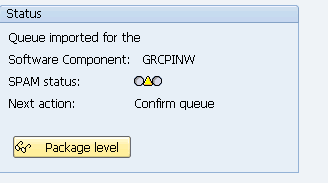
Once the queue has been imported, the SPAM status turns yellow. Confirm the successful import by choosing Support Package → Confirm.

Checking Logs
- Import Log: shows logs for the SPAM phases handled by the
tptransport control program. Go to Import log → Queue.

- Action Log: contains information about each phase, the point at which a phase stopped, and detailed error information. Open it from Action log.

- While the support packages are being imported, logs are written to the
/usr/sap/trans/tmpdirectory. - Once the import process is complete, logs are available in
/usr/sap/trans/log.
