
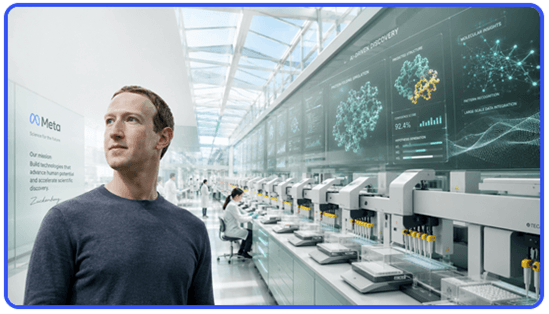
Zuckerberg’s Biohub Launches $500M AI Biology Model
ALSO: 70% oppose data centers, Anthropic’s $1.5B FDE bet


Welcome to Guru99 AI Report!
Top Story: Hey there — Zuckerberg just dropped $500M to make biology as predictable as ChatGPT. Meanwhile, 70% of Americans want AI’s data centers anywhere but their backyard. We’ve got both stories, plus what’s quietly rewiring your brain.
🚀 Zuckerberg drops $500M to crack the code of life!
Brief Buzz:
The Chan Zuckerberg Initiative-backed Biohub just unveiled a $500M Virtual Biology Initiative to build open datasets and AI models capable of predicting how human cells behave — a major push to make biology as “simulatable” as language and protein folding.
- $400M will fuel data generation and imaging tech, while $100M supports external research labs.
- Nvidia, Allen Institute, and Arc Institute are joining in, with all datasets being open-sourced as a shared foundation for AI biology research.
- Today’s biology datasets cap out near 1 billion cells — Biohub says an order of magnitude more is needed to truly move the needle.
- The end goal: AI that helps in “understanding disease and reprogramming it at the level of cells, molecules, and tissues.”
💡 Why Should You Care?
If this works, it could fundamentally change how medicine is developed. Instead of years of trial-and-error lab experiments, scientists could simulate diseases and test treatments inside an AI model — slashing drug discovery timelines and costs. Demis Hassabis has even suggested AI could one day end disease. The real test? Whether the scaling magic that cracked language and proteins also works on the messy complexity of human cells.
🤔 Why Americans Suddenly Hate Their Neighbors’ Newest Buildings

Brief Buzz:
A new Gallup poll reveals AI’s growing PR crisis: roughly 70% of Americans oppose data center construction in their neighborhoods, citing environmental damage, rising costs, and quality-of-life worries. The opposition cuts across party lines, signaling real trouble ahead for AI’s massive infrastructure expansion.
- 48% strongly oppose local data centers; only 7% strongly favor them.
- Environmental concerns dominate: 50% worry about resource strain, plus water use, power grid stress, and pollution.
- Opposition is bipartisan: 75% of Democrats, 74% of independents, and 63% of Republicans against.
- Only 16% of Americans use AI regularly, per a Microsoft study, highlighting low everyday engagement.
- Supporters (a minority) hope for jobs, tax revenue, and infrastructure upgrades.
💡 Why Should You Care?
Data centers powering AI guzzle water and electricity, potentially driving up your utility bills and straining local resources. Without public buy-in, AI’s infrastructure boom faces grassroots activism, legal battles, and political backlash — which could stall the technology’s promised future and turn AI into the next big campaign issue.
⚡ This AI Habit Is Quietly Rewiring Your Brain

Brief Buzz:
While companies race to boost AI literacy, ServiceNow’s chief learning officer Jayney Howson warns we’re “sleepwalking” into losing critical soft skills. As workers offload thinking to AI, they risk forfeiting the instincts and judgment that made them effective in the first place, according to a report from The Deep View.
- ServiceNow University has enrolled over 2 million people in AI upskilling courses, but Howson is now seeing a troubling side effect emerge across departments.
- Workers, especially in sales, are leaning on AI-generated meeting briefs and customer summaries instead of trusting their own read of the room.
- This cognitive offloading weakens decision-making, making employees dependent on tools to structure their thinking rather than support it.
- Howson prescribes a three-part skill mix: core role expertise, AI fluency, and the judgment to know when not to use AI.
💡 Why Should You Care?
Every knowledge worker is in the firing line. If AI becomes a crutch, performance could collapse the moment a tool fails or goes offline. Worse, companies pushing aggressive AI mandates may quietly erode the very human instincts — reading people, navigating uncertainty, trusting your gut — that make workers valuable in the first place.
🚀 AI just got a memory upgrade — and it changes everything

Brief Buzz:
Celonis just unveiled the Celonis Context Model (CCM) — a real-time digital twin of business operations designed to give enterprise AI the context it desperately needs to actually deliver value. Paired with a major acquisition, it could reshape how big companies deploy AI.
- CCM unifies structured and unstructured data across systems, policies, and processes into one language AI can understand — going beyond a typical knowledge graph or MDM system.
- Celonis acquired Ikigai Labs, an MIT-founded company led by Dev Shah, specializing in forecasting and what-if scenario simulation.
- Early evaluations with AstraZeneca, Mercedes, and Domino Foods showed dramatic gains in efficiency, accuracy, and task completion.
- Co-CEO Alex Rinke says the biggest blocker for enterprise AI isn’t smarter models — it’s the lack of business context.
- Builds on Celonis’s Gartner Magic Quadrant leadership in process intelligence.
💡 Why Should You Care?
Most enterprise AI projects quietly fail because the AI doesn’t actually understand the business it’s working in. If CCM delivers, expect faster customer service, smarter pricing, quicker insurance claims, and fewer frustrating bot interactions at the companies you deal with daily. For the half of Fortune 200 companies already using Celonis, this could be the difference between AI hype and AI that genuinely saves you time.
🚀 Hollywood’s AI crisis just met its match — and it’s a game-changer!

Brief Buzz:
Hollywood’s biggest names are drawing a line in the sand against AI. A new alliance led by Cate Blanchett’s nonprofit RSL Media has unveiled the “Human Consent Standard,” giving actors and creators granular control over how their likeness and work get used by AI systems.
- The standard lets creators set terms ranging from complete restriction to unlimited permissions, embedded directly into their digital IP, identity, or character.
- Heavy-hitter backers include Viola Davis, Kristen Stewart, Tom Hanks, Meryl Streep, and George Clooney.
- AI crawlers will be required to check works against an RSL registry launching in June, which translates creator terms into signals AI systems can read.
- It joins a growing resistance movement including the “Stealing Isn’t Innovation” petition and the Creators Coalition on AI.
- The irony: a WIRED report this week found struggling Hollywood screenwriters are increasingly taking AI training gigs to pay the bills.
💡 Why Should You Care?
This fight isn’t just for celebrities. If “consent-first” becomes the norm for AI training, it sets a powerful precedent for protecting your face, voice, writing, and photos from being scraped online without permission — reshaping the rules for everyone in the digital age.
🎯 AI Labs Borrow Palantir’s Playbook to Win Enterprise Deals

Brief Buzz:
Selling AI to Fortune 500 giants isn’t just about flashy demos anymore. In just two weeks, Anthropic, OpenAI, and Google all reached for the same playbook: embedding engineers directly inside customer offices to ship real code, not slide decks.
- Anthropic launched a $1.5B venture with Blackstone and Goldman Sachs to place engineers inside mid-sized firms.
- OpenAI spun up its own Deployment Company the very same week.
- Google is now hiring hundreds of Forward-Deployed Engineers (FDEs) to compete.
- The strategy copies Palantir’s “Deltas” model — a decade-old playbook tied to its 640% stock return since 2022 lows.
- FDEs bridge a critical gap: customers know their data and compliance; vendors know the AI architecture.
💡 Why Should You Care?
This shift means the AI tools shaping your bank, hospital, or workplace will soon be deeply baked into core systems — not bolted-on chatbots. Expect smarter, more tailored enterprise software, but also serious vendor lock-in: once Claude or GPT runs a company’s compliance workflow, swapping it out becomes nearly impossible.


Hey! I’m Krishna Rungta
Founder of Guru99.com, Editor-in-chief & Technology Expert
Was this email forwarded to you? Sign up for free here.
