
Snapchat Lays Off 1,000 Employees Due to AI Adoption
ALSO: Eli Lilly’s $2.75B deal, Meta’s token leaderboard


Welcome to Guru99 AI Report!
Top Story: AI is quietly rewriting the rules this week — Snap trimmed 1,000 jobs, Eli Lilly placed a $2.75B bet on AI drug discovery, and Meta is ranking engineers by token spend. Curious where you fit in? Let’s unpack it.
💼 Snap Cuts 1,000 Jobs Amid AI Transformation

Brief Buzz:
Snap Inc. is laying off roughly 1,000 employees — about 16% of its full-time workforce — and shutting more than 300 open roles, CEO Evan Spiegel announced in an April 15, 2026 memo. The restructuring aims to unlock profitability, with AI cited as the reason smaller teams can now do more.
- Layoffs plus 300+ unfilled roles closed, part of Spiegel’s “crucible moment” pivot toward profitable growth
- Expected to slash annualized costs by over $500 million by the second half of 2026, clearing a path to net-income profitability
- AI tools credited with driving gains across Snapchat+, ad platform performance, and Snap Lite infrastructure
- US departing staff receive four months of severance, healthcare coverage, equity vesting, and career transition support
💡 Why Should You Care?
Snap joins a growing list of tech giants slimming down while leaning on AI to do more with less. Even high-profile companies are now restructuring around AI-assisted workflows — a clear signal that AI-driven job disruption isn’t theoretical, it’s happening right now.
🧠 Why Humans Still Matter in a World of AI Agents
Brief Buzz:
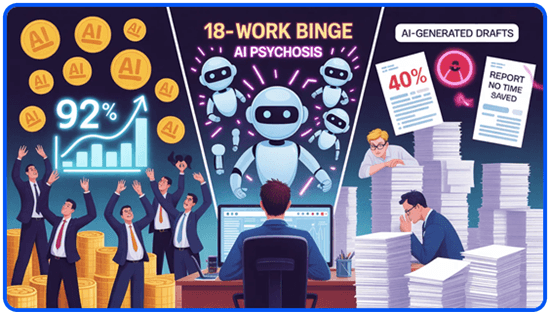
The AI agent gold rush is in full swing, but beneath the hype lies a messier reality. From “workslop” flooding inboxes to “AI psychosis“ driving coders into 18-hour work binges, experts warn that agents without proper human direction are creating more chaos than productivity.
- Peter Steinberger, founder of OpenClaw, warns agents are “spiky smart” but churn out slop without clear human vision and sharp questions.
- A recent study shows white-collar workers are drowning in AI-generated “workslop” — poorly directed documents they’re forced to clean up.
- A telling disconnect: 92% of executives say AI boosts productivity, yet 40% of workers claim it saves them no time at all.
- Coined from Andrej Karpathy’s comments, “AI psychosis” describes coders managing agent swarms in a token-maxxing frenzy — worn almost as a badge of honor.
- Insiders at the HumanX conference say the psychosis trend is wildly exaggerated, but low-quality output is still being rewarded.
💡 Why Should You Care?
If you work in an office, you’re probably already feeling this. Agents promise productivity but often deliver more work — piles of half-baked drafts someone has to fix. The real takeaway: AI tools are only as sharp as the humans steering them. Asking better questions beats deploying more agents, every time.
🚀 Adobe’s Groundbreaking AI for Enterprises is Here!
Brief Buzz:
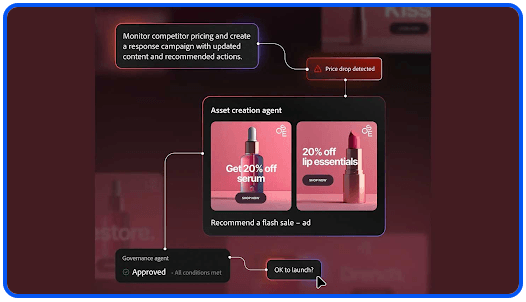
Adobe dropped CX Enterprise at its Adobe Summit — a new agentic platform built to help businesses orchestrate marketing, content, and customer interactions through coordinated networks of AI agents working together.
- The platform unifies three pillars — brand visibility, content supply chain, and customer engagement — under one agentic orchestration layer.
- CX Enterprise Coworker assembles the right agents and tools for each user goal, creating plans and executing multi-step actions autonomously.
- Adobe’s Marketing Agent now plugs into ChatGPT, Claude, Gemini, and Copilot, bridging major AI assistants with Adobe apps.
- A new agent skills catalog lets enterprises build reusable, customizable workflows tailored to their needs.
💡 Why Should You Care?
The entire design and marketing world is racing toward agentic workflows, with Figma, Canva, and Adobe all jockeying for position. But the bigger shake-up? AI labs are starting to cut out the middleman — launches like Claude Design could make legacy orchestration platforms increasingly optional, meaning the marketing stack you rely on today might look very different a year from now.
🚀 Eli Lilly’s $2.75B Gamble Could Revolutionize Drug Discovery!

Brief Buzz:
Pharmaceutical heavyweight Eli Lilly just inked a blockbuster $2.75 billion deal with Hong Kong-based Insilico Medicine to bring AI-discovered drugs to the global market. The partnership marks one of the biggest bets yet on generative AI’s power to reshape how medicines are found and fast-tracked.
- Insilico pockets $115 million upfront, with the rest tied to regulatory milestones and royalties on future sales.
- The company has already developed 28 drugs using generative AI, with nearly half in clinical-stage trials.
- Insilico will join Lilly’s Gateway Labs biotech community, deepening a collaboration that started in 2023.
- AI dramatically cuts research timelines by synthesizing molecules faster than traditional lab methods.
- The deal follows Lilly’s $3 billion China investment push announced earlier this year.
💡 Why Should You Care?
This deal signals that AI-discovered medicines are no longer hype — they’re becoming a real pipeline for Big Pharma. For patients awaiting breakthroughs in cancer, rare diseases, or Alzheimer’s, faster discovery could mean life-saving treatments arriving years sooner and potentially at lower costs.
🧐 Why Token Spend Is The New Status Symbol

Brief Buzz:
Meta’s internal “Claudeonomics” leaderboard is ranking 85,000 employees by their AI token consumption, sparking a bizarre new productivity race. The company burned through 60 trillion tokens in 30 days — triple the text of every book ever published — revealing how tech giants are measuring engineering value in all the wrong ways.
- Token gaming is rampant: Meta employees leave AI agents running idle overnight to boost rankings, while an OpenAI engineer clocked 210 billion tokens in one week.
- “Tokenmaxxing” echoes the early 2000s obsession with lines of code — a metric that famously misrepresented real developer impact.
- Reasoning models worsen the problem by generating verbose inner monologues, turning inference-time compute into costly overhead.
- Even Nvidia’s Jensen Huang endorsed the trend, suggesting $500K engineers should spend $250K yearly on tokens (though he sells the chips powering it all).
💡 Why Should You Care?
When trillion-dollar companies confuse activity with achievement, the costs trickle down — in higher software prices, wasted energy, and AI tools optimized for consumption rather than usefulness. If engineers are rewarded for burning tokens instead of solving problems, expect bloated, over-engineered AI products that chatter endlessly without delivering real value.
🤖 How to Automate Your Chrome Browser with Gemini

This guide walks you through how to enable and make the most of our favorite Gemini in Chrome features. If you’re subscribed to Google AI Pro, you’ll also discover how to activate and use Chrome automations.
Step-by-step:
- In Chrome, go to Settings → AI Innovations → Gemini in Chrome, then switch on “Show Gemini at the top of the browser” and “Share current tab with Gemini”. On Google AI Pro, also turn on “Let Gemini browse for you”.
- Open three product tabs, click Gemini, type @ to attach tabs, then prompt: “Compare [products] and tell which offers the best features for the best price”.
- Gemini will analyze the options and provide a recommendation. Works even without Pro since you’re sharing tabs directly.
- With AI Pro, try: “Find me a cheaper [product type] with these same features.” Gemini will generate a plan and execute it in Chrome on your behalf.
💡 Pro Tip
To get the most accurate comparisons, make sure each product tab is fully loaded on the actual product page (not a search results page) before tagging it with @ — this gives Gemini direct access to specs, pricing, and reviews, resulting in sharper, more reliable recommendations.
📸 AI Generator Images: Collector’s Edition

ChatGPT Prompt
Realistic 1/7 scale action figure of [PLAYER NAME] on a computer desk, clear acrylic base, monitor showing ZBrush sculpting process of the same figure, BANDAI-style box with the figure inside in the background, modern collector’s workspace, soft animated ambient lighting, subtle motion blur on background elements, floating holographic UI elements around the figure, cinematic depth of field, highly detailed textures, shimmering reflections on the acrylic base, slight particle effects in the air to create atmosphere, 3:4 aspect ratio, 300 DPI, ultra-realistic rendering, dynamic animated scene vibes.


Hey! I’m Krishna Rungta
Founder of Guru99.com, Editor-in-chief & Technology Expert
Was this email forwarded to you? Sign up for free here.
