
Anthropic Economic Index 2026: When People Use AI
ALSO: Microsoft dumps OpenAI, 78% hit by AI breaches


Welcome to Guru99 AI Report!
Top Story: Ever wondered exactly when AI slips into your day? This week we track Claude around the clock, spotlight the security blind spots hiding in AI agents, and reveal why the billable hour is quietly disappearing. Let’s dig in.
🕐 Claude Now Follows Your Daily Rhythm, Hour by Hour
Brief Buzz:
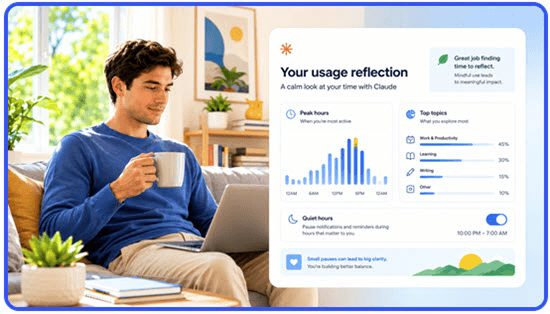
Anthropic just dropped its latest Economic Index report, and it’s watching the clock. By sampling Claude usage around the clock and surveying 9,700 users, it maps exactly how — and when — AI slips into your daily grind, from morning news to midnight sleep tips.
- New hourly data (not old seven-day snapshots) caught news questions peaking at breakfast, recipes at dinner, and sleep advice before dawn.
- Personal chats jumped from ~one-third on weekdays to nearly half on weekends, leaning into health, money, and support.
- The heaviest AI delegators expect Claude to handle even more next year — and feel better about their pay, job security, and purpose.
- 93% of chats now produce something usable, mostly explanations, documents, and step-by-step guidance.
💡 Why Should You Care?
Benchmarks measure how smart AI is; this reveals how embedded it’s become. When Claude handles your recipes and sleep tips, everyday trust matters as much as raw capability.
🚨 AI Agents Are Becoming Security Blind Spots

Brief Buzz:
Enterprises are racing to add AI agents to daily workflows, but security is lagging badly. In a new DigiCert survey of 1,001 IT and security leaders, most had already run into AI-related incidents or vulnerabilities — even as 75% deployed four or more AI systems in just six months.
- Nearly 80% of organizations reported an AI-related security incident or vulnerability.
- About half traced incidents to an unauthorized or misconfigured AI agent — not faulty AI-generated code.
- Flagged risks: prompt injection, data poisoning, unauthorized access, and weak traceability.
- 90% discuss AI governance at the board level, but only about half have formal programs — and only 57% have dedicated AI security budgets.
- In response, companies are moving toward stronger AI identity, access, and audit controls.
💡 Why Should You Care?
AI is a security surface, not just a productivity tool. If you can’t answer what’s running, what it can access, and who’s accountable, one rogue agent means real trouble.
💸 AI Is Quietly Killing Consulting’s Billable Hour

Brief Buzz:
The old consulting deal — bill smart people by the hour — is cracking. As AI compresses 40-hour projects into 10, firms can’t justify the clock anymore. Now the industry is scrambling toward fixed fees and outcome-based pay, and it could reshape how everyone gets paid.
- Deloitte reportedly showed consultants a chart predicting traditional labor-based consulting could shrink sharply by 2035, with AI agents taking a bigger share.
- Clients now want firms to put “skin in the game”, so firms are testing fixed-fee and outcome-based pricing.
- McKinsey says 30%+ of its global fees already come from pricing linked to client outcomes.
- The catch: outcome pay can reward rushed work, and “savings” often means cutting headcount — making AI consulting a potential layoff accelerant.
💡 Why Should You Care?
Not just a consultant problem — billable hours and salaries both punish efficiency. Done right, AI’s gains mean real payouts. Done wrong: fewer people, higher quotas, same paycheck.
🤖 Agents Are Quietly Replacing Your Chatbot at Work

Brief Buzz:
New OpenAI research offers the clearest look yet at how AI agents are reshaping work — not just automating tasks, but expanding what people can do. Inside OpenAI, agents have already overtaken chatbots as the everyday tool of choice.
- Agents are replacing chatbots: every OpenAI department now leans on its Codex agent, with the average worker generating 85% of their output there instead of in ChatGPT.
- Work jumps from minutes to hours: 70% of sampled users have handed the agent a task worth over an hour of human effort, and 25% have delegated a full 8-hour job.
- Jobs expand, not just shrink: workers used agents to take on tasks outside their expertise, becoming more valuable rather than redundant.
- The shift is broad: fresh KPMG data pegs employee agent adoption at 68%, with just 2% of leaders reporting real pushback.
💡 Why Should You Care?
Agents aren’t only cutting busywork — they’re stretching what one person can pull off. Soon, knowing how to delegate to them may matter as much as knowing your own job.
🧠 Your Curiosity Is the Edge AI Can’t Replace

Brief Buzz:
A new Midlife Unfiltered conversation argues that as AI gets better at answering almost anything, our sharpest human advantage isn’t speed or recall — it’s curiosity. The hosts unpack how to use AI as a thinking partner, not a replacement brain.
- Use AI two ways: as a thinking partner you challenge, or as an answer machine you blindly accept — only the first keeps your judgment sharp.
- Beware the bias loop the hosts call “building, boosting, bracing”: leading questions get amplified by algorithms until your views harden. Prompt for blind spots instead.
- “Cognitive debt” is real — MIT research found essay-writers using ChatGPT showed weaker brain connectivity and poorer recall than unaided peers, though authors call it early and narrow.
- The fix: “cognitively wrestle” with AI’s output, fact-check it, and keep prompts hypothetical to protect privacy — Kiki Hart shares starter prompts to practice.
💡 Why Should You Care?
AI makes us faster, but outsourcing every thought risks dulling the curiosity and critical thinking that keep us sharp, independent, and connected. The encouraging part: it’s never too late to start.
🔄 Microsoft Starts Swapping OpenAI, Anthropic for Its Own AI

Brief Buzz:
Frustrated with Excel or Outlook? The AI helping you may have quietly switched teams. Microsoft has begun replacing OpenAI and Anthropic models with its own in-house MAI models in these apps — handling tens of thousands of prompts a week — all to shrink a ballooning AI bill.
- Microsoft’s internally built models now complete tens of thousands of routine Excel and Outlook prompts weekly, Bloomberg reported — work that once leaned on OpenAI and Anthropic.
- The driver is cost: running its own models is far cheaper than licensing others. AI chief Mustafa Suleyman says the aim is to “reduce and ultimately eliminate” Anthropic spending.
- It’s part of a wider squeeze — Microsoft also cut 4,800 jobs (2.1% of staff) this week, insisting those roles “are not being replaced by AI.”
- The bet: with Office 365’s built-in user base, models even 80–90% as good as rivals could win if they’re cheaper and seen as safe.
💡 Why Should You Care?
If your Copilot answers feel different, now you know why. Most users won’t notice a change — but even AI giants are scrambling to tame runaway costs, and “good enough and cheap” may soon beat “best.”


Hey! I’m Krishna Rungta
Founder of Guru99.com, Editor-in-chief & Technology Expert
Was this email forwarded to you? Sign up for free here.
