
What is a Business Analyst? Roles & Responsibilities
 Editorial Team
⚡ Smart Summary
Business Analysts translate business problems into clear requirements, connecting stakeholders and technology so organisations improve processes, launch new features, and make data-backed decisions with confidence across sectors like IT, finance, and operations.

What is a Business Analyst?
A Business Analyst is a person who helps businesses to analyze their processes, products, services, and systems to improve current processes and make profitable decisions through insights and data analysis. A Business analyst also helps organizations to document business processes by assessing the business model and its integration with technology.
Who is a Business Analyst?
Business Analysts have emerged to have a key role in recent business scenarios. Some people think that the role of a Business Analyst is to make money for the organization, which may not be true in direct context. But indirectly, the actions and decisions taken by Business Analysts do leave an impact on the financial prospects of the organization.
What does a Business Analyst Do?
A primary job responsibility of a Business Analyst is to communicate with all stakeholders & to elicit, analyze and validate the requirements for changes to business processes, information systems, and policies.
A professional business analyst plays a big role in moving an organization toward efficiency, productivity, and profitability.
Before we jump into the tutorial, we will see some basic perspective of a Business Analyst to help the organization succeed. The foremost priority for any business analyst will be to try to understand the following things
- Understand what the business does and how it does it
- Determine how to improve existing business processes
- Identify the steps or tasks to support the implementation of new features
- Design the new features to implement
- Analyze the impact of implementing new features
- Implement the new features
Next in this Business Analyst basics tutorial, we will learn about Business Analyst roles and responsibilities.
Business Analyst Roles and Responsibilities
A Business Analyst can be from any sector, and the role differs based on the sector. Business Analysts are classified into various categories like
- Business Analyst
- Business Process Analyst
- IT Business Analyst
- Business System Analyst
- System Analyst
- Data Analyst
- Functional Architect
- Usability or UX Analyst
Skills of a Good Business Analyst
Basically, Business Analyst skills are judged on these four attributes:
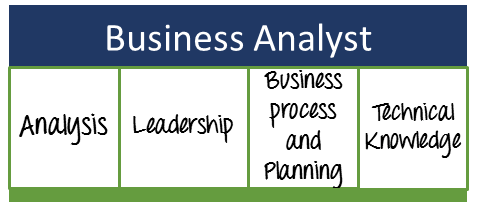
Skills of a Good Business Analyst
- Analytical skills– Strong analytical skills separate a good Business Analyst from an average one. A good part of BA role includes basics of business analysis, analyzing data, workflow, user or stakeholder inputs, documents, etc.
- Leadership skills– One of the Business Analyst responsibilities is directing team members, forecasting budget, helping team members with the problem, etc.
- Business process and planning– Planning the project scope, understanding and implementing the requirements of the project, identifying resources required for the project and so on
- Technical skill– If a business analyst is in the IT sector, a few technical aspects are expected to be known like operating systems, hardware capabilities, database concepts, networking, SDLC methodology, etc.
Certifications
As per the International Institute of Business Analysis (IIBA), CBAP (Certified Business Analysis Professional) certification is a recognized certificate for a professional Business Analyst. They provide two types of certifications. The certification exam is computer based and consists of multiple choice questions.
- Certification of Competency in Business Analysis: Pre-requisite for this certification is at least 3,750 hours of work experience
- Certified Business Analysis Professional (senior level): Pre-requisite for this certification is at least 7,500 hours of work experience
Off-shore students can take the certification exam online. For more information, you can visit the IIBA website.
Jobs
Job prospects for Business Analyst requirements rise every year, especially for the IT sector. The average salary of business analyst is estimated around $80,000 – $130,000, even at entry level.
International Institute of Business Analysis (IIBA) is growing exponentially indicating increasing demand of Business Analyst. Business Analysts always remain an organizational priority since they work in close proximity to top executives, clients, and stakeholders.
According to the U.S. Bureau of Labor Statistics, management-analyst jobs, which include Business Analysts, are projected to grow about 10 percent from 2022 to 2032 — faster than the average for all occupations.
Popular Business Analysis Techniques and Frameworks
Business Analysts rely on a small set of proven techniques to move from vague business problems to clear, testable requirements. The following techniques appear in the BABOK Guide and across most enterprise projects.
- SWOT analysis: Maps strengths, weaknesses, opportunities, and threats to inform strategy and prioritise features.
- PESTLE analysis: Reviews political, economic, social, technological, legal, and environmental factors that influence the business context.
- MoSCoW prioritisation: Sorts requirements into Must-have, Should-have, Could-have, and Would-not-have this time, keeping scope focused and stakeholders aligned.
- Use case modelling: Describes system behaviour from the actor’s point of view and forms the backbone of many requirements documents.
- Business process modelling (BPMN): Uses standardised diagrams to visualise current-state and future-state processes, making handoffs and inefficiencies visible.
- Root cause analysis (Five Whys, Fishbone): Traces symptoms back to underlying causes so fixes address the real problem instead of the surface issue.
- Gap analysis: Compares the current state against the desired future state and highlights the work needed to close the difference.
Choosing the right technique depends on the phase of the project. Discovery leans on SWOT, PESTLE, and process modelling. Requirements definition relies on use cases and MoSCoW. Solution assessment uses gap analysis and root cause analysis. Applying these techniques consistently is what separates a routine analyst from a Business Analyst who drives measurable outcomes.
Top Tools Used by Business Analysts
Business Analysts use a mix of modelling, documentation, and collaboration tools to run their work. The most common tools cover four areas.
- Requirements management: Jama Connect, IBM DOORS, and Blueprint capture requirements, trace them to tests, and support impact analysis for change requests.
- Diagramming and modelling: Microsoft Visio, Lucidchart, and draw.io render process flows, use case diagrams, and data models used by developers and stakeholders.
- Backlog and workflow: Jira, Azure DevOps, and monday.com track epics, stories, and defects across agile teams, giving Business Analysts a live view of scope and priority.
- Collaboration and documentation: Confluence, SharePoint, and Notion store the business analysis plan, meeting notes, and decisions in one searchable place.
The right toolset depends on team size, regulatory needs, and the delivery method. Many teams start with a lightweight combination of Jira, Confluence, and Lucidchart and add heavier requirements management tools when scale demands it.
