Capability Maturity Model (CMM) in Software Engineering

โšก Smart Summary

Capability Maturity Model (CMM) is a benchmark used to measure how mature an organization’s software process is. Developed at the Software Engineering Institute, it defines five levels that guide teams from chaotic, ad-hoc work toward continuous, optimized improvement.

  • ๐Ÿ“Š Definition: CMM is a benchmark that measures the maturity of an organization’s software development process.
  • ๐Ÿ›๏ธ Origin: It was developed at the Software Engineering Institute in the late 1980s for the U.S. Air Force.
  • ๐Ÿชœ Five Levels: Initial, Managed, Defined, Quantitatively Managed, and Optimizing form the maturity ladder.
  • โณ Implementation Time: Full adoption typically takes months per level, not an overnight change.
  • ๐Ÿงฉ Key Process Areas: Each level, except Level 1, is defined by Key Process Areas (KPAs) that group related goals.
  • โš ๏ธ Limitation: CMM states what a process should address, not how to implement it, and ignores business strategy.

Capability Maturity Model (CMM)

What is CMM?

Capability Maturity Model is used as a benchmark to measure the maturity of an organization’s software process.

CMM was developed at the Software Engineering Institute in the late 80’s. It was developed as a result of a study financed by the U.S. Air Force as a way to evaluate the work of subcontractors. Later, based on the CMM-SW model created in 1991 to assess the maturity of software development, multiple other models were integrated with CMM-I.

Capability Maturity Model

What is Capability Maturity Model (CMM) Levels?

The model defines five progressive maturity levels:

  1. Initial
  2. Repeatable/Managed
  3. Defined
  4. Quantitatively Managed
  5. Optimizing

Capability Maturity Model (CMM) Levels

What happens at different levels of CMM?

The table below breaks down the activities and benefits at each level.

Levels Activities Benefits
Level 1 Initial
  • At level 1, the process is usually chaotic and ad hoc.
  • A capability is characterized on the basis of the individuals and not of the organization.
  • Progress not measured.
  • Products developed are often behind schedule and over budget.
  • Wide variations in the schedule, cost, functionality, and quality targets.
None. A project is Total Chaos.
Level 2 Managed
  • Requirement Management
  • Estimate project parameters like cost, schedule, and functionality
  • Measure actual progress
  • Develop plans and process
  • Software project standards are defined
  • Identify and control products, problem reports, changes, etc.
  • Processes may differ between projects
  • Processes become easier to comprehend
  • Managers and team members spend less time explaining how things are done and more time executing it
  • Projects are better estimated, better planned, and more flexible
  • Quality is integrated into projects
  • Costing might be high initially but goes down over time
  • Requires more paperwork and documentation
Level-3 Defined
  • Clarify customer requirements
  • Solve design requirements, develop an implementation process
  • Makes sure that the product meets the requirements and intended use
  • Analyze decisions systematically
  • Rectify and control potential problems
  • Process Improvement becomes the standard
  • Solution progresses from being “coded” to being “engineered”
  • Quality gates appear throughout the project effort with the entire team involved in the process
  • Risks are mitigated and do not take the team by surprise
Level-4 Quantitatively Managed
  • Manages the project’s processes and sub-processes statistically
  • Understand process performance, quantitatively manage the organization’s project
  • Optimizes Process Performance across the organization
  • Fosters Quantitative Project Management in an organization
Level-5 Optimizing
  • Detect and remove the cause of defects early
  • Identify and deploy new tools and process improvements to meet needs and business objectives
  • Fosters Organizational Innovation and Deployment
  • Gives impetus to Causal Analysis and Resolution

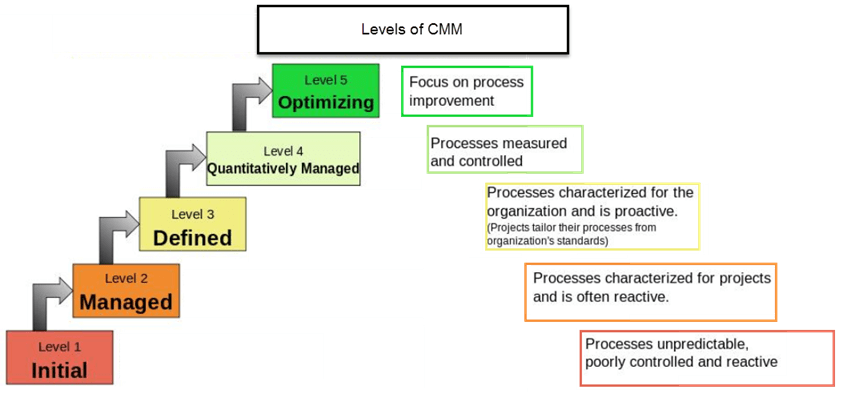
The following diagram gives a pictorial representation of what happens at different CMM levels:

Different Levels of CMM

How long does it Take to Implement CMM?

CMM is the most desirable process to maintain the quality of the product for any software development company, but its implementation takes a little longer than what is expected.

  • CMM implementation does not occur overnight.
  • It is not merely “paperwork.”
  • Typical times for implementation are:
  • 3-6 months -> for preparation
  • 6-12 months -> for implementation
  • 3 months -> for assessment preparation
  • 12 months -> for each new level

Internal Structure of CMM

Each level in CMM is defined into a key process area or KPA, except for level-1. Each KPA defines a cluster of related activities, which when performed collectively achieve a set of goals considered vital for improving software capability.

For different CMM levels, there are sets of KPAs. For instance, for CMM model-2, the KPAs are:

  • REQM – Requirement Management
  • PP – Project Planning
  • PMC – Project Monitoring and Control
  • SAM – Supplier Agreement Management
  • PPQA – Process and Quality Assurance
  • CM – Configuration Management

Likewise, for other CMM models, you have specific KPAs. To know whether the implementation of a KPA is effective, lasting, and repeatable, it is mapped on the following basis:

  1. Commitment to perform
  2. Ability to perform
  3. Activities performed
  4. Measurement and Analysis
  5. Verifying implementation

Limitations of CMM Models

The model also has several limitations:

  • CMM determines what a process should address instead of how it should be implemented.
  • It does not explain every possibility of software process improvement.
  • It concentrates on software issues but does not consider strategic business planning, adopting technologies, establishing a product line, and managing human resources.
  • It does not tell what kind of business an organization should be in.
  • CMM will not be useful in a project having a crisis right now.

Why Use CMM?

Today CMM acts as a “seal of approval” in the software industry. It helps in various ways to improve software quality.

  • It guides towards a repeatable standard process and hence reduces the learning time on how to get things done.
  • Practicing CMM means practicing a standard protocol for development, which means it not only helps the team save time but also gives a clear view of what to do and what to expect.
  • The quality activities gel well with the project rather than being thought of as a separate event.
  • It acts as a communicator between the project and the team.
  • CMM efforts are always towards the improvement of the process.

FAQs

CMM is the original model focused mainly on software process maturity. CMMI (Capability Maturity Model Integration) is its successor, covering software, hardware, and services with an integrated framework. Most organizations today adopt CMMI rather than the older CMM.

CMM is widely used in IT and software services, defense, aerospace, banking, and telecom. Any organization that outsources or delivers complex software uses it to benchmark quality, reduce risk, and demonstrate reliable, repeatable processes to clients.

Yes, though CMMI has largely replaced the original CMM. Maturity assessments remain relevant for organizations that need to prove process discipline in outsourcing contracts, government tenders, and quality audits, even alongside Agile and DevOps practices.

AI can analyze process data, detect defects early, and predict schedule or cost risks. By automating measurement and reporting, it supports the higher CMM levels, where organizations rely on quantitative management and continuous, data-driven improvement.

Yes. AI tools automate testing, code review, and process monitoring, making practices repeatable and measurable. This helps teams move from ad-hoc work toward defined and optimized levels, though human governance is still needed to sustain the gains.

Summarize this post with: