
calloc() Function in C Library with Program EXAMPLE
 Editorial Team
⚡ Smart Summary
calloc() in C reserves multiple contiguous blocks of memory on the heap and initializes every byte to zero, returning a void pointer that lets programs create clean, ready-to-use arrays and data structures at runtime.
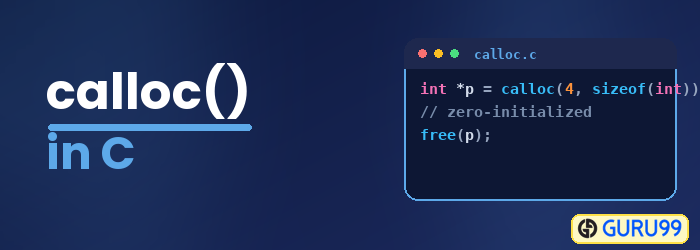
What is calloc in C?
The calloc() in C is a function used to allocate multiple blocks of memory having the same size. It is a dynamic memory allocation function that allocates the memory space to complex data structures such as arrays and structures and returns a void pointer to the memory. Calloc stands for contiguous allocation.
Malloc function is used to allocate a single block of memory space while the calloc function in C is used to allocate multiple blocks of memory space. Each block allocated by the calloc in C programming is of the same size.
Why Use calloc() in C?
Ordinary variables and fixed-size arrays lock their dimensions when the program is compiled, which wastes space when fewer elements are needed and fails outright when more are required. calloc() removes that limit by reserving memory at runtime and, unlike malloc(), it clears every byte to zero before handing the block back. This makes calloc() the natural choice whenever a program needs a clean, predictable region of memory for an array or structure whose size is known only while the code is running.
Dynamic allocation with calloc() fits several common situations:
- Numeric arrays that should start at zero, such as counters, histograms, or running accumulators.
- Data structures where leftover garbage values would cause subtle, hard-to-trace bugs.
- Buffers whose length depends on user input or a file read while the program runs.
- Blocks too large for the limited stack, since calloc() draws from the much larger heap.
Because the reserved block is contiguous and already zeroed, it can be treated immediately as a ready-to-use array without a separate initialization loop.
calloc() Syntax:
ptr = (cast_type *) calloc (n, size);
- The above statement example of calloc in C is used to allocate n memory blocks of the same size.
- After the memory space is allocated, then all the bytes are initialized to zero.
- The pointer which is currently at the first byte of the allocated memory space is returned.
Whenever there is an error allocating memory space such as the shortage of memory, then a null pointer is returned as shown in the below calloc example.
How to use calloc
The below calloc program in C calculates the sum of an arithmetic sequence.
#include <stdio.h>
    int main() {
        int i, * ptr, sum = 0;
        ptr = calloc(10, sizeof(int));
        if (ptr == NULL) {
            printf("Error! memory not allocated.");
            exit(0);
        }
        printf("Building and calculating the sequence sum of the first 10 terms \ n ");
        for (i = 0; i < 10; ++i) { * (ptr + i) = i;
            sum += * (ptr + i);
        }
        printf("Sum = %d", sum);
        free(ptr);
        return 0;
    }
Result of the calloc in C example:
Building and calculating the sequence sum of the first 10 terms
Sum = 45
Difference Between calloc() and malloc()
calloc() and malloc() both reserve memory on the heap and both return a void pointer, or NULL on failure, yet they differ in three practical ways that decide which one to use.
- Initialization: calloc() sets every byte in the new block to zero, while malloc() leaves the contents uninitialized, so a malloc() block holds unpredictable garbage until the program writes to it.
- Arguments: calloc() takes two arguments, the number of elements and the size of each, written calloc(n, size); malloc() takes a single argument, the total number of bytes, written malloc(n * size).
- Speed: malloc() is marginally faster because it skips the zeroing step, which is why code that immediately overwrites the memory often prefers it.
Both functions are declared in stdlib.h and both release their memory with the same free() function. Choose calloc() when a clean, zeroed block matters, and malloc() when raw speed is preferred and the program handles initialization itself.
How to Free Memory Allocated by calloc()
Memory reserved by calloc() lives on the heap and is never released automatically. When a program keeps allocating without freeing, it slowly consumes all available memory, a defect known as a memory leak. The free() function returns a finished block to the system so the space can be reused by later allocations.
The free() function takes a single argument, the pointer that calloc() returned, and releases the entire block at once:
int *ptr;
ptr = calloc(10, sizeof(int));
if (ptr != NULL) {
    /* use the allocated memory here */
    free(ptr);   /* release the block */
    ptr = NULL;  /* avoid a dangling pointer */
}
Follow these rules to manage calloc() memory safely:
- Call free() exactly once for every successful calloc(); freeing the same block twice causes undefined behavior.
- Set the pointer to NULL after freeing so it cannot be reused as a dangling pointer.
- Never free() a pointer that calloc() did not return, including one shifted by pointer arithmetic.
- Match every allocation with a release before the pointer goes out of scope.
Because calloc() and malloc() both draw from the same heap, the freeing discipline is identical for either function: one free() for each successful allocation, and no access to the block afterward. Keeping allocation and release in balance is the core habit of manual memory management in C, and it prevents both leaks and the crashes caused by reusing memory that has already been returned.
