
AI Job Loss 2026: Why Every Expert Is Guessing
Harvard’s AI work twist, Google’s AI health hub


Welcome to Guru99 AI Report!
Top Story: Everyone’s predicting AI’s impact on your job — but what if even the experts are guessing? This week, we unpack the contradictions, the surprising productivity twist, and what actually matters.
🚀 AI Is Rewriting Your Career — Here’s What That Really Means
Brief Buzz:
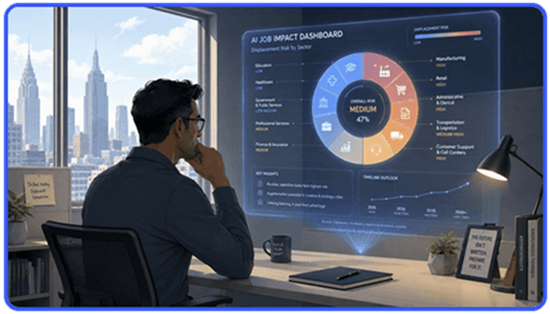
Senior Applied Scientist Marina Wyss cuts through the noise in her latest deep-dive on AI and employment, revealing a startling truth: nobody actually knows what AI will do to the job market. Contradictory reports, hesitant experts, and a terrible forecasting track record leave workers navigating in the dark.
- Reports wildly contradict each other: predictions swing from mass unemployment to massive job creation, with zero consensus emerging across major studies.
- Even top AI researchers refuse to commit to specific numbers, hedging publicly when pushed for displacement timelines.
- The historical track record is dismal — past forecasts about technology destroying jobs have repeatedly missed the mark, often spectacularly.
- Wyss’s advice: stop doomscrolling, start building adaptable, transferable skills that compound over time, as she explains in her full analysis.
💡 Why Should You Care?
If you’ve been losing sleep over AI stealing your job, take a breath. The honest answer from someone inside the industry is that the apocalyptic timelines flooding your feed are largely guesswork dressed as data. Focus on adaptability and continuous learning — that’s what actually survives every technological shift.
📰 America’s New AI Playbook Splits Leaders — Here’s Why It Matters

Brief Buzz:
The White House just dropped its National AI Policy Framework, a sweeping pitch to centralize AI regulation under federal authority and block states from making their own rules. Critics say it’s full of contradictions, while supporters argue a unified approach is overdue.
- The framework calls AI an “inherently interstate phenomenon”, arguing states shouldn’t regulate AI development at all, and proposes shielding developers from liability for third-party misuse, as detailed in the White House policy document.
- Key federal priorities include child safety (age-assurance tools, parental controls), fighting AI-enabled scams against seniors, and protecting free speech from AI-driven suppression.
- It pushes a “balanced approach” to IP, letting AI train on copyrighted material while promising stronger creator rights, plus “regulatory sandboxes” to fuel innovation.
- Plans include building an “AI-ready workforce” through expanded training and apprenticeships.
- Policy experts like the Center for Democracy and Technology’s Samir Jain flagged internal contradictions, pointing to the administration’s earlier “woke AI” executive order as conflicting with its own anti-coercion stance.
💡 Why Should You Care?
AI is evolving faster than any previous tech wave, and who writes the rulebook shapes your daily life, from the content your kids see to whether artists get paid when their work trains models. If federal rules replace state ones, protections could either become stronger and more consistent, or weaker and easier for Big Tech to navigate. Either way, this decides who’s accountable when AI causes harm, and that affects everyone.
🚀 Plot Twist! AI Is Making Us Work MORE — Here’s Why

Brief Buzz:
A new Harvard University study tracking around 200 workers at a US tech company over eight months reveals a surprising twist in the AI revolution: instead of lightening the load, AI tools are quietly piling on more work for the people who use them.
- Workers adopted AI voluntarily — not by mandate — and only later noticed their workloads had expanded without them realizing it, according to the Harvard Business Review findings.
- AI made previously out-of-reach tasks accessible, like non-technical employees suddenly tackling coding and engineering work.
- Reduced friction in starting and finishing tasks blurred the lines between work hours and personal time.
- Treating AI as a background “partner” enabled multitasking — but multiplied responsibilities rather than easing them.
- Concerns are growing amid the broader debate on AI-driven job displacement, tracked by MIT researchers.
💡 Why Should You Care?
If your workplace rolls out AI tools promising “efficiency gains,” brace yourself: faster work often becomes the new minimum, not a ticket to clocking off early. The trickiest skill of this era might not be prompting better — it could be learning to do less with the time AI saves you.
⌚️ Google Merges Fitbit With Its AI Health Vision

Brief Buzz:
Google just took its Gemini-powered AI health coach public, folding Fitbit into a new unified Google Health platform and launching a sleek $99 screenless tracker — a bold move to make AI the centerpiece of personal wellness.
- The AI coach builds personalized weekly workouts, interprets uploaded medical records, and can even ID what you ate from a phone photo, as outlined in Google’s official Google Health announcement.
- Google is merging Fitbit, Health Connect, Apple Health, wearables, and U.S. medical records into one central hub.
- The new Fitbit Air weighs just 12g and ships sensors for heart rate, oxygen, and temperature straight to the AI — no screen, no distractions.
- Apple Watch, Garmin, and Oura owners get AI coach access later this year, signaling Google’s hardware-agnostic play.
💡 Why Should You Care?
This could turn scattered wearable data into genuinely actionable health guidance — the kind most trackers promise but rarely deliver. The flip side? You’d be handing Google your most intimate health details, making privacy and data trust worth a careful look before strapping in.
✈️ Japan Airlines Rolls Out Humanoid Robots at Haneda

Brief Buzz:
Japan Airlines is rolling humanoid robots onto the tarmac at Tokyo’s Haneda Airport, partnering with GMO AI & Robotics on a two-year trial covering baggage handling and cabin cleaning. It’s a real-world test driven by Japan’s worsening labor crunch and a record tourism surge.
- The pilot kicks off this May and runs through 2028, gradually scaling across one of the world’s busiest airports (60M+ passengers a year).
- A video demo features Unitree’s G1 humanoid sliding cargo onto conveyor belts — though JAL says it’s still evaluating multiple commercial robots.
- Japan’s working-age population is projected to shrink 31% by 2060, fueling demand for automation in physically demanding roles.
- Analysts caution that humanoids still lack the dexterity for delicate tasks and will need human supervision, especially around safety, as noted in CNBC’s report.
- Research firm Counterpoint estimates large-scale humanoid deployment is under five years away.
💡 Why Should You Care?
This trial signals humanoid robots are stepping out of demo reels and into actual paying jobs. If Haneda works, expect airports, hospitals, and warehouses worldwide to follow — a preview of how aging societies will lean on machines to keep economies moving.
🤔 What Is IBM’s CEO Saying Most Companies Are Getting Wrong About AI?

Brief Buzz:
At IBM’s annual Think conference, CEO Arvind Krishna delivered a wake-up call: companies are using AI for surface-level tweaks instead of transforming how they actually make money. We’re in “day zero” of the AI revolution, and most enterprises are missing the moment.
- Most businesses run AI “at the margin,” leaving core revenue-generating processes largely untouched.
- Hesitation stems from fear of the unknown — risk, employee pushback, and unclear ROI.
- Krishna’s advice: pick 2-3 high-impact areas to scale massively rather than running 100 small experiments.
- Choose projects where leadership is genuinely invested, not just AI-curious.
- Use early wins as momentum to accelerate broader AI adoption across the organization.
💡 Why Should You Care?
If your employer is dabbling in AI chatbots or auto-generated emails but ignoring the bigger picture, you’re seeing exactly what Krishna warns against. The companies that rethink core processes — not just decorate them with AI — will define the next decade of business. For workers, this means the AI tools landing on your desk soon could reshape entire workflows, not just save you a few minutes. For consumers, expect faster service, smarter products, and lower prices from companies that get this right — and “slow oblivion,” as Krishna puts it, for those that don’t.


Hey! I’m Krishna Rungta
Founder of Guru99.com, Editor-in-chief & Technology Expert
Was this email forwarded to you? Sign up for free here.
