
SAP Kernel Upgrade: Steps & Tutorial
 Editorial Team
⚡ Smart Summary
Download and Upgrade SAP Kernel describes the executable core that connects every SAP application with the underlying operating system. This walkthrough explains how to verify the kernel version, retrieve patches from the SAP Service Marketplace, and apply a controlled upgrade safely.

What is a SAP Kernel?
The SAP Kernel is a central program that acts as the interface between every SAP application and the underlying operating system. It is the engine that allows the SAP system to start, communicate with the database, and respond to user requests reliably.
- The Kernel consists of executable programs stored under /sapmnt/<SID>/exe on UNIX or \usr\sap\SID\SYS\exe\run on Windows.
- These executables start the R/3 system, initialize memory, create buffers, manage user requests, and efficiently use available hardware resources.
- The Kernel also starts and stops all application services, including the dispatcher, message server, and collector processes.



Why is a Kernel Upgrade Required?
Kernel upgrades keep the SAP landscape stable, secure, and aligned with the latest SAP corrections and operating system support.
- The SAP Kernel is the core of the application and contains the executable files (.exe binaries) used to start critical processes inside SAP.
- The Kernel is the heart of the operating system integration. It controls every event in SAP, including starting and shutting down the database, starting and stopping SAP, running saposcol, and uncaring SAP files.
- During a Kernel upgrade, new versions of the executable files replace the older ones, applying bug fixes, security patches, and performance improvements.
How to Check Kernel Version
Before any upgrade, confirm the currently installed version using one of the three methods below.
Method 1) Log on to the SAP system and navigate to SM51 → Release Notes.

Method 2) Log on to the SAP system and go to the System tab on the menu bar, then select Status.

Method 3) Log on at the operating system level, switch to user <SID>adm, and run the command disp+work. You can also issue disp+work –version for the same result.

Download Kernel from Service Marketplace
Once the current version is known, the next step is to fetch the latest kernel package from SAP.

- Visit the SAP Service Marketplace at https://service.sap.com. You will need your OSS ID and password.
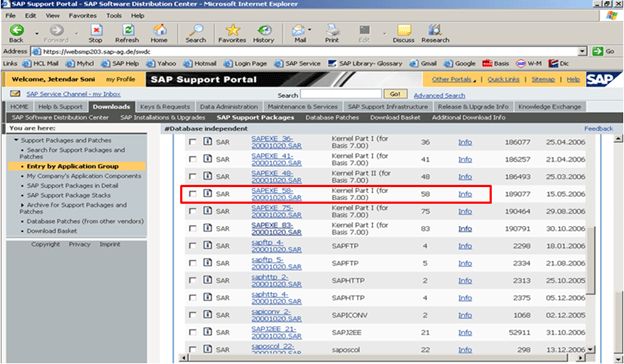
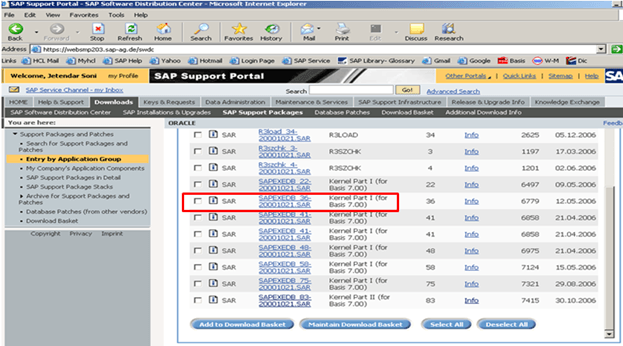
- Navigate to Downloads → SAP Support Packages → Entry By Application Group → SAP Kernel 6.00 64 Bit → Select your OS (LINUX / WINDOWS / SOLARIS / AIX) → Database Dependent and Database Independent Kernel Patch.
- Two SAR archive files, SAPEXE.SAR (database independent) and SAPEXEDB.SAR (database dependent), will be downloaded.
SAP Kernel Upgrade Steps
Follow the steps below sequentially to apply the new kernel safely without losing the previous version.
Step 1) Create a new directory at the OS level with sufficient free space. A common naming convention is exe_new<ddmmyy>.
Step 2) Transfer the downloaded SAPEXEDB.SAR and SAPEXE.SAR files into the new directory at OS level.
Step 3) Change the current directory to the path where the SAR files are stored (for example, cd /sapmnt/PR2/exe_new20122006). Verify the location using pwd.
Step 4) Uncompress the SAR files using the SAPCAR executable:
SAPCAR -xvf SAPEXE.SAR
SAPCAR -xvf SAPEXEDB.SAR
Step 5) Create another directory named exe_old<ddmmyy> in the same path and take a backup of the existing kernel. Use cp (copy, do not move) to back up the existing exe directory to exe_old<ddmmyy>.
Step 6) Stop the SAP application. The database does not need to be shut down for a kernel upgrade, but the SAP application must be offline.
stopsap r3Step 7) Copy the files from the new kernel directory into the existing kernel directory:
cp -rp /sapmnt/<SID>/exe_new<ddmmyy>/* /sapmnt/<SID>/exe/Step 8) The copy replaces all files in the existing kernel directory with the new kernel binaries. Verify the kernel version at the OS level using disp+work. The patch number should reflect the upgrade.
Step 9) Log on to the OS as root (UNIX only). The kernel directory contains a script named saproot.sh. Execute it:
./saproot.sh <SID>Step 10) This script assigns the correct permissions to every executable in the kernel, including the br* files used by BR*Tools and other administrative utilities.
Step 11) Start the SAP system:
startsap r3Step 12) Finally, verify the upgraded kernel version through SM51 or System → Status to confirm the new patch level is active.
