
SAP Background Job Processing SM36
 Editorial Team
⚡ Smart Summary
Background job processing in SAP enables non-interactive execution of time-consuming programs behind normal operations, scheduled via SM36 and monitored through SM37. It supports three priority classes and six lifecycle statuses to ensure efficient workload management.

What is a Background Job in SAP?
A background job is a non-interactive process that runs behind normal interactive operations in an SAP system. Background jobs execute in parallel and do not disturb foreground processes or operations. They are scheduled using transaction code SM36 and monitored through SM37 by viewing job logs.
Advantages of Background Jobs in SAP
- It reduces manual effort and automates repetitive tasks that would otherwise require user interaction.
- It can be scheduled as per the user’s choice, allowing flexible execution timing.
- It runs seamlessly in the background without requiring user input, freeing up the system for interactive work.
- Once you define the variant for a background job, the user does not have to worry about providing field values each time. This also reduces the possibility of input errors.
- It is ideal for time-consuming or resource-intensive programs, which can be scheduled to run during off-peak hours when system load is low.



Types of Background Job Priority Classes
SAP categorizes background jobs into three priority classes that determine execution order and resource allocation.
- Class A (High/Critical Priority): Urgent or critical tasks must use Class A priority. It reserves one or more background work processes. Available processes for Class B and C = Total work processes (set in RZ03) minus processes reserved for Class A.
- Class B (Medium Priority): Once Class A jobs complete, Class B jobs begin executing before Class C jobs.
- Class C (Low Priority): Runs only after both Class A and Class B jobs have completed. Suitable for non-urgent, routine tasks.
Possible Statuses of a Background Job
Every background job in SAP passes through a defined lifecycle. These statuses help administrators track job progress.
- Scheduled: Program name and variant are defined, but start conditions (Start Date, End Date, Frequency) have not been specified. The job will not execute until start conditions are set.
- Released: All required criteria are fulfilled including start conditions. The job is waiting for its scheduled start time.
- Ready: All conditions are met, but the job is in a queue waiting for a background work process to become available.
- Active: The job is running in the background. Its status cannot be changed once Active.
- Finished: The job executed successfully without any errors.
- Cancelled: The job did not complete. Either the administrator forcefully cancelled it, or an error occurred. Investigate from the job logs in SM37.
How to Schedule a Background Job Using SM36
You can schedule a background job using transaction code SM36. Both planned and immediate jobs can be configured.
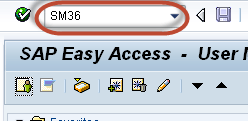
Step 1) Execute T-code SM36.
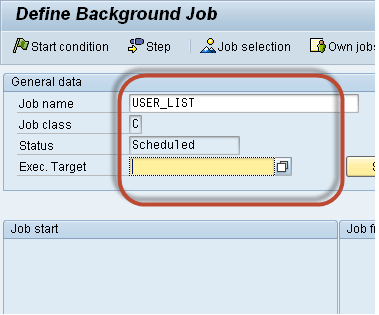
Step 2) Fill in the job name, priority class (A/B/C), and the target server. Defining a target server helps with workload balancing across application servers.
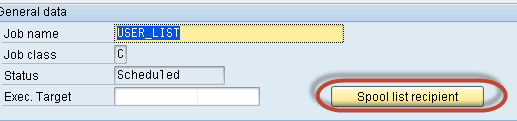
Step 3) Click on “Spool List Recipient” to receive output in your mailbox. Check email from SBWP.
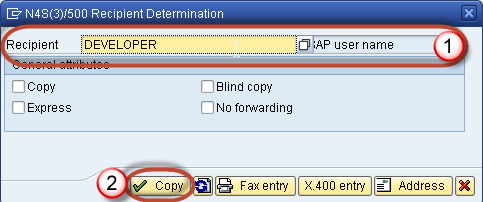
Step 4) Insert your SAP username and click the Copy button.
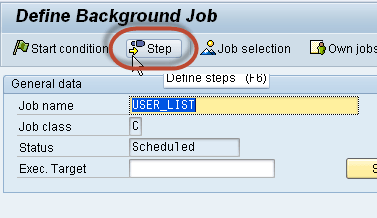
Step 5) Click the Step button to define the ABAP program and variant details.
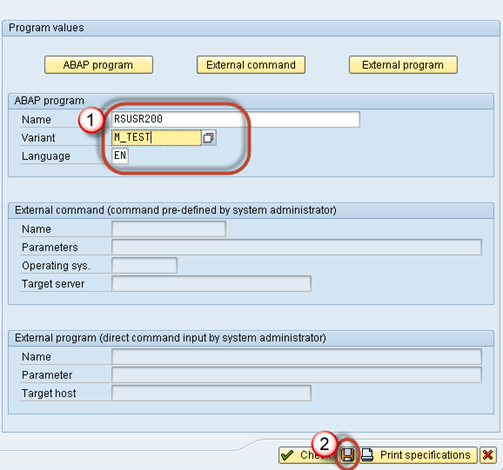
Step 6) Define the program name and variant details.
- Enter your program name and variant name. If you have not created a variant, leave it blank.
- Press Save.
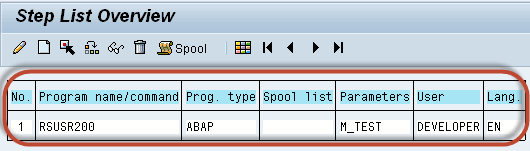
Step 7) Once the job step is saved, you will see the confirmation screen.
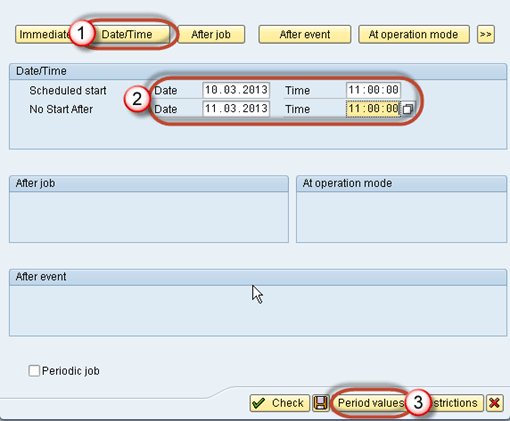
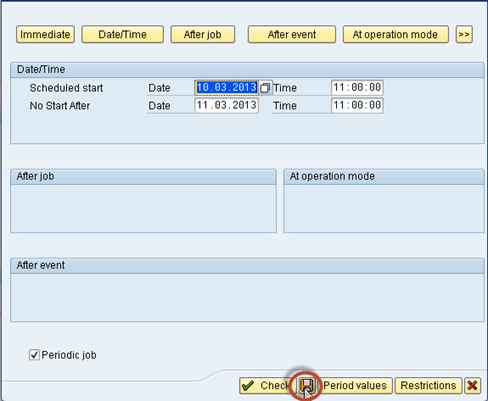
Step 8) Click Start Condition to fill start date, end date, and frequency. Without a start condition, the job will always remain in Scheduled status and will never run.
- Click on Date/Time for periodic jobs. Selecting “Immediate” runs the job right away as a one-time execution.
- Define start date/time and end date/time. The job is released only when it meets its scheduled start date/time.
- Press Periodic Values.
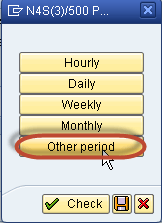
Step 9) Select the period — Hourly, Daily, Weekly, or Other Period. We select Other Period.
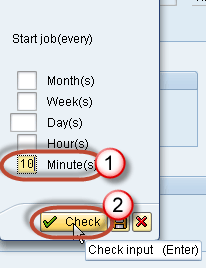
Step 10) Specify the recurring criteria. For example, run every 5 days from the start date. Here we select every 10 minutes.
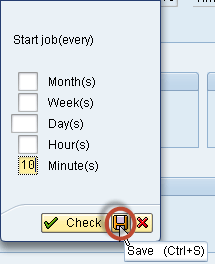
Step 11) Click Save.
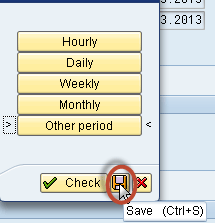
Step 12) Click Save again.
Step 13) Click Save on the main screen.
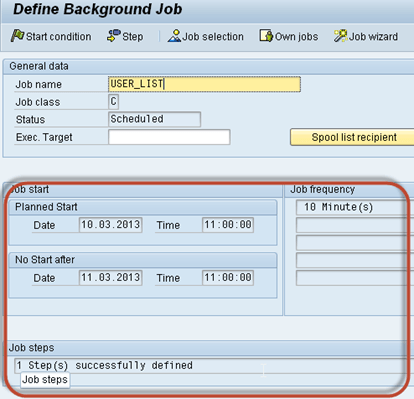
Step 14) Once job step and start conditions are defined, the summary window appears.
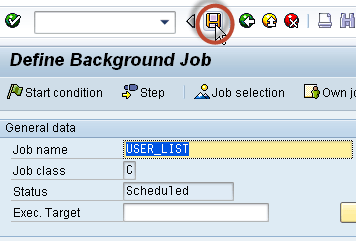
Step 15) Press Save to finalize the background job.
How to Monitor a Background Job Using SM37
After scheduling, verify job status using transaction code SM37, which provides a centralized view of all background jobs.
Step 1) Execute T-code SM37.
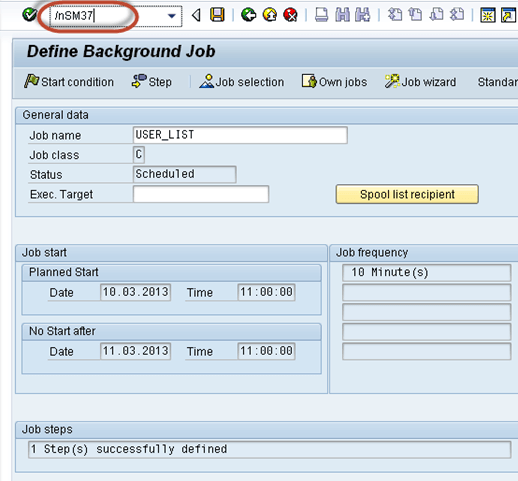
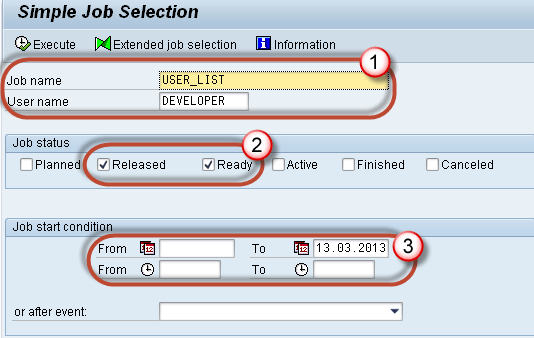
Step 2) Select your criteria for the job you want to monitor.
- Enter the job name and username who scheduled the job.
- Select the status of the job.
- Specify the date range. Here, we specify only the end date while keeping From Date open.
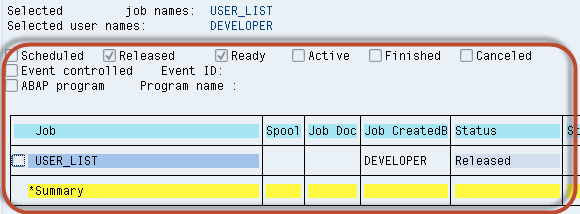
Step 3) The status shows Released, meaning start conditions are met and the job is in the queue waiting for a background work process to become available.
How to Deschedule a Background Job
Descheduling reverts a job from Released back to Scheduled status so it will not run in the future. You cannot deschedule a job once it reaches Active status.
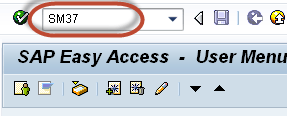
Step 1) Execute SM37.
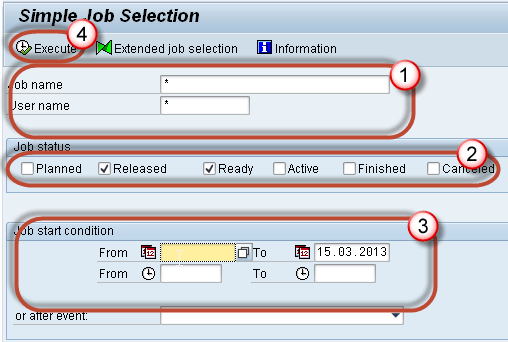
Step 2) Fill the criteria.
- Job name and username who scheduled the job.
- Select status — only Released or Ready jobs can be descheduled.
- Specify the date range.
- Press Execute (F8).
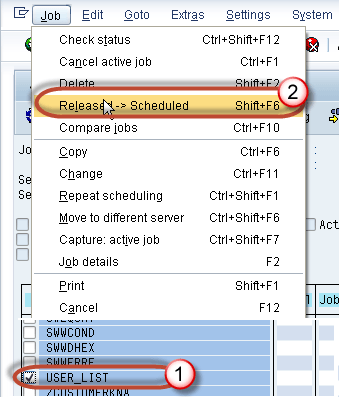
Step 3) Select the job and press Job → Released → Scheduled.
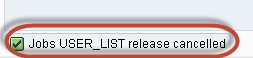
Step 4) A confirmation message appears in the status bar once the job is descheduled.
Background Job Processing vs Foreground Processing
Foreground processing requires an active user session and blocks the screen until the task completes, making it unsuitable for long-running operations. Background processing runs independently without locking the user interface. Foreground jobs suit quick interactive tasks like data entry and configuration changes. Background jobs are better for mass data uploads, period-end closings, large report generation, and scheduled data transfers. SAP best practice recommends running resource-intensive programs as background jobs during off-peak hours.
