
5 BEST Crypto Wallet for Businesses (2026)
 Editorial Team

Ever felt overwhelmed trying to choose between dozens of crypto wallets that all promise security and simplicity—but deliver confusion instead? Picking the wrong one can expose your business to hidden fees, liquidity traps, delayed withdrawals, poor scaling, data latency, and unfair access rules. I have seen countless newcomers lose both time and capital to wallets that looked polished but lacked real protection. Using unverified tools or chasing hype-based recommendations often leads to compliance risks and costly downtime. Reliable, well-audited wallets help businesses trade, store, and scale digital assets with confidence and transparency.
After spending 167+ hours researching and testing 18 tools, I narrowed down the best crypto wallets based on real-world performance. My findings come from firsthand, hands-on experience, supported by research on reliability and security. This guide explains key features, pros and cons, and current pricing to help you choose wisely. Read on to explore which wallet truly fits your business. Read more…

Uphold is one of the best crypto asset management. It is great for buying, trading, and holding more than 250 cryptocurrencies, traditional currencies, and precious metals. It is strongly committed to protecting customer data and privacy. It integrates an assisted self-custody solution known as Vault.
Best Crypto Business Wallets: Top Picks!
| Wallet | Custody Type | Key Security | Learn More |
|---|---|---|---|
Uphold |
custodial | Centralized custody | Learn More |
 Ledger Enterprise |
Custodial (enterprise) | Hardware-backed protection | Learn More |
 Coinbase |
custodial | Coinbase holds private keys | Learn More |
 MPCVault |
Non-custodial | MPC + multisig (no single key) | Learn More |
 Zengo |
Non-custodial | MPC | Learn More |
1) Uphold
Uphold is a crypto platform known for real-time asset transparency and global reach, making it ideal for managing multiple currencies, digital assets, and payments in one place. It publishes live reserves and liabilities, reinforcing its transparency philosophy. Users can access fiat, crypto, and precious metals from a single dashboard. Uphold’s SOC 2 Type 2 and ISO 27001 certifications enhance its security and reliability.
With an intuitive interface, it’s especially suited for business users, small teams, and freelancers who want a streamlined, secure solution for handling payments, currencies, and digital assets without switching between multiple tools. On its official X handle, @UpholdInc recently announced a U.S. debit card relaunch offering up to 6% XRP cashback and access to 300+ crypto assets for everyday spending. This update underscores Uphold’s push to blend real-world payment utility and crypto mobility for business users.

Features
- Multi-Asset Support: This feature lets you manage crypto, fiat, and metals in one place. It’s ideal for businesses handling diversified treasuries. I’ve used it for global settlements—it simplifies asset conversions without shifting between multiple tools.
- One-Step Conversion: You can convert between any two supported assets instantly. It’s efficient, cutting out extra trades or spreads. For active traders, this reduces execution friction and slippage during volatile sessions.
- Low Minimums: You can start trading or transferring with minimal amounts. This feature helps startups test workflows before scaling capital exposure. It’s a practical entry point for cautious businesses entering crypto.
- Real-Time Reserve Transparency: Uphold updates its reserve and liability data every 30 seconds. This live proof-of-assets model builds rare trust. As a strategist, I value this openness for due diligence before moving institutional funds.
- Automated Recurring Buys: You can schedule recurring crypto purchases to average entry prices over time. It’s excellent for managing treasury exposure without timing markets. Businesses benefit from predictable dollar-cost averaging strategies.
- Assisted Self-Custody Wallet Option: You can opt for partial key management control. It’s ideal for teams transitioning toward full custody. This hybrid approach ensures compliance support while enhancing autonomy.
Pros
Cons
How to Get Started with Uphold Wallet?
These are the steps to begin with:
Step 1) Go to Uphold.com and create a business or individual account.
Step 2) Complete KYC by providing business details and valid identification documents.
Step 3) Next, you need to link your card or bank account for fiat deposits and withdrawals.
Step 4) Buy, sell, or move crypto assets instantly within your account.
2) Ledger Enterprise
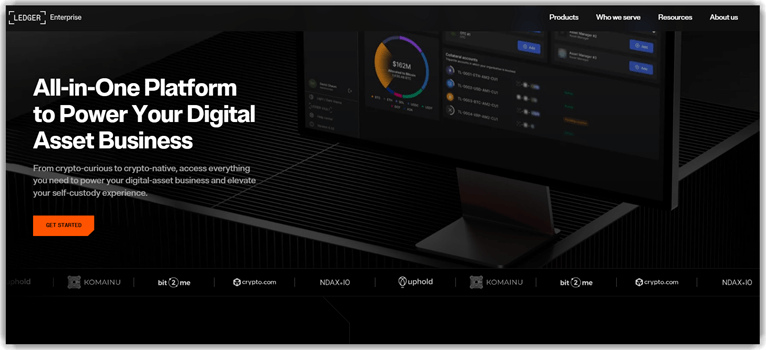
Ledger Enterprise is Ledger’s institutional-grade solution, built for organizations needing secure, scalable crypto asset management. Trusted across the digital asset ecosystem, it’s ideal for businesses focused on compliance, governance, and operational efficiency across large portfolios. Leveraging the same security foundation as Ledger’s consumer products, it combines hardware-based protection with advanced security protocols.
Ledger Enterprise stands as a leading choice for institutions seeking proven, hardware-backed protection for digital assets with full transparency and operational confidence. The official X account, @ledger_business, has been spotlighting its recent security partnerships and policy automation features. These enhancements show Ledger’s focus on real-time compliance intelligence—a timely step as institutional players demand more automation in crypto asset management.
Features
- Governance Controls: Ledger Enterprise lets you assign granular user roles and permissions. This hardware wallet supports workflow segregation for compliance, treasury, and operations teams. Each action is logged immutably for complete internal transparency.
- Compliance Monitoring: Ledger automates AML and KYC compliance checks. It scans transaction activity for anomalies or high-risk patterns. This helps institutions meet evolving regulatory expectations with minimal manual oversight.
- Disaster Recovery Options: Ledger Enterprise offers encrypted backups and multi-site recovery solutions. You can restore access rapidly in case of hardware loss or operational failure. It’s essential for business continuity assurance.
- Cold–Hot Wallet Bridge Management: Businesses can automate secure transfers between cold storage and operational hot wallets. It improves liquidity access without compromising reserve safety—a must for trading desks.
- Customizable Dashboard Analytics: Executives can customize dashboards to visualize asset allocation, exposure by region, or liquidity ratios. This helps in data-driven portfolio management and strategic planning.
Pros
Cons
How to Get Started with Ledger Enterprise Wallet?
Here are the steps to proceed with:
Step 1) Go to Ledger Enterprise and request a demo or consultation.
Step 2) Integrate Ledger’s hardware and governance suite into your business systems.
Step 3) Assign user roles and configure transaction approval workflows.
Step 4) Begin storing and managing your digital assets with full enterprise-grade security.
3) Coinbase
Coinbase offers business users a regulated, reliable entry into crypto — ideal for teams managing treasury or payments that value stability over speculation. Favored by institutions for its predictable, professional infrastructure, Coinbase operates under strict regulatory oversight as a publicly listed exchange. This transparency enforces strong internal controls and conservative risk management.
With a reputation built on trust, compliance, and disciplined operations, Coinbase stands out as a serious, regulation-first platform for businesses seeking dependable crypto management. The @CoinbaseBiz feed on X recently announced the launch of instant global payouts and shareable crypto payment links, making it easier for firms to pay contractors or accept crypto payments from clients around the world.

Features
- Business Account Structure: Coinbase makes it simple to separate business and personal transactions clearly. This structure enhances financial transparency and audit readiness. It’s essential for teams handling multi-entity crypto treasuries and external reporting workflows.
- Stablecoin Support: Coinbase offers deep liquidity in USDC, ideal for settlement stability. It reduces exposure to market volatility while maintaining blockchain accessibility. I’ve used it for predictable, on-chain corporate payments during market swings.
- Reporting Tools: You can export transaction histories and balance sheets directly for audits or tax submissions. This simplifies compliance and monthly reconciliation. The detailed records save hours in financial oversight.
- Coinbase Commerce: This feature lets merchants accept crypto payments directly through e-commerce checkouts. It’s plug-and-play and supports instant conversions to stablecoins or fiat. Great for online retailers wanting crypto revenue without volatility.
- Mobile Management: The Coinbase mobile app lets executives oversee transfers, approvals, and alerts securely on the go. I’ve found it helpful during travel when market conditions shift quickly. It ensures uninterrupted control over capital.
- Treasury Views: You can access consolidated dashboards showing all wallet and product balances in real time. It’s a strategic advantage for treasury teams monitoring asset distribution and portfolio exposure at a glance.
Pros
Cons
How to Get Started with Coinbase Wallet?
Follow these steps to get started:
Step 1) Sign up on Coinbase.com and select “Business” during setup.
Step 2) Provide company registration documents and undergo a compliance review.
Step 3) Enable custodial or non-custodial options depending on your business needs.
Step 4) Deposit crypto or fiat and use Coinbase tools to send, receive, or trade assets.
4) MPCVault
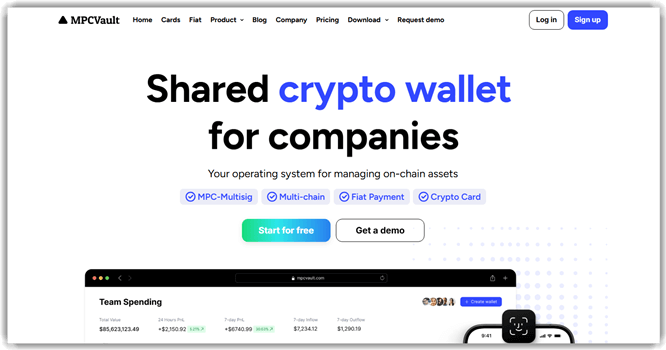
MPCVault is a modern digital asset custody solution designed for organizations prioritizing control and security. Known for its reliability and transparency, it offers a professional-grade platform for teams managing crypto assets collectively and efficiently. Backed by advanced cryptographic infrastructure and audited smart protocols, MPCVault ensures institutional-level safety and trust. It’s ideal for corporate teams, fund managers, and Web3 startups handling shared treasury operations or custodial duties.
For organizations moving from personal wallets to institutional-grade management, MPCVault provides the perfect balance of accessibility, scalability, and security — making crypto custody both safer and more streamlined. According to their X feed, MPCVault recently introduced browser-plugin access — a small update that can significantly streamline Web3 onboarding for teams and simplify daily crypto operations.
Features
- MPC Technology: This feature eliminates single-point failure risks by splitting key shards across multiple parties. It ensures cryptographic resilience and near-zero breach probability. As a strategist, I appreciate its mathematical integrity in protecting institutional-scale holdings.
- Multi-User Access: You can define user tiers like traders, reviewers, or compliance officers with distinct permissions. This brings clarity to shared wallet operations. It’s ideal for organizations balancing control and collaboration.
- Policy Engine: This automates spending limits, transaction approvals, and custom thresholds. I’ve configured this personally to reduce manual oversight during busy trading cycles. It ensures governance without slowing execution speed.
- Hardware Integration: This feature connects directly with HSMs for additional cryptographic enforcement. It’s perfect for regulated institutions needing verifiable key custody. I value how it merges digital agility with hardware-backed compliance.
- Audit Logs: You can review every transaction event with tamper-proof timestamps. This feature simplifies compliance audits and forensic analysis. It turns transparency into a security asset.
- Enterprise API: MPCVault integrates seamlessly with ERPs, accounting suites, and fintech systems. This API support ensures treasury automation and reconciliation at scale. Businesses can plug it into existing workflows without friction.
Pros
Cons
How to Get Started with MPCVault Wallet?
You need to follow these steps to get started with MPCVault:
Step 1) Visit MPCVault.com and apply for a business account.
Step 2) Create your organization dashboard and invite team members with defined roles.
Step 3) Establish signing policies, multi-user approval thresholds, and access permissions.
Step 4) Transfer funds to your wallet and begin managing enterprise-level crypto securely.
Link: https://mpcvault.com/
5) Zengo
Zengo is a next-generation crypto wallet redefining how businesses store and manage digital assets. I would rate it as the best crypto wallet for business; it combines modern design with advanced security for managing assets across multiple networks. Its keyless security system uses threshold cryptography instead of traditional private keys, eliminating single points of failure. This innovation has earned Zengo strong trust in the crypto community.
For traders and teams, it provides a sophisticated yet simple experience with advanced encryption and user autonomy—ideal for different-sized businesses prioritizing security, accessibility, and efficient crypto management. On X (Twitter), @ZenGo recently announced a new partnership with Onramper that unlocks 130+ local payment methods and lower fees — making it easier for users worldwide to onboard or cash out crypto via fiat, especially in emerging markets.

Features
- Treasury Operations: This feature lets teams send, receive, and swap assets seamlessly within one interface. With support for dozens of chains and thousands of tokens, it centralizes business crypto flow management effortlessly and securely.
- Instant On/Off-Ramp with Company IBAN: You can move funds directly between fiat and crypto using your corporate IBAN. It’s fast, compliant, and designed for companies that need reliable liquidity access without waiting on external exchanges.
- Custom Governance and Workflows: It lets businesses define user roles like Approvers, Controllers, or View-only participants. This ensures operational clarity and accountability. Each action in the treasury can be governed through well-defined, auditable workflows.
- Batch Transactions: Zengo enables executing multiple transactions in one go. This saves significant time during payroll, payouts, or vendor settlements. I’ve used this myself — it drastically improves operational efficiency during volatile markets.
- Battle-Tested MPC Security: This feature removes traditional seed phrase risks with cutting-edge MPC architecture. Trusted by over 2 million users since 2018, its open-source cryptography has undergone multiple audits and has never been breached.
- Accountant View-Only Access: You can grant accountants restricted access to review wallet history without moving funds. This streamlines reconciliation and audit work while maintaining financial control. It bridges crypto activity with accounting integrity effortlessly.
Pros
Cons
How to Get Started with Zengo Wallet?
Here are the steps to start your business journey with Zengo Wallet:
Step 1) Visit the Zengo website or your app store and install the mobile app.
Step 2) Register using your email and secure your wallet with biometric authentication.
Step 3) Use Zengo’s Keyless Recovery system to safely back up your access key on the cloud.
Step 4) Deposit crypto or purchase directly through the app using supported payment methods.
Comparison between the best crypto wallets for business
| Feature | Uphold | Ledger Enterprise | Coinbase | MPCVault |
|---|---|---|---|---|
| DeFi / dApp Access | ✔️ | ✔️ | ✔️ | ✔️ |
| Compliance Tools | ✔️ | ✔️ | ✔️ | ✔️ |
| File versioning/history | ✔️ | ✔️ | ✔️ | ✔️ |
| API / Integration Support | ✔️ | ✔️ | ✔️ | ✔️ |
What Are Crypto Wallets for Business and How Do They Work?
Crypto wallets for business are digital tools that let companies securely store, send, and receive cryptocurrencies. They are much like a corporate bank account, but for digital assets. These wallets come in two main types: custodial wallets, managed by third-party providers, and non-custodial wallets, where the business controls its own private keys.
These wallets often include multi-user access, spending limits, and transaction tracking to fit team operations. In short, they help businesses handle crypto payments, manage treasuries, and maintain control over funds with enterprise-level security and transparency.
How Businesses Can Access Loans Through Crypto Wallets?
Businesses can access loans through crypto wallets by using their digital assets—like Bitcoin or Ethereum—as collateral on lending platforms. Many wallets integrate directly with DeFi or CeFi lending services, allowing companies to lock in crypto and borrow stablecoins or fiat without selling their holdings. The process is typically fast: connect your wallet, choose the collateral amount, and receive funds instantly. This lets businesses maintain market exposure while gaining liquidity for operations or expansion. However, they must monitor collateral ratios carefully, since price drops can trigger margin calls or liquidation.
How to Choose the Right Wallet Type for Your Business Model?
Choosing the right crypto wallet for your business starts with understanding how you plan to use digital assets. The best option depends on your transaction volume, team size, and security priorities.
In short, align your wallet choice with your operations, risk tolerance, and scalability goals. Here’s a quick breakdown to guide you:
- Custodial wallets: Ideal for small businesses or startups that prefer simplicity and customer support. The provider manages private keys and handles security.
- Non-custodial wallets: Better for larger firms, DAOs, or teams needing multi-signature control and transparency.
- Integrated wallets: Perfect for e-commerce setups requiring API connections and automated payment tracking.
How AI Is Transforming Crypto Wallets for Businesses?
AI is reshaping how businesses use crypto wallets by making them smarter, safer, and more efficient. Machine learning models now detect unusual activity in real time, reducing fraud and hacking risks. AI-driven analytics also help companies track spending, forecast cash flow, and optimize when to convert or stake assets.
Some wallets use natural language chatbots for faster support and transaction insights, while others automate compliance checks and reporting. Ultimately, AI turns crypto wallets from simple storage tools into intelligent financial hubs, empowering businesses to make data-driven decisions and manage digital assets with greater confidence and precision.
Verdict
After testing countless options, I found that these three crypto wallets strike the perfect balance between security, business utility, and innovation. They represent the future of digital asset management for enterprises.
- Uphold: This crypto business wallet stands out for its transparency and multi-asset support. I appreciate how it simplifies global payments while maintaining strict compliance—a must for serious business operations.
- Ledger Enterprise: Ledger Enterprise provides hardware-backed protection with granular governance and automated compliance monitoring. I value its scalable controls and disaster-recovery options for institutions managing large portfolios.
- Coinbase: Coinbase pairs regulation-first custody with strong reporting and payment tools. I like its USDC liquidity, global payouts, and consolidated treasury views for businesses that need predictable operations.
FAQs
Uphold is one of the best crypto asset management. It is great for buying, trading, and holding more than 250 cryptocurrencies, traditional currencies, and precious metals. It is strongly committed to protecting customer data and privacy. It integrates an assisted self-custody solution known as Vault.
