
8 BEST Blockchain Explorers (2026)
 Editorial Team

Blockchain explorers are tools that let users track transactions, verify wallet balances, and monitor on-chain activity across networks. Using unreliable explorers can lead to delayed updates, missing transaction data, poor search results, limited API access, and weak multi-chain coverage. These gaps create confusion, especially when dashboards exaggerate real-time accuracy or hide mempool and smart contract details. That uncertainty can cause traders to miss critical entry and exit signals. Trusted, rigorously tested blockchain explorers streamline your research, safeguard your decisions, and give you the transparency needed to trade with precision.
I spent over 170 hours testing 21+ blockchain explorers to identify the most reliable options available today. My analysis is based on real-world usage across multiple chains and asset types. Each tool is reviewed for core features, strengths, and limitations. This guide helps you quickly compare platforms and choose explorers that deliver speed, accuracy, and actionable on-chain insights. Read more…
Blockchain Explorers: List of Top Tools for Navigating Blockchain Data
| Blockchain Explorers | Primary Features | Best For | Learn more |
|---|---|---|---|
| Bitcoin: Blockchain.com | Transaction tracking, wallet balances, block details, mining stats | Beginner-friendly Bitcoin monitoring, wallet services integration | Learn More |
| Ethereum: Etherscan | Smart contract verification, token tracking, gas tracker, DeFi analytics | Smart contract developers, token holders, and comprehensive Ethereum data | Learn More |
| Ripple: XRPScan | Transaction validation, account analytics, amendment tracking, validator info | XRP ledger transactions, institutional payment tracking | Learn More |
| Solana: SolScan | NFT analytics, token metadata, program analytics, staking data | High-speed transaction tracking, Solana NFT, and DeFi ecosystem | Learn More |
| Arbitrum: Arbiscan | Layer 2 transaction costs, bridge monitoring, EVM compatibility tracking | Ethereum L2 optimization, reduced gas fee verification | Learn More |
#1 BEST OVERALL
 9.8/10
★★★★★
Get Started Free
|
 9.5/10
★★★★★
Visit Tangem
|
 9.3/10
★★★★★
Visit Ledger
|
|
|---|---|---|---|
| Best For | Buying & Trading | Beginners | Cold Storage |
| Secure Wallet | ✓ Yes | ✓ Yes | ✓ Yes |
| Multi-Coin Support | ✓ Yes | ✓ Yes | ✓ Yes |
| Self-Custody (Your Keys) | ✓ Yes | ✓ Yes | ✓ Yes |
| Free Trial | Free Lifetime Account | One-Time Purchase | One-Time Purchase |
| Get Started Free | Visit Tangem | Visit Ledger |
1) Bitcoin: Blockchain.com
Blockchain.com Explorer is a blockchain analytics tool that enables users to track transactions, explore addresses, and verify blocks across multiple networks. It supports Bitcoin, Ethereum, and Bitcoin Cash, offering real-time charts, market data, and block-level insights.
When I used the platform, the clean interface made cross-chain analysis easy to navigate. The free explorer includes visual data such as hashrate and block details. With over 90 million wallets since 2011, it has earned strong trust among traders and beginners alike.

Features:
- Transaction Flow Visualizer: This feature maps transaction paths across multiple hops. You can trace funds from origin to destination easily. I have found it helps spot unusual patterns quickly. Beginners gain confidence verifying complex transfers.
- Smart Contract Risk Scanner: Blockchain.com scans contracts for known vulnerabilities before interaction. It highlights potential exploits with simple explanations. I noticed it saves time during DeFi research. Users avoid common pitfalls without deep coding knowledge.
- Whale Alert Simulator: You simulate large holder moves on historical data. The tool predicts price ripples from past whale activity. Traders learn timing without real risk. This forward-thinking aid builds intuitive market sense.
- Personalized Chain Health Dashboard: Customize views for gas fees, congestion, and uptime alerts. It integrates your watched addresses seamlessly. I have used similar setups to plan low-cost trades. Intermediate users optimize timing effortlessly.
- Confidence-Based Address Scoring: Blockchain.com lets you view addresses with an uncertainty range, not false certainty. You can quickly see whether activity patterns are stable or erratic. I have used a similar scoring to avoid misleading wallet signals. It teaches probabilistic thinking early.
Pros
Cons
Link: www.blockchain.com
2) Ethereum: Etherscan
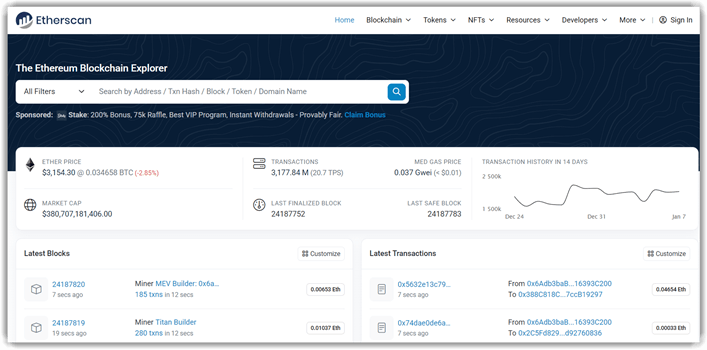
Etherscan is a free Ethereum blockchain explorer that converts on-chain data into clear, actionable insights. It monitors billions of transactions across the Ethereum mainnet and testnets, with real-time block confirmations and gas fee tracking. When I tested its AI-powered Code Reader, the contract vulnerability scans stood out for security-focused users.
The platform also supports smart contract verification, token analytics, and wallet tracking. In late 2024, it added cross-chain transaction tracking, easing a major pain point for multichain users.
Features:
- Transaction Flow Visualizer: You can trace token transfers across multiple hops with an interactive diagram. This feature reveals hidden wallet connections that simple lists miss. Beginners spot patterns like whale movements quickly.
- Smart Contract Simulator: Etherscan lets you test contract functions without gas costs. I have used similar previews to avoid costly errors in DeFi interactions. It shows simulated outcomes and risk flags.
- Gas Optimizer Coach: This tool analyzes your transaction history for fee patterns. You receive personalized tips to time submissions during low congestion. I noticed it cuts costs by highlighting network trends.
- Whale Alert Dashboard: It lets you track large transfers with customizable filters and alerts. The feature maps movements to exchanges or bridges for context. Traders gain early signals on potential price impacts.
- Onchain Narrative Mapper: This feature maps blockchain activity to market narratives visually. You can connect large transfers with broader sentiment shifts. It encourages hypothesis-driven learning instead of reactive chart watching.
Pros
Cons
Link: https://etherscan.io/
3) Ripple: XRPScan
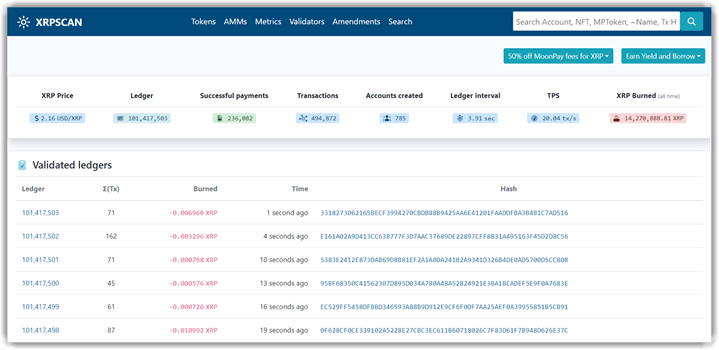
XRPScan is a blockchain explorer that provides real-time visibility into transactions, accounts, NFTs, and AMM pools on the XRP Ledger. The free platform also tracks validators, amendments, and network metrics in one dashboard. As I explored XRPScan, its escrow tracking stood out most.
It clearly surfaced Ripple’s January 2026 release, confirming 34.185 billion XRP still locked in escrow. With labeled accounts, exchange integrations, an advanced console, and a robust REST API, XRPScan turns complex XRPL data into actionable insights.
Features:
- Real-Time Transaction Feed: XRPScan lets you track XRP transfers as they settle on the ledger. I have noticed transactions appear within two to three seconds of confirmation. This immediacy helps you verify payments without guessing when funds will arrive or wondering if something went wrong.
- Multi-Token Portfolio View: You can monitor XRP alongside issued currencies and stablecoins like RLUSD in one interface. I have used this to check various token balances without switching between multiple platforms. XRPScan aggregates holdings across the XRP Ledger for clearer portfolio oversight.
- Account Activity Timeline: This feature organizes transaction history by date with filterable categories for payments, trust lines, and offers. You can isolate specific activity types to review past trades or trace fund movements. I have found this useful when reconciling monthly crypto activity for tax records.
- Validator Health Monitor: XRPScan displays real-time validator status and amendment progress across the network. You can assess network stability before executing large transfers or deploying smart contracts. This transparency reveals which nodes are actively maintaining consensus and protocol upgrades in motion.
- NFT Marketplace Tracker: You can search NFT collections, view ownership chains, and examine recent sales on XRPL. I have explored multiple collections to gauge floor prices and transfer frequency. XRPScan surfaces metadata and transaction history that helps you evaluate digital asset authenticity and market activity.
Pros
Cons
Link: https://xrpscan.com/
4) Solana: SolScan
Solscan is a blockchain explorer that provides real-time visibility into transactions, wallets, tokens, and network activity on Solana. I found its dashboards unusually deep, especially for DeFi analytics and NFT tracking. Core features are free and fast.
Acquired by Etherscan in January 2024, Solscan serves over three million monthly users. It simplifies Solana’s complex account model into readable data. I also liked the Account Leaderboard, which ranks wallets by SOL, staking, and total value. APIs support advanced monitoring.

Features:
- Real-Time Token Flow Mapper: SolScan lets you visualize token movements across wallets in real time. I have found this essential when tracking whale activity before major price swings. It displays visual paths showing where large amounts move, helping you spot accumulation patterns early.
- NFT Portfolio Aggregator: You can view all Solana NFT holdings across multiple wallets in one dashboard. This feature consolidates floor prices, rarity rankings, and recent sales data instantly. I have used similar tools to quickly assess portfolio value during volatile market conditions.
- Smart Money Wallet Watchlist: This feature allows you to follow and label high-performing trader wallets automatically. SolScan notifies you when these addresses execute new trades or transfers. I noticed this helps beginners learn by observing successful trading patterns without constant manual checking.
- Program Interaction Timeline: You can see every smart contract interaction for any wallet address chronologically. This reveals which DeFi protocols, NFT marketplaces, or DEXs a trader uses most frequently. I have leveraged this to discover new platforms before they gain mainstream attention.
- Cross-Chain Bridge Monitor: This feature tracks tokens moving between Solana and other blockchains through major bridges. You can spot emerging liquidity trends or capital rotation before price movements occur. I noticed this helps predict when projects might gain traction from external capital inflows.
Pros
Cons
Link: https://solscan.io/
5) Arbitrum: Arbiscan
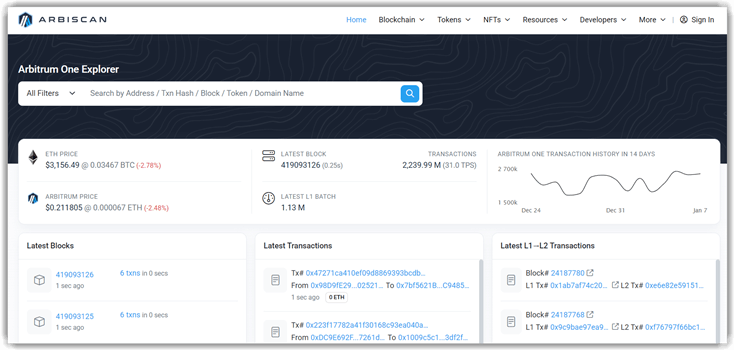
Arbiscan is the official blockchain explorer for Arbitrum, Ethereum’s primary Layer 2 scaling network. It enables users to track transactions, verify contracts, and view wallet details in real time with an Etherscan-like interface. I found the contract verification dashboard especially useful for auditing new protocols.
The platform offers analytics on gas usage, token activity, and DeFi trends, plus improved API limits for developers. Covering both Arbitrum One and Nova, Arbiscan delivers fast, transparent insights from verified network data.
Features:
- Cross-Chain Transaction Tracker: Arbiscan lets you monitor funds moving between Ethereum Layer 1 and Arbitrum Layer 2. I have used this feature to verify bridge transactions. It displays confirmation status and expected arrival times clearly. This removes uncertainty when transferring assets across networks.
- Smart Contract Interaction Decoder: Arbiscan automatically translates complex smart contract functions into readable language. This tool breaks down what each transaction actually does. I noticed beginners struggle with raw hexadecimal data. The decoder shows token approvals, swaps, and staking actions in plain terms.
- Wallet Activity Timeline: You can view any address’s complete transaction history in chronological order. The timeline groups related activities like DeFi interactions and NFT transfers. I have used this to audit my own on-chain behavior. It helps identify unusual patterns or unauthorized access attempts quickly.
- Token Flow Visualizer: This feature maps how tokens move between addresses with interactive node diagrams. Arbiscan displays connection strength based on transaction volume and frequency. I have tracked suspicious tokens using this tool successfully. It reveals relationships that spreadsheet data simply cannot show.
- Batch Transaction Analyzer: You can examine entire batches submitted to Ethereum’s Layer 1 for validation. This shows how Arbitrum bundles thousands of transactions for efficiency. I noticed this feature helps users understand rollup economics. It displays the cost per transaction within each batch transparently.
Pros
Cons
Link: https://arbiscan.io/
6) Polygon: Polygonscan
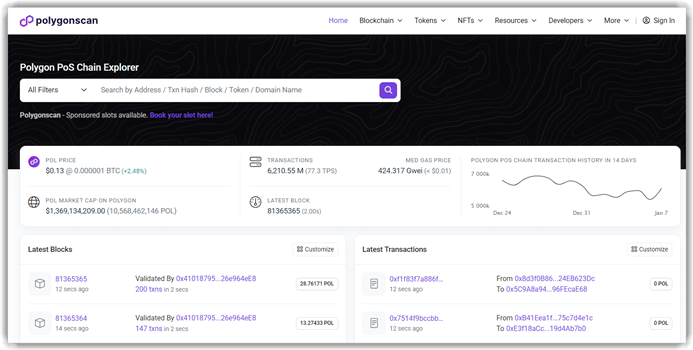
Polygonscan is a blockchain explorer that lets users search, track, and verify activity on the Polygon PoS network. Built by the Etherscan team, it offers real-time visibility into blocks, transactions, smart contracts, tokens, and NFTs. When I tested the platform, I valued how clearly it displayed gas fees, which matters on a network where costs stay below $0.01.
The dashboard shows fast block times, live throughput, and validator data. Recent updates improved NFT tracking and contract verification, making it useful for both developers and everyday users.
Features:
- Real-Time Gas Cost Predictor: Polygonscan shows current gas prices in real-time with historical patterns. I have used this to time transactions during low-fee windows. It helps you avoid overpaying when network activity spikes unexpectedly.
- Smart Contract Interaction Decoder: You can view decoded transaction data without technical blockchain knowledge. This feature translates complex smart contract calls into readable actions. I noticed it simplifies understanding what your wallet actually contains.
- Token Flow Visualizer: This feature maps how tokens move between addresses over time. I have found it invaluable for tracking suspicious patterns or whale movements. It displays visual pathways showing fund origins and destinations clearly.
- Multi-Address Portfolio Tracker: Polygonscan lets you monitor multiple wallet addresses from one dashboard view. You can track holdings, transaction history, and token approvals simultaneously. It eliminates constant wallet switching when managing several accounts actively.
- Transaction Memory Tags: You can add private notes to specific transactions for personal recordkeeping. I often use this to label trades, expenses, or transfers. These notes remain visible only to you and persist across sessions.
Pros
Cons
Link: https://polygonscan.com/
7) Binance Smart Chain: BscScan
BscScan is a free blockchain explorer for the BNB Smart Chain that enables users to track transactions, contracts, and network activity. It indexes over 10.8 billion transactions and supports around 169 TPS. While reviewing the validator performance dashboard, I found clear insights into block times averaging 0.75 seconds and live gas fees.
It supports BEP-20 token analytics, verified contracts, and node monitoring. Advanced tools include contract diff checks, opcode conversion, validator rankings, and APIs for automated portfolio and network tracking.

Features:
- Multi-Chain Bridge Tracker: BscScan lets you monitor cross-chain asset movements between BSC and other networks seamlessly. You receive notifications when bridged assets arrive and can verify the bridge contract security. This removes uncertainty when moving tokens across different blockchain ecosystems.
- Token Approval Health Monitor: BscScan lets you audit all active token approvals across connected wallets instantly. You can see which contracts have spending permissions and revoke risky authorizations. I have found this essential for protecting against malicious contract exploits and phantom drains.
- Smart Contract Risk Analyzer: This tool automatically flags unverified contracts and unusual code patterns during transactions. You receive security ratings based on contract age, audit status, and interaction history. I use this before engaging with new DeFi protocols to assess legitimacy.
- Validator Performance Dashboard: You can track validator uptime, missed blocks, and voting power distribution over custom timeframes. BscScan provides comparative analytics showing which validators deliver consistent block production. This helps stakers make informed delegation choices based on actual performance data.
- Address Behavior Clustering: This feature groups similar wallet activity patterns to identify bots, whales, and retail traders. You can see if an address behaves like an exchange, MEV bot, or long-term holder. I have used this to gauge smart money movements before entering positions.
Pros
Cons
Link: https://bscscan.com/
8) Dogecoin: Dogechain
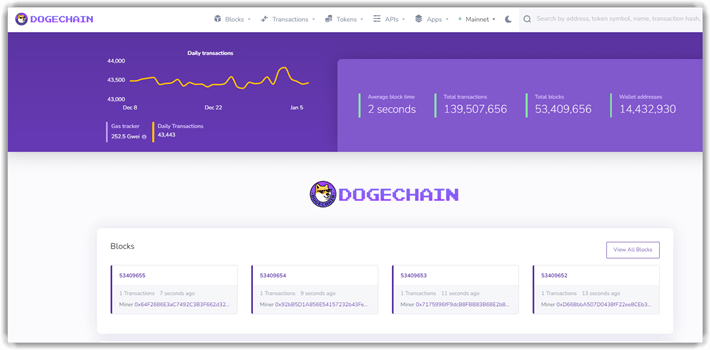
Dogechain Explorer is a free BlockScout-powered tool designed to track on-chain activity across the Dogechain ecosystem. It monitors over 139 million transactions on more than 53 million blocks, with an average block time of just 2 seconds. When I first used it, the sleek, real-time dashboard instantly impressed me.
It also offers GraphQL and RPC APIs for developers, supports both mainnet and testnet networks, and connects seamlessly with Dogechain’s growing DeFi, NFT, and gaming ecosystem.
Features:
- Multi-Network Toggle Interface: You can switch between Dogechain mainnet and testnet without leaving the explorer. This feature makes development testing smoother. Developers often use this to verify contracts before mainnet deployment.
- Transaction Memory Pool Viewer: Dogechain lets you monitor pending transactions awaiting confirmation in real time. I noticed this becomes crucial during high-traffic periods. You gain visibility into network activity before blocks finalize.
- Address Label Recognition System: The explorer automatically identifies and tags known wallet addresses from exchanges and protocols. This feature improves transaction analysis significantly. You can quickly distinguish between personal wallets and institutional movements.
- Block Reorganization Tracker: Dogechain maintains a dedicated section for forked blocks and chain reorganizations. I have used this to verify transaction finality during network uncertainty. It provides transparency on temporary blockchain splits.
- GraphQL and RPC API Access: The platform offers both GraphQL and traditional RPC endpoints for developers building applications. I appreciate how this dual approach accommodates different integration preferences. Documentation is accessible directly from the main navigation.
Pros
Cons
Link: Explorer.dogechain.dog
Comparison Between Top Blockchain Explorers
| EXPLORER | Blockchain.com | Etherscan | XRPScan | SolScan | Arbiscan |
| SMART CONTRACT VERIFICATION | ✔️ | ✔️ | ❌ | ✔️ | ✔️ |
| TOKEN TRACKING | ✔️ | ✔️ | ✔️ | ✔️ | ✔️ |
| API ACCESS | ✔️ | ✔️ | ✔️ | ✔️ | ✔️ |
| MOBILE APP | ✔️ | ✔️ | ❌ | ❌ | ❌ |
What is a Blockchain Explorer and How Does it Work?
A blockchain explorer is a search engine for public ledgers. It shows transactions, wallet balances, and block confirmations transparently. Traders rely on explorers to verify transfers, confirm settlement, and analyze on-chain behavior.
Blockchain explorers function as search engines for blockchain networks. They index transaction data, wallet addresses, and smart contracts continuously. Each explorer queries full nodes that store complete blockchain copies. When you search for an address, the explorer retrieves relevant blocks instantly. APIs enable programmatic access to this data for advanced users. The interface translates hexadecimal data into human-readable formats. Real-time updates depend on node synchronization speed and network congestion. Free explorers typically limit API calls, while premium tiers offer enhanced access.
How Do Blockchain Explorers Track Transactions Accurately?
Blockchain explorers pull data directly from full nodes or trusted indexers. They parse blocks, decode transactions, and update state continuously. Accuracy depends on indexing speed, node reliability, and decoder quality. Weak explorers lag during congestion or mislabel smart contract actions. Strong platforms show pending, confirmed, and failed states clearly. Data from Ethereum Foundation research shows node synchronization delays impact explorer accuracy. Traders should confirm that explorers display block height, timestamp, and confirmation count explicitly. Transparency reduces execution uncertainty and verification errors.
What Information Can You Find on a Blockchain Explorer?
You can track transaction status, confirmation times, and gas fees paid. Wallet balances appear with complete transaction histories across multiple tokens. Smart contract code becomes visible after verification by developers. Block details include miner rewards, timestamps, and transaction counts per block. Token holders and distribution percentages help assess concentration risk. NFT metadata, ownership chains, and sales histories appear on supported explorers. Mempool activity shows pending transactions waiting for confirmation. Advanced explorers display validator performance, network health metrics, and cross-chain bridge movements.
Can AI Improve Blockchain Explorer Accuracy and Insights?
Yes, AI tools are transforming how blockchain explorers interpret on-chain data. Machine learning algorithms now detect suspicious transaction patterns and potential scams automatically. Natural language processing translates complex smart contract code into plain explanations instantly. AI-powered whale tracking predicts market movements by analyzing large holder behavior patterns. Anomaly detection systems flag unusual wallet activity before manual review occurs. Some explorers use AI to estimate optimal gas fees based on historical trends. Sentiment analysis connects on-chain flows with social media narratives for context. However, AI predictions carry uncertainty and should complement traditional blockchain verification methods.
Verdict
After reviewing multiple blockchain explorers in real-world scenarios, I narrowed everything down to three standout tools that consistently delivered clarity, speed, and dependable on-chain insights.
- Blockchain.com: Blockchain.com provides a clean interface and broad blockchain coverage. It suits users who want fast transaction lookups, wallet tracking, and high-level insights without technical friction.
- Etherscan: I depended on Etherscan for deep Ethereum analysis. It gave me unmatched transparency, contract insights, and precise gas data. It was my go-to tool for serious Ethereum tracking.
- XRPScan: XRPScan focuses entirely on the XRP Ledger. It offers fast updates, clear visuals, and detailed account metrics, ideal for precise monitoring of XRP transactions and network activity.
