---
description: What are the levels of testing? A level of software testing is a process where every unit or component of a software/system is tested. The main goal of system testing is to evaluate the system&#039;s compl
title: Levels of Software Testing
image: https://www.guru99.com/images/levels-of-software-testing.png
---


[Skip to content](#main) 

**⚡ Smart Summary**

Levels of Testing in software testing organize quality checks into four sequential stages that validate a system from its smallest unit to final user acceptance. This resource explains unit, integration, system, and acceptance testing and their distinct purposes.

* 🔬 **Unit Testing:** Developers test the smallest component in isolation to confirm each module fulfills its intended functionality.
* 🔗 **Integration Testing:** Testers combine modules and verify correct data flow between them before full system checks.
* 🖥️ **System Testing:** The complete integrated system is validated against functional and non-functional requirements, including performance and security.
* ✅ **Acceptance Testing:** Users or customers confirm the delivered system meets specification and contract requirements.
* 📈 **Progressive Assurance:** Each level builds on the previous one, catching defects earlier and reducing risk across the lifecycle.

[ Read More ](javascript:void%280%29;) 

![Levels of Testing]()

## 4 Levels of Testing

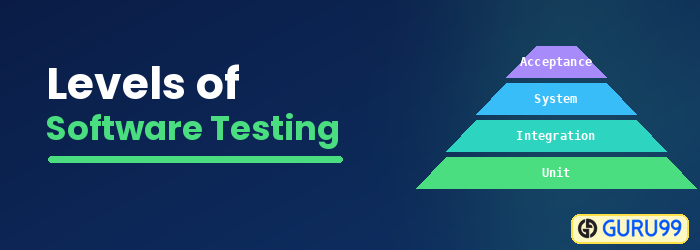
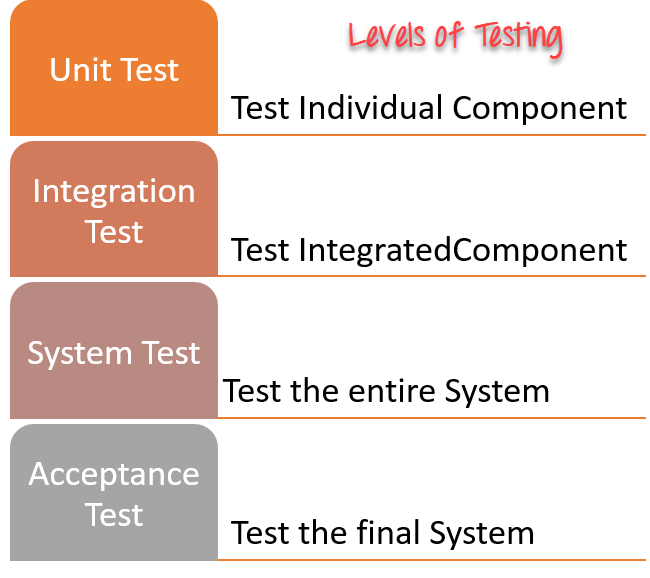
There are mainly four **Levels of Testing** in software testing :

1. **Unit Testing** : checks if software components are fulfilling functionalities or not.
2. **Integration Testing** : checks the data flow from one module to other modules.
3. **System Testing** : evaluates both functional and non-functional needs for the testing.
4. **Acceptance Testing** : checks the requirements of a specification or contract are met as per its delivery.

[](https://www.guru99.com/images/1/041318%5F0535%5FLevelsofTes1.png)

Each of these testing levels has a specific purpose. These testing level provide value to the software development lifecycle.

## Each Testing Level Details

### Unit testing:

A [Unit](https://www.guru99.com/unit-testing-guide.html) is the smallest testable portion of system or application which can be compiled, liked, loaded, and executed. This kind of testing helps to test each module separately.

The aim is to test each part of the software by separating it. It checks that component are fulfilling functionalities or not. This kind of testing is performed by developers.

### Integration testing

[Integration](https://www.guru99.com/integration-testing.html) means combining. For Example, In this testing phase, different software modules are combined and tested as a group to make sure that integrated system is ready for system testing.

Integrating testing checks the data flow from one module to other modules. This kind of testing is performed by testers.

### System Testing

[System testing](https://www.guru99.com/system-testing.html) is performed on a complete, integrated system. It allows checking system’s compliance as per the requirements. It tests the overall interaction of components. It involves load, performance, reliability and security testing.

System testing most often the final test to verify that the system meets the specification. It evaluates both functional and non-functional need for the testing.

### Acceptance testing

[Acceptance testing](https://www.guru99.com/user-acceptance-testing.html) is a test conducted to find if the requirements of a specification or contract are met as per its delivery. Acceptance testing is basically done by the user or customer. However, other stockholders can be involved in this process.

## FAQs

🔁 Which level of testing is performed first?

Unit testing is performed first. Developers test individual components in isolation, then integration testing combines modules, followed by system testing of the whole application, and finally acceptance testing by users or customers.

⚖️ What is the difference between verification and validation in testing?

Verification checks whether the software is built correctly against specifications, mainly through reviews. Validation checks whether the right product was built by testing actual behavior. Verification is process-oriented; validation is product-oriented.

🤖 How is AI used across software testing levels?

AI generates and prioritizes test cases, predicts defect-prone modules, and maintains scripts as code changes. It supports unit, integration, and system testing by reducing manual effort and surfacing risks earlier in the lifecycle.

⚙️ Can AI automate unit and integration testing?

Yes. AI tools can auto-generate unit tests from code and create integration test scenarios, then self-heal broken tests. Human oversight remains important to confirm coverage and validate complex business logic.

#### Summarize this post with:

ChatGPT Perplexity Grok Google AI 

**Stay Updated on AI** **Get Weekly AI Skills, Trends, Actionable Advice.** 

##### Sign up for the newsletter

Subscribe for Free 

You have successfully subscribed.  
Please check your inbox. 

![AI-Newsletter]() Chosen by over **350,000+** professionals 

[Scroll to top ](#wrapper)Scroll to top 

× 

Toggle Menu Close 

Search for: 

Search

```json
{"@context":"https://schema.org","@graph":[{"@type":"Organization","@id":"https://www.guru99.com/#organization","name":"Guru99","sameAs":["https://www.facebook.com/Guru99Official","https://twitter.com/guru99com"],"logo":{"@type":"ImageObject","@id":"https://www.guru99.com/#logo","url":"https://www.guru99.com/images/guru99-logo-v1-150x59.png","contentUrl":"https://www.guru99.com/images/guru99-logo-v1-150x59.png","caption":"Guru99","inLanguage":"en-US"}},{"@type":"WebSite","@id":"https://www.guru99.com/#website","url":"https://www.guru99.com","name":"Guru99","publisher":{"@id":"https://www.guru99.com/#organization"},"inLanguage":"en-US"},{"@type":"ImageObject","@id":"https://www.guru99.com/images/levels-of-software-testing.png","url":"https://www.guru99.com/images/levels-of-software-testing.png","width":"700","height":"250","caption":"Levels of Software Testing","inLanguage":"en-US"},{"@type":"BreadcrumbList","@id":"https://www.guru99.com/levels-of-testing.html#breadcrumb","itemListElement":[{"@type":"ListItem","position":"1","item":{"@id":"https://www.guru99.com","name":"Home"}},{"@type":"ListItem","position":"2","item":{"@id":"https://www.guru99.com/softwaretesting","name":"Software Testing"}},{"@type":"ListItem","position":"3","item":{"@id":"https://www.guru99.com/levels-of-testing.html","name":"Levels of Software Testing"}}]},{"@type":"WebPage","@id":"https://www.guru99.com/levels-of-testing.html#webpage","url":"https://www.guru99.com/levels-of-testing.html","name":"Levels of Software Testing","dateModified":"2026-06-29T19:38:12+05:30","isPartOf":{"@id":"https://www.guru99.com/#website"},"primaryImageOfPage":{"@id":"https://www.guru99.com/images/levels-of-software-testing.png"},"inLanguage":"en-US","breadcrumb":{"@id":"https://www.guru99.com/levels-of-testing.html#breadcrumb"}},{"@type":"Person","@id":"https://www.guru99.com/author/thomas","name":"Thomas Hamilton","description":"I am Thomas Hamilton, a seasoned professional in software testing, specializing in crafting comprehensive guides to help you master your software testing skills.","url":"https://www.guru99.com/author/thomas","image":{"@type":"ImageObject","@id":"https://www.guru99.com/images/thomas-hamilton-author-v2-120x120.png","url":"https://www.guru99.com/images/thomas-hamilton-author-v2-120x120.png","caption":"Thomas Hamilton","inLanguage":"en-US"},"worksFor":{"@id":"https://www.guru99.com/#organization"}},{"articleSection":"Software Testing","headline":"Levels of Software Testing","description":"What are the levels of testing? A level of software testing is a process where every unit or component of a software/system is tested. The main goal of system testing is to evaluate the system&#039;s compl","keywords":"testing","speakable":{"@type":"SpeakableSpecification","cssSelector":[".entry-title",".summary"]},"@type":"Article","author":{"@id":"https://www.guru99.com/author/thomas","name":"Thomas Hamilton"},"dateModified":"2026-06-29T19:38:12+05:30","image":{"@id":"https://www.guru99.com/images/levels-of-software-testing.png"},"copyrightYear":"2026","name":"Levels of Software Testing","subjectOf":[{"@type":"FAQPage","mainEntity":[{"@type":"Question","name":"Which level of testing is performed first?","acceptedAnswer":{"@type":"Answer","text":"Unit testing is performed first. Developers test individual components in isolation, then integration testing combines modules, followed by system testing of the whole application, and finally acceptance testing by users or customers."}},{"@type":"Question","name":"What is the difference between verification and validation in testing?","acceptedAnswer":{"@type":"Answer","text":"Verification checks whether the software is built correctly against specifications, mainly through reviews. Validation checks whether the right product was built by testing actual behavior. Verification is process-oriented; validation is product-oriented."}},{"@type":"Question","name":"How is AI used across software testing levels?","acceptedAnswer":{"@type":"Answer","text":"AI generates and prioritizes test cases, predicts defect-prone modules, and maintains scripts as code changes. It supports unit, integration, and system testing by reducing manual effort and surfacing risks earlier in the lifecycle."}},{"@type":"Question","name":"Can AI automate unit and integration testing?","acceptedAnswer":{"@type":"Answer","text":"Yes. AI tools can auto-generate unit tests from code and create integration test scenarios, then self-heal broken tests. Human oversight remains important to confirm coverage and validate complex business logic."}}]}],"@id":"https://www.guru99.com/levels-of-testing.html#schema-1125797","isPartOf":{"@id":"https://www.guru99.com/levels-of-testing.html#webpage"},"publisher":{"@id":"https://www.guru99.com/#organization"},"inLanguage":"en-US","mainEntityOfPage":{"@id":"https://www.guru99.com/levels-of-testing.html#webpage"}}]}
```